
IHR WARENKORB IST AKTUELL LEER.
Haben Sie noch nichts passendes gefunden? Stöbern Sie durch unser komplettes Sortiment.
Oder melden Sie sich an bzw. registrieren Sie sich.
- Kostenlose Lieferung
- Kauf auf Rechnung
- Ex Libris Tiefpreis
- Filiallieferung und 650+ Abholorte
- Rabatt-Bons als Club-Mitglied
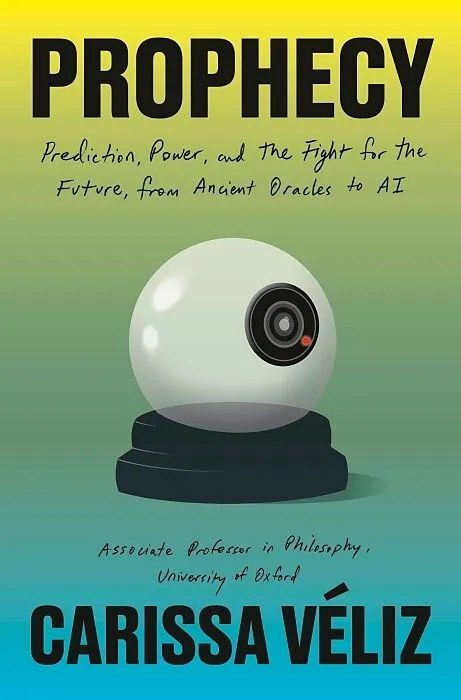
Prophecy
Beschreibung
From an award-winning University of Oxford professor comes a brilliant, urgent new look at prophecies--the predictions that determine our lives, from our personal finances and the quality of our healthcare to the news and social media we consume and the produc...Format auswählen
- Fester EinbandCHF 30.95

Wird oft zusammen gekauft
Andere Kunden kauften auch
Beschreibung
From an award-winning University of Oxford professor comes a brilliant, urgent new look at prophecies--the predictions that determine our lives, from our personal finances and the quality of our healthcare to the news and social media we consume and the produces foisted upon us. Today’s computer scientists play the same role as the oracles of the ancient world and the astrologers of the Middle Ages. Modern predictions not only advise on war, crop output, and marriages, but algorithms and statisticians also now determine whether we can get a loan, a job, an apartment, or an organ transplant. And when we cede ground to these predictions, we lose control of our own lives. In this powerful, refreshing new look at the many ways prediction shapes our everyday lives, University of Oxford professor Carissa Véliz explains how putting too much stock in others’ predictions makes us vulnerable to charlatans, con artists, dubious technology, and self-deception. Examining a wide range of subjects both personal and societal, including medicine, climate, technology, society, and others, Véliz uncovers a number of insights: predictions about humans tend to be self-fulfilling; more data doesn’t guarantee better outcomes; AI is more likely to increase risk than decrease it; and a free and robust society requires not more prediction, but better preparation. Véliz argues in this incisive and bracingly original book that the main promise of prediction is not knowledge of the future, but rather power over others.
Autorentext
Carissa Véliz is an associate professor at the Institute for Ethics in AI at the University of Oxford. Her first book, Privacy Is Power (Melville House) was an Economist book of the year and has been published in seven languages. Her academic work has been published in The Harvard Business Review, Nature, AI & Society, and The American Journal of Bioethics, among others. She is the author of the forthcoming The Ethics of Privacy and Surveillance (Oxford University Press) and the editor of the forthcoming Oxford Handbook of Digital Ethics.
Klappentext
**“Lively. . . . Rousing. . . . Prophecy—roving, intelligent, irreducibly idiosyncratic—can expand our sense of possibility, starting now.” —The New York Times Book Review
Tech empires are the prophets of the modern day, and like the ancient oracles and medieval astrologers that preceded them, they're not in it for the common good—they're in it for power. Award-winning University of Oxford professor Carissa Véliz brilliantly argues why we must reclaim that power, and shows us how.
“A masterpiece. . . . The most important book you will read for years.” —Roger McNamee, New York Times bestselling author of Zucked
Shortlisted for the Financial Times Business Book of the Year**
For thousands of years, oracles, seers, and astrologers advised leaders and commoners alike about the future. But predictions are often power plays in disguise, obfuscating accountability and stripping individuals of their agency. Today we face the same threat of powerful prophets but under a new facade: tech.
Not only do modern predictions made by tech companies advise on war, industry, and marriages, but artificial intelligence also now determines whether we can get a loan, a job, an apartment, or an organ transplant. And when we cede ground to these predictions, we lose control of our own lives.
Drawing on history’s cautionary tales and modern-day tech companies’ malfeasance—from surveillance and biased algorithms to a startling lack of accountability—Carissa Véliz demonstrates that big tech’s prophecies are just as shallow, dangerous, and unjust as their ancient counterparts’. What she uncovers in the process is chilling. Artificial intelligence is increasing risk in business and society while creating a false sense of security. In this incisive, witty, and bracingly original book, Véliz contends that the main promise of prediction is not knowledge of the future but domination over others. Powerful people use predictions to determine our future. Prophecy is an invitation to defy those orders and live life on our own terms.
Leseprobe
Chapter One
Prophets and Power
A brief history of prediction, or why astrologers get thrown off cliffs
In Rome, Tiberius was the first emperor to have had a court astrologer. He had fallen out of favor with his predecessor, Augustus, and was exiled in Rhodes when he met Thrasyllus. The future emperor was in the habit of testing astrologers when he needed advice. If they proved to be wrong, he’d have them thrown off a cliff on his way back home. But Thrasyllus impressed him. First, he predicted that Tiberius would succeed Augustus as emperor. Excellent start. Then came the test question: How did Thrasyllus’s own horoscope look that day?
The astrologer looked to the stars and visibly panicked. Whether he had heard of Tiberius’s cruel habits, had inferred his patron’s intentions from his body language, or had indeed learned them from the stars, Thrasyllus answered that he was in grave peril. Smart man. Tiberius embraced him, congratulated him on his divinatory prowess, and assured him he’d escape danger. From then on, the astrologer was his trusted ally. Thrasyllus had shown Tiberius that he understood that predictions are not about knowledge but power.
Prophecy and power are kindred spirits. They walk through the same hallways, share meals with the same people, and exchange money between themselves. Prophets are powerful both because their services are coveted, and are therefore compensated generously, and because their predictions give them influence. In turn, prophets risk the rage of power because predictions can constitute a challenge to power. A prediction that a battle will be lost can itself threaten victory.
Whoever has power runs a risky business. The powerful enjoy the views from above, but they are also forced to safeguard themselves against those who vie for their place at the top. The mighty have often reached the summit through theft, murder, and other unpalatable ways of stepping over others, leaving a trail of resentment in their path. Being too powerful can be as dangerous as being powerless; tyrants rarely die from old age. Since prophets wield authority, they have historically shared the risk that comes with power: One imprudent prediction could cost them their lives. But that has never stopped them from prophesying and being in high demand.
“His business was dread,” wrote Toni Morrison of a psychic. Thomas Hobbes wrote that our urge to look into the future is rooted in “perpetual fear.” It’s good for self-preservation to have a sense of the terrible things that might come.
What would you be willing to give up to avoid the worst thing that will ever happen to you? I would’ve appreciated a heads-up that the two men sitting across the aisle would rob at gunpoint all the passengers of the bus I was in. It would’ve been helpful to know that a flood from the neighbor upstairs, who was on holiday, was going to cause my flat’s ceiling to collapse a week before I was due to sell it. And I would’ve surrendered almost anything for a few warnings that came too late. Wouldn’t you like a tip-off to give you a chance at dodging the next wrecking ball? You might be able to escape a car crash, or being the victim of a crime, or getting involved with the wrong person. Maybe with foreknowledge you could save your loved one from an untimely death. Can you feel the anxiety that drives you to want to know the future? How much would you be willing to pay for an accurate prediction?
Before coming up with a…