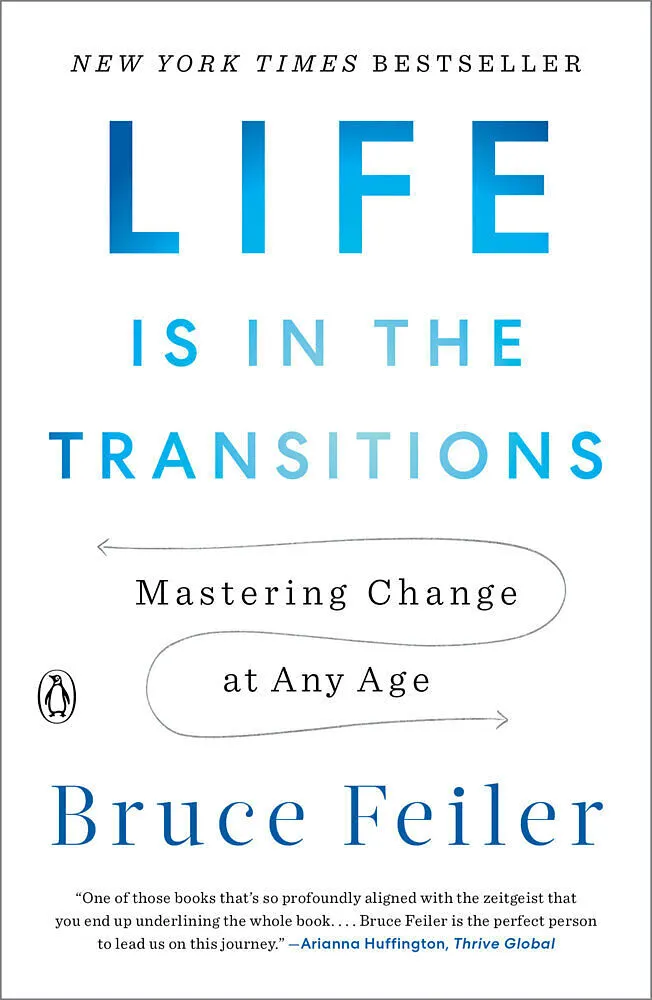
Life Is in the Transitions
Beschreibung
A New York Times bestseller! A pioneering and timely study of how to navigate life's biggest transitions with meaning, purpose, and skill Bruce Feiler, author of the New York Times bestsellers The Secrets of Happy Families and Council of Dads, has long ex...Format auswählen
- Kartonierter Einband (Kt)CHF 18.80
- Fester EinbandCHF 30.40

Wird oft zusammen gekauft
Andere Kunden kauften auch
Beschreibung
**A New York Times bestseller!
A pioneering and timely study of how to navigate life's biggest transitions with meaning, purpose, and skill**
Bruce Feiler, author of the New York Times bestsellers The Secrets of Happy Families and Council of Dads, has long explored the stories that give our lives meaning. Galvanized by a personal crisis, he spent the last few years crisscrossing the country, collecting hundreds of life stories in all fifty states from Americans who d been through major life changes from losing jobs to losing loved ones; from changing careers to changing relationships; from getting sober to getting healthy to simply looking for a fresh start. He then spent a year coding these stories, identifying patterns and takeaways that can help all of us survive and thrive in times of change.
What Feiler discovered was a world in which transitions are becoming more plentiful and mastering the skills to manage them is more urgent for all of us. The idea that we ll have one job, one relationship, one source of happiness is hopelessly outdated. We all feel unnerved by this upheaval. We re concerned that our lives are not what we expected, that we ve veered off course, living life out of order. But we re not alone.
Life Is in the Transitions introduces the fresh, illuminating vision of the nonlinear life, in which each of us faces dozens of disruptors. One in ten of those becomes what Feiler calls a lifequake, a massive change that leads to a life transition. The average length of these transitions is five years. The upshot: We all spend half our lives in this unsettled state. You or someone you know is going through one now.
The most exciting thing Feiler identified is a powerful new tool kit for navigating these pivotal times. Drawing on his extraordinary trove of insights, he lays out specific strategies each of us can use to reimagine and rebuild our lives, often stronger than before.
From a master storyteller with an essential message, Life Is in the Transitions can move readers of any age to think deeply about times of change and how to transform them into periods of creativity and growth.
Autorentext
Bruce Feiler is the author of six consecutive New York Times bestsellers, including The Secrets of Happy Families, The Council of Dads, and Walking the Bible. He's the writer/presenter of two primetime series on PBS, and his two TED Talks have been viewed more than two million times. A native of Savannah, Georgia, Bruce lives in Brooklyn with his wife, Linda Rottenberg, and their twin daughters.
Klappentext
From the New York Times bestselling author of The Secrets of Happy Families and Council of Dads, a pioneering study of the disruptions upending contemporary life and a bold guide for how to navigate life's growing number of transitions with more meaning, balance, and joy.
Bruce Feiler has long been writing about the stories that give our lives meaning. Recently he began to notice a new pattern: Many of us feel overwhelmed by the unprecedented pace of change we're experiencing. We know that our old stories, with their predictable plot points along linear paths, no longer hold true. The idea that we'll have one job, one relationship, one source of happiness is hopelessly outdated. Yet we're unnerved by all this upheaval. We're concerned that our lives are not what we expected; that we're veering off course; living life out of order.
Galvanized by a personal crisis and family emergency, Feiler set out on what became an epic journey. He crisscrossed the country, collecting hundreds of life stories from Americans of all ages, all walks of life, and in all fifty states. He then spent a year coding these stories, identifying patterns and takeaways for how we live now and how can live better. But we're not alone.
Life Is in the Transitions introduces a fresh, illuminating vision of the nonlinear life, in which each of us faces dozens of disruptors. Drawing on his extraordinary trove of insights, Feiler unveils a powerful new transition toolkit with proven strategies for coping with these pivotal, painful, unsettling times. From a master storyteller with a timely message, Life Is in the Transitions can move readers of any age to think deeply about times of personal change and how to transform them into periods of creativity and growth.
Leseprobe
INTRODUCTION
The Life Story Project
What Happens When Our Fairy Tales Go Awry
I used to believe that phone calls don t change your life, until one day I got a phone call that did. It was from my mother. Your father is trying to kill himself.
He s what?
Suddenly she was talking and I wasn t really following. Something about a bathroom, a razor, a desperate lunge for relief.
Good God.
And that wasn t the last time. Later he tried to climb out of a window while I was scrambling eggs.
As a writer, I m often asked whether I learned to write from my dad. The answer is no. My father was uncommonly friendly, even twinkling we called him a professional Savannahian, for the seaside city in Georgia where he d lived for eighty years but he was more of a listener and a doer than a teller and a scribbler. A navy veteran, civic leader, Southern Demo- crat, he was never depressed a minute in his life.
Until he got Parkinson s, a disease that affects your mobility and your mood. My dad s father, who also got the disease late in life, shot himself in the head a month before I graduated from high school. My father had promised for years he wouldn t do the same. I know the pain and shame it causes.
Then he changed his mind or at least that part of his mind he could still control. I ve lived a full life, he said. I don t want to be mourned; I want to be celebrated.
Six times in the next twelve weeks my father attempted to end his life. We tried every remedy imaginable, from counseling to electroconvulsive therapy. Yet we couldn t surmount his core challenge: He had lost a reason to live.
My family, always a bit hyperfunctional, dove in. My older brother took over the family real estate business; my younger sister helped research medical treatments.
But I m the narrative guy. For three decades, I had devoted my life to exploring the stories that give our lives meaning from the tribal gather- ings of the ancient world to the chaotic family dinners of today. I have long been consumed by how stories connect and divide us on a societal level, how they define and deflate us on a personal level.
Given this interest, I began to wonder: If my dad was facing a narrative problem, at least in part, maybe it demanded a narrative solution. Maybe what my father needed was a spark to restart his life story.
One Monday morning I sat down and did the simplest, most restor- ative thing I could imagine.
I sent my dad a question.
What were your favorite toys as a child?
What happened next changed not only him, but everyone around him, and ultimately led me to reevaluate how we all achieve meaning, balance, and joy in our lives.
This is the story of what happened next, and what we all can learn from it.
This is the story of the Life Story Project.
The Story of your Life
Stop for a second and listen to the story going on in your head. It s there, somewhere, in the background. It s the story you tell others when you first meet them; it s the story you tell yourself when you visit a meaningful place, when you flip through old photographs, when you celebrate an achievement, when you rush to the hospital. It s the story of who you are, where you came from, where you dream of going in the future. It s the high point of your life, the low point, the turning point. It s what you believe in, what you fight for, what matters most to you. It s the story of your life.
And that story isn t just part of you. It …