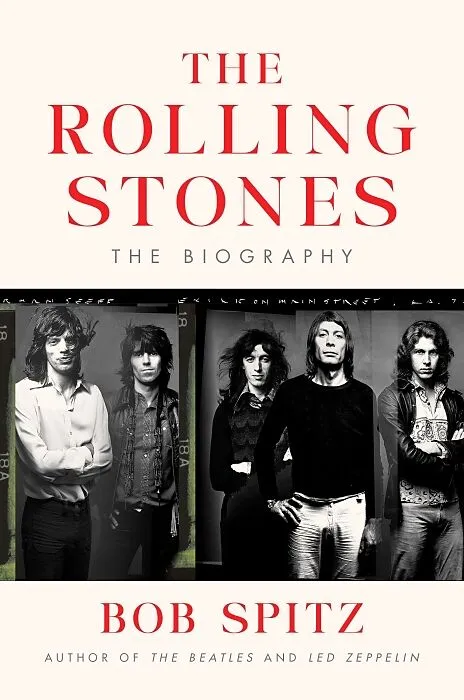
The Rolling Stones
Beschreibung
From the award-winning, bestselling author of classic histories of the Beatles and Led Zeppelin, a groundbreaking reckoning with the world’s greatest rock ''n'' roll band All great music is a threat. What left is there to say about The Rolling Stones? A ...Format auswählen
- Livre ReliéCHF 42.80

Wird oft zusammen gekauft
Andere Kunden kauften auch
Beschreibung
From the award-winning, bestselling author of classic histories of the Beatles and Led Zeppelin, a groundbreaking reckoning with the world’s greatest rock ''n'' roll band All great music is a threat. What left is there to say about The Rolling Stones? A hell of a lot, it turns out. Bob Spitz has brought his indefatigable energy and five decades of experiences in the fields and hollows of rock ''n’ roll to bear on his five-year journey to reexamine one of popular music’s greatest stories. There are myriad revisions to the conventional narrative which underscore just how in control of that narrative the band has been up to now--small example: no, Muddy Waters was not mopping the floors at Chess Records when the Stones showed up. But in a larger sense, as with the Beatles and Led Zeppelin, Spitz’s greatest gift is for the big picture. He knows where the magic is, and At its heart the story is about two boys, Mick and Keith, and their unique, fraught, alchemical bond, often tested, never sundered. The Glimmer Twins. The bandmates, like Charlie Watts, who found their groove in relation to this double star made the trip intact, while those who struggled, like Brian Jones and Mick Taylor, were chewed up and spit out. This is a story with many dark corners, including a surprising number of deaths. But whether Jagger and Richards sold their souls to the devil is at the crossroads for blues greatness or just squeezed their heroes for every drop of inspiration, in the end their connection to their music and to each other put them in a category of one, where they very much remain.
Autorentext
Bob Spitz is the award-winning author of The Beatles and Led Zeppelin: The Biography as well as ten other works of non-fiction. His best-selling book Dearie: The Remarkable Life of Julia Child has been made into a documentary and will open as a play called The Recipe early next year. A lifelong musician, Spitz helped manage Bruce Springsteen and Elton John at crucial points in their careers. He lives in New York City and Los Angeles
Klappentext
**An Instant New York Times Bestseller
“A magisterial work that charts the 60-year journey of ‘the greatest rock and roll band in the world.’ . . . Hundreds of books have been written about the Rolling Stones, but few sparkle quite like Spitz’s. For anyone who loves or even likes the Stones, it’s indispensable.” —Los Angeles Times**
All great music is a threat.
What left is there to say about The Rolling Stones? A hell of a lot, it turns out.
Bob Spitz has brought his indefatigable energy and five decades of experiences in the fields and hollows of rock 'n’ roll to bear on his five-year journey to reexamine one of popular music’s greatest stories. There are myriad revisions to the conventional narrative which underscore just how in control of that narrative the band has been up to now—small example: no, Muddy Waters was not mopping the floors at Chess Records when the Stones showed up. But in a larger sense, as with the Beatles and Led Zeppelin, Spitz’s greatest gift is for the big picture. He knows where the magic is, and why it is. He is as clear-eyed a connoisseur of the show business, the spectacle and the collateral damage of this whirlwind as anyone alive, and that lucid gaze pierces a lot of incrusted bullshit, but the ultimate goal is to connect with a creative force whose power shows no signs of fading, over sixty years on.
At its heart the story is about two boys, Mick and Keith, and their unique, fraught, alchemical bond, often tested, never sundered. The Glimmer Twins. The bandmates, like Charlie Watts, who found their groove in relation to this double star made the trip intact, while those who struggled, like Brian Jones and Mick Taylor, were chewed up and spit out. This is a story with many dark corners, including a surprising number of deaths. But whether Jagger and Richards sold their souls to the devil is at the crossroads for blues greatness or just squeezed their heroes for every drop of inspiration, in the end their connection to their music and to each other put them in a category of one, where they very much remain.
Leseprobe
Chapter One
The Blues Brothers
Keith was born my brother by accident by different parents.
-Mick Jagger
He's a smart little motherfucker, I'll give him that.
-Keith Richards
Michael Philip Jagger's situation was complicated. There were expectations weighing on his shoulders. Born July 26, 1943, in an England under attack, Mike, as he was known, was vessel for the Jagger family's hopes of an upwardly mobile trajectory. His parents, Joe and Eva, had already crossed the tracks from a working-class Dartford subdivision to one of the borough's posher new enclaves called the Close, sporting single-family homes and big backyards. Eva, a clever housewife, sold Avon beauty products to boost the family income. Joe, in a few high-flying years, had leapfrogged from high school gym teacher to lecturer at St. Mary's College and television sports guru, establishing his bona fides as one of England's preeminent fitness experts. He was grooming Mike to follow in his footsteps.
Joe and Mike were an early television tag team. Viewers tuned in regularly to watch their routines. When there was an exercise to demonstrate, Joe had Mike spring into action and perform twenty jumping jacks, or press a hundred pounds, or chin a bar. The kid was a natural. He not only handled anything Joe threw at him but turned on the charm.
Mike had all the tools necessary to leap social classes in a single bound. He played cricket, rugby, basketball, and tennis. He excelled at track, threw the javelin, undertook a taxing daily regimen of push-ups and sit-ups. Academically, he was a decent, if lazy, student-he graduated twelfth in a class of twenty-five-more intuitive than intellectual. Friends considered him outgoing. And he had spunk.
"I didn't have any inhibitions," he recalled. Even as a kid, at fifteen or sixteen, he'd front a little pop combo and "do mad things," raising the heat in a local auditorium by dropping to his knees and rolling on the ground in some weird mash-up of Johnnie Ray and Bruno Sammartino. Audiences were shocked at first-he could see it in their faces-but they ate it up, save for two stony-eyed observers who patrolled the back aisles of his performances. "My parents were extremely disapproving of it all," he remembered; "it was just not done" in polite company. The music and behavior were "for very low-class people."
Keeping up appearances generally meant conformity in 1950s Britain, but Mike had his own ideas. Image was a contrivance he played with from the outset. It didn't matter if he was on a stage or running the quarter mile for Dartford Grammar. "I thought, 'Sod how we did in competition.' My first thought was: 'How does my hair look?'"
This was one strange boy. There were time-honored formalities in place to preserve the status quo. Etiquette to be adhered to and respected. But Mike Jagger was already pushing at boundaries, testing his elders, trying on various identities for size. He was content either to sing as part of a choir, until his voice broke, or to make a complete fool of himself in front of twenty people. He flouted Dartford Grammar's faux-Etonian dress code by wearing casual clothes, he challenged the headmaster, ignored the school's mandate to join the militaristic Combined Cadet Force, and was initiated into sexual experience with a boy.
And he listened to music. Not those insipid pop hits of the day on the BBC's Light Programme, but that vulgar stuff corrupting British teenagers that streamed over Radio Luxembourg and Armed Forces Radio. He fancied the bad boys-Eddie Cochran, Gene Vincent, Jerry Lee Lewis, Elvis Presley. And those Black music…