Beschreibung
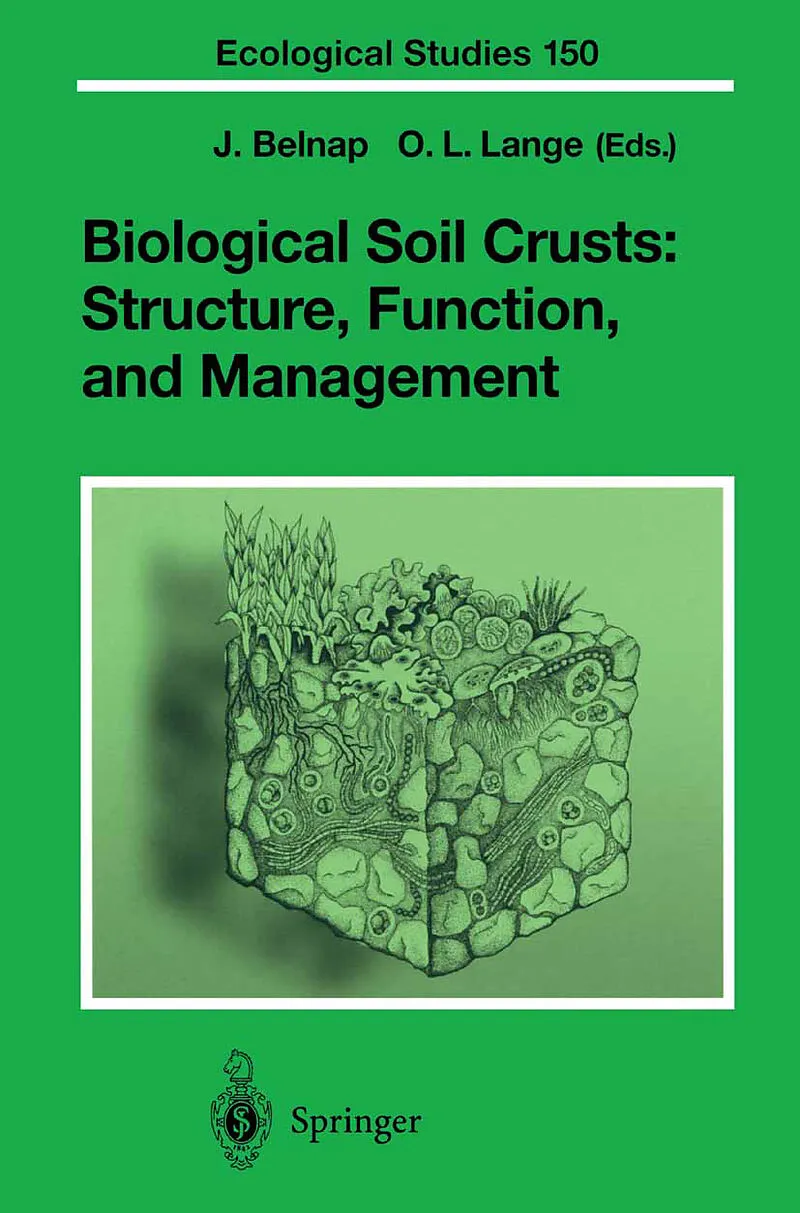
In arid and semiarid lands throughout the world, where the cover of vegetation is sparse or absent,the open spaces between the higher plants are generally not bare of autotrophic life,but covered by a community of highly specialized organisms. This soil-surfac...In arid and semiarid lands throughout the world, where the cover of vegetation is sparse or absent,the open spaces between the higher plants are generally not bare of autotrophic life,but covered by a community of highly specialized organisms. This soil-surface community consists of cyanob- teria, algae, lichens, mosses, microfungi, and other bacteria in differing proportions. Cyanobacterial and microfungal filaments, rhizinae and rhi- morphs of lichens, and the rhizinae and protonemata of bryophytes weave throughout the top few millimeters of soil,gluing loose soil particles together. This forms a crust up to a few centimeters thick that stabilizes and protects soil surfaces from erosive forces (Cameron and Blank 1966; Friedmann and Galun 1974; Belnap and Gardner 1993).These crusts occur in all hot,cool,and cold-arid and semiarid regions of the world,and may constitute up to or more than 70% of the living cover. Biological soil crusts have only recently been recognized as having a major influence on terrestrial ecosystems.
A thoroughly revised second printing of the successful hardcover edition Provides applied scientists, land managers and conservationists with sound guidelines for decision making Contains more than 60 color photographs of different crusts from around the world Includes supplementary material: sn.pub/extras
Klappentext
In arid lands, where vegetation is sparse or absent, the open ground is not bare but generally covered by a community of small, highly specialized organisms. Cyanobacteria, algae, microfungi, lichens, and bryophytes aggregate soil particles to form a coherent skin - the biological soil crust. It stabilizes and protects the soil surface from erosion by wind and water, influences water runoff and infiltration, and contributes nitrogen and carbon to desert soils. Soil surface disturbance, such as heavy livestock grazing, human trampling or off-road vehicles, breaks up the fragile soil crust, thus compromising its stability, structure, and productivity. This book is the first synthesis of the biology of soil crusts and their importance as an ecosystem component. Composition and functioning of different soil-crust types are discussed, and case studies are used to show the impact of crusts on landscape hydrology, soil stability, nutrient cycles, and land management.
Inhalt
I Taxonomic Composition, Ecology, and Biogeography of Soil-Crust Communities.- 1 Biological Soil Crusts: Characteristics and Distribution.- 2 Biological Soil Crusts of North America.- 3 Biological Soil Crusts of South America.- 4 Lichen-Rich Soil Crusts of Arctic Greenland.- 5 Biological Soil Crusts of the Subalpine, Alpine, and Nival Areas in the Alps.- 6 Biological Soil Crusts of European Temperate and Mediterranean Regions.- 7 Biological Soil Crusts of Asia Including the Don and Volga Region.- 8 Biological Soil Crusts of the Middle East.- 9 Biological Soil Crusts of Africa.- 10 Biological Soil Crusts of Australia.- 11 Biological Soil Crusts of Antarctica.- 12 Synopsis: Comparative Biogeography and Ecology of Soil-Crust Biota.- II Heterotrophic Components of Biological Soil Crusts.- 13 Soil Fungi as Components of Biological Soil Crusts.- 14 Microbes and Microfauna Associated with Biological Soil Crusts.- III Structure of Biological Soil Crusts: Microscale to Landscape.- 15 Comparative Structure of Physical and Biological Soil Crusts.- 16 Small Scale Environments and Distribution of Biological Soil Crusts.- 17 Ecological Determinants of Species Composition of Biological Soil Crusts on a Landscape Scale.- IV Biological Soil Crusts as an Ecosystem Component: Carbon and Nitrogen Acquisition and Interaction with Vascular Plants.- 18 Photosynthesis of Soil-Crust Biota as Dependent on Environmental Factors.- 19 Factors Influencing Nitrogen Fixation and Nitrogen Release in Biological Soil Crusts.- 20 Biological Soil Crusts and Ecosystem Nitrogen and Carbon Dynamics.- 21 Influence of Biological Soil Crusts on Soil Environments and Vascular Plants.- V Soil Stability and Hydrology as Influenced by Soil Crusts.- 22 Effects of Biological Soil Crusts on Water Redistribution in the Negev Desert, Israel: Case Study in Longitudinal Dunes.- 23 Biological Soil Crusts and Water Relations in Australian Deserts.- 24 Biological Soil Crusts and Hydrology in North American Deserts.- 25 Biological Soil Crusts and Wind Erosion.- 26 Synopsis: Influence of Biological Soil Crusts on Arid Land Hydrology and Soil Stability.- VI Disturbance to Biological Soil Crusts: Resistance, Resilience, and Restoration.- 27 Disturbance and Recovery of Biological Soil Crusts.- 28 Impacts of Fire on Biological Soil Crusts.- VII Monitoring and Management of Biological Soil Crusts.- 29 Biological Soil Crusts and Livestock in Arid Ecosystems: Are they Compatible?.- 30 Global Change and the Future of Biological Soil Crusts.- 31 Remote Sensing of Biological Soil Crusts.- 32 Monitoring and Management of Biological Soil Crusts.- VIII Conclusion.- 33 Structure and Functioning of Biological Soil Crusts: Synthesis.- Taxonomic Index.
Tief- preis
Tief- preis