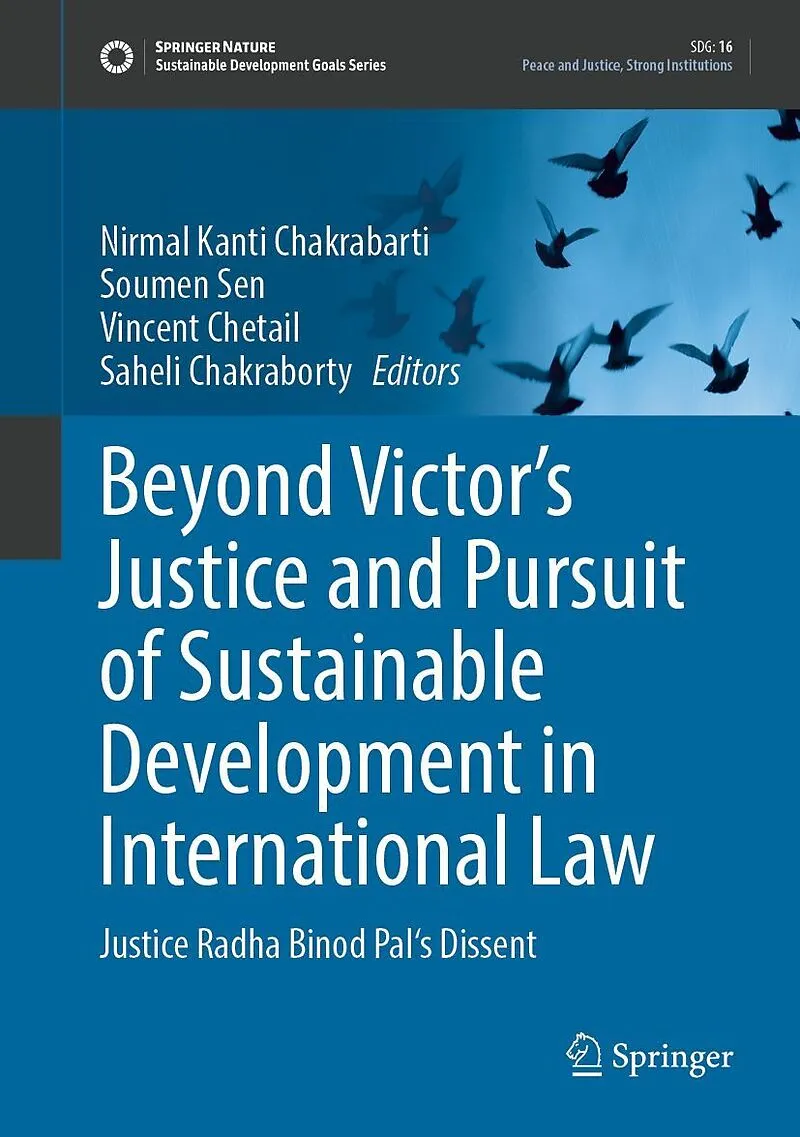
Beyond Victor's Justice and Pursuit of Sustainable Development in International Law
Beschreibung
This volume provides a nuanced analysis of the profound impact left by the dissenting opinion in the Tokyo Trial by Justice Radha Binod Pal's ideological stance on modern international criminal law. It consists of a detailed examination of this bold opinion o...
Format auswählen
- Fester EinbandCHF 165.20

Wird oft zusammen gekauft
Andere Kunden kauften auch
Beschreibung
This volume provides a nuanced analysis of the profound impact left by the dissenting opinion in the Tokyo Trial by Justice Radha Binod Pal's ideological stance on modern international criminal law. It consists of a detailed examination of this bold opinion on post-war justice that built the legacy of Justice Radha Binod Pal. Through an interdisciplinary perspective, this collection analyses the contemporary impact of Justice Pal's dissent and his ideologies and how they can impact contemporary dialogue in international law revolving around fairness, justice, accountability and inclusivity in international law and global power dynamics. It explores the intersection of his critique with contemporary concerns such as the decolonisation of international law, the legitimacy of global legal institutions, and the pursuit of a just world order. By engaging with issues such as territorial conflicts, and the role of legal pluralism, this volume aligns with the broader objectives of SDG16 (Peace, Justice, and Strong Institutions), offering a critical lens on how international law can evolve to promote equitable and transparent global governance. With contributions ranging from analysis of historical perspectives to examination of contemporary implications, the edited volume shall be essential for readers interested in international law and scholars established in the research field of international criminal law, international humanitarian law and human rights, fair global order and the evolving role of dissent, inclusivity, cultural and social contextualisation.
Intersects historical perspectives with contemporary issues, showing their relevance in modern global justice structure Blends historical analysis, philosophical discussions, and established international legal theories Bridges Justice Radha Binod Pal's dissenting Tokyo Trial jurisprudence with principles of SDG 16
Autorentext
Nirmal Kanti Chakrabarti is Vice Chancellor of West Bengal National University of Juridical Sciences, Kolkata, India. He was earlier affiliated to University of Calcutta's Department of Law and School of Law, KIIT University, Bhubaneshwar, India. Prof. Chakrabarti has so far authored 7 books and published more than 100 articles and research papers in various national and international journals. His areas of research interest are criminology and criminal justice. He has contributed to sponsored research projects and collaborative projects with Ministry of Law & Justice, Govt of West Bengal; Ford Foundation; World Justice Project of ABA-USA; UNDP; UGC; ICSSR; etc. In 2001, the Indian Society of Criminology conferred a fellowship to Dr. Chakrabarti for his contribution to the field of criminology. In 2017, Prof. Chakrabarti was awarded the Prof. K. Chockalingam Award by the Indian Society of Victimology for his contribution to victimology in India. He was awarded a Research Scholarship by the Max Planck Institute of Foreign and International Criminal Law, Freiburg, Germany, in 2017 and 2018.
Soumen Sen has been a Judge of the Calcutta High Court since 2011. Before that, he had been practicing since 1991 as an Advocate in the High Court at Calcutta, both on the Original Side and Appellate Side and before other Courts/Tribunals for 20 years designated as Senior Central Government Advocate. He has appeared in civil, constitutional, banking and arbitration matters, and on behalf of Reserve Bank of India (RBI), Securities and Exchange Board of India (SEBI), Small Industries Development Bank of India (SIDBI) & other statutory authorities.
Vincent Chetail is Professor of International Law and Director of the Global Migration Centre at Geneva Graduate Institute, Switzerland. He held research positions at Harvard Law School, King's College London and European University Institute, and has taught at various other universities, such as Sciences Po Paris, Queen Mary University, Queen's University of Belfast, and University Paris Pantheon-Assas. An internationally recognised authority on migration, displacement and international law, Prof. Chetail regularly serves as a consultant and advisor to governments, NGOs and international organizations. As an independent expert, he has been notably involved in the drafting of several international instruments, such as the African Union Protocol on the Free Movement of Persons. He has authored the first report of the WHO documenting national migration policies in times of Covid-19. He was awarded 20 research grants from different funding agencies, and he has published over 20 books and 70 articles on different topical issues related to human rights, migration, refugee protection, collective security, armed conflicts, criminal justice and legal history. Prof. Chetail is the General Editor of two book series, 'Theory and Practice of Public International Law' and 'Organisation internationale et relations internationales' , as well as Emeritus Editor-in-Chief of the Refugee Survey Quarterly and a member of several editorial boards (including Cambridge Asylum and Migration Studies ; Jus Gentium: Journal of International Legal History ).
Saheli Chakraborty is Assistant Professor of International Law at The West Bengal National University of Juridical Sciences (WBNUJS), India. Her areas of research specialization include international refugee law and international criminal law, and she has published extensively in these areas. She was the youngest delegate at the 'Youth for Peace' workshop in 2017 at Thailand, hosted by Asian Resource Foundation (ARF). She is currently serving as the Director of the International Office, WBNUJS.
Inhalt
Chapter 1. Justice Beyond Hegemony: Radha Binod Pal, International Law, and the Pursuit of SDG 16.- Chapter 2. A Critique of Criminal Jurisprudence Across Jurisdictions and its Decolonisation Attempts Based on the Ideals of Justice Radha Binod Pal.- Chapter 3. Justice Dr. Radha Biond Pal in a Quest for Justice and Truth: A Causal Analysis of Justice Pal's Ideologies with a Focus on Contemporary Impact.- Chapter 4. Justice Pal's Legacy: Past, Present, and Future.- Chapter 5. From dissent to mainstream: what does Radha Binod Pal tell us about TWAIL today?.- Chapter 6. The Rise and Decline of the Crime of Aggression in International Criminal Law.- Chapter 7. Imperialism and Colonialism Masquerading as Universalism: A Critical Appraisal of Enforcement of International Criminal Law against the Global South.- Chapter 8. Justice Radha Binod Pal and the Principle of Non-retroactivity of Law: An Analysis with Reference to Its Modern-Day Relevance.- Chapter 9. The role of dissent in International Trade and Investment Dispute Resolution: Drawing Inspiration from Justice Radha Binod Pal.- Chapter 10. The Past, Present And Future Of International Criminal Law: A Critical Third World Approach.- Chapter 11. Justice Beyond Retribution: Fairness in Judgments of Crimes Against Humanity and The Ideals of Justice Radha Binod Pal.- Chapter 12. Shaping Indian Approaches to International Law: The Legacy of Justice Radha Binod Pal.- Chapter 13. Justice Pal's Dissent based on an analysis of Power v Justice.- Chapter 14. Use of force in Contemporary International Law and Justice Pal's Views on Crimes against Peace.- Chapter 15. Re-Reading the Pal Judgement in Political Lens.- Chapter 16. Justice Radhabinod Pal's Dissent At The Tokyo Trial And His Memory In Contemporary Japan: Reflections Through The Prisms Of Colonialism And Imperialism.- Chapter 17. Interrogating The Notion Of 'Victors Justice': A Reassessment Of Dr Radhabinod Pal's Dissentient Judgement In Tokyo.- Chapter 18. The Tokyo Trial: A Critical Examination of Justice Pal's Dissent.- Chapter 19. Global Justice Sustainable Development and Migration: Integrating Justice Pal's ideas.- Chapter 20. Retelling Radha Binod Pal: The outsider and th…


