Haben Sie noch nichts passendes gefunden? Stöbern Sie durch unser komplettes Sortiment.
Oder melden Sie sich an bzw. registrieren Sie sich.


Beschreibung
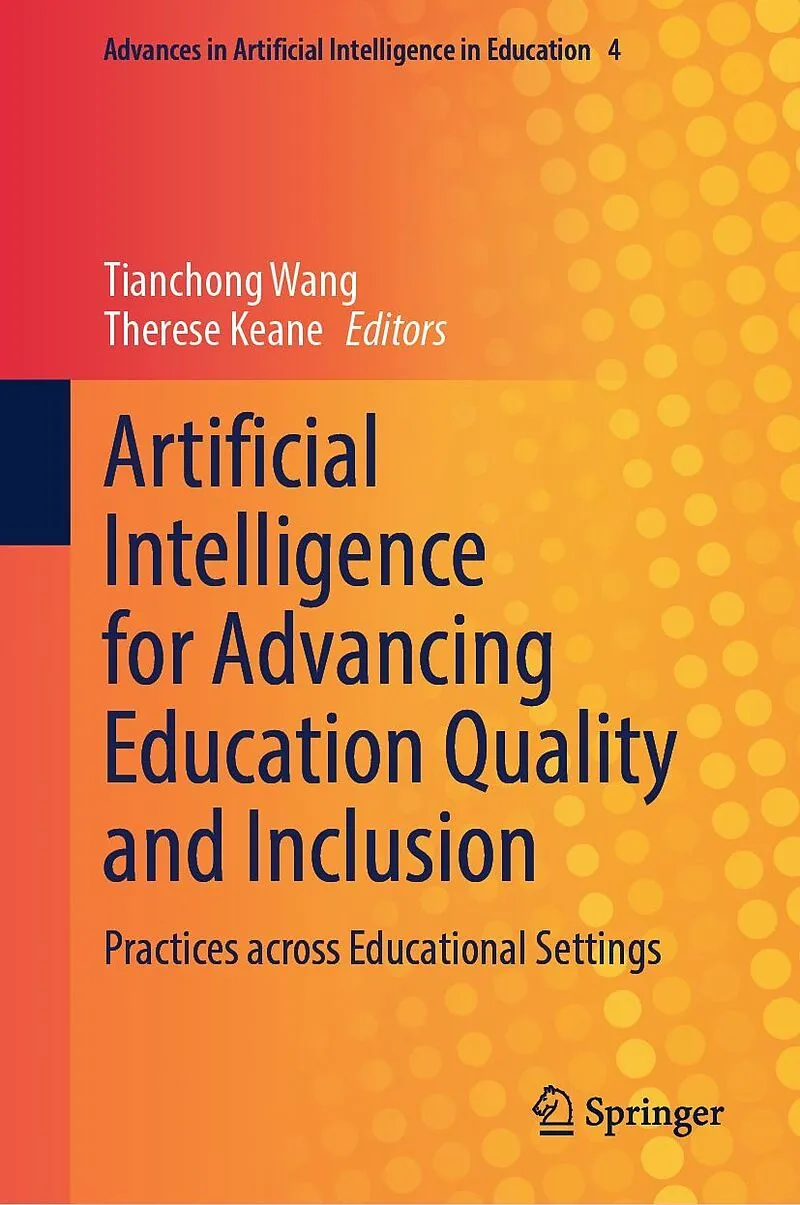
This volume illuminates the transformative potential of Artificial Intelligence (AI) in shaping the future of learning, particularly in terms of advancing quality and inclusion across educational settings. It explores the diverse ways AI technologies can be h...
This volume illuminates the transformative potential of Artificial Intelligence (AI) in shaping the future of learning, particularly in terms of advancing quality and inclusion across educational settings. It explores the diverse ways AI technologies can be harnessed to enhance pedagogical practices, enrich learning experiences, improve educational outcomes, widen access to quality knowledge sources, and empower minds for all. It thereby aligns with the broader objectives of promoting education quality and inclusion for all as outlined in the United Nations' SDG4 - Education 2030 agenda. This book combines multidisciplinary perspectives, offering a comprehensive view on AI in Education (AIED) practices geared towards quality and inclusion. Through a curated collection of evidence-based research, the volume offers pragmatic insights into the intricate AIED nexus.
Provides evidence-based insights into leveraging AI in diverse educational settings Aligns with the United Nations' SDG4 - Education 2030 agenda for quality and inclusion Delivers a holistic examination of AI's impact on educational practices
Autorentext
Dr Tianchong Wang is a Senior Lecturer in STEM in Innovative Education Futures at Flinders University's College of Education, Psychology and Social Work. He holds an EdD from the Chinese University of Hong Kong, an MSc from the University of Hong Kong, and a BA from Hong Kong Baptist University, along with various ICT qualifications. His work centres on technology-enhanced learning and teaching, with a particular focus on Artificial Intelligence (AI) in Education. Tianchong is an Associate Editor for Education and Information Technologies, a Q1 SSCI journal. He developed and taught Hong Kong’s first master-level course on AI in Education at the University of Hong Kong in 2020. An advocate for the UN's SDG4, Tianchong’s research aims to enhance education equity, quality, and inclusiveness, foster positive change in learning environments, and empower educators and learners in underprivileged communities. He actively engages with international and regional stakeholders such as UNESCO, The World Bank Group, and The Commonwealth of Learning in various capacities. In 2016, Tianchong co-developed UNESCO's framework for quality blended learning adoption and contributed to large-scale development projects addressing urban–rural disparities in STEM education quality in developing Asia. He also authored UNESCO’s reports on transforming teaching and learning with new digital technologies in 2022, and served as Consultant and Chief Rapporteur for UNESCO’s roundtable on generative AI and education in Asia–Pacific in 2023, and recently worked as an international expert for UNESCO’s Fostering STEM Education in Africa and Small Island Developing States (SIDS) initiative. Tianchong is committed to empowering girls in STEM and is co-CI of the 2023 Google Award for Inclusion Research, promoting female inclusion in generative AI in K-12 schools in Australia. Besides research, he conducts teacher capacity-building activities in the Global South. His media commentaries on AI in education have been featured in international higher education platforms and national media outlets, contributing to public understanding of this fascinating field.
Professor Therese Keane has been a champion for empowering girls in STEM for over 30 years. Currently she is the Associate Dean of Research and Industry Engagement, and Professor of STEM Education at La Trobe University’s School of Education in Melbourne Australia. Her passion and many achievements have been acknowledged by her peers in her receiving numerous international, national and state awards. She has worked in a variety of school settings where she has taught IT and lead in K-12 education as the Director of ICT. Her Doctorate in Education focused on ICT Leadership in schools. Therese’s research and expertise lie at the intersection of ICT issues related to children, young people, teachers, parents, principals, ICT education, educational technologies, technological innovations, and gender in computing. Her work is interdisciplinary and theoretically robust but at its core is a concern with how various educational settings (early education, primary and secondary schools) and their stakeholders learn, use and teach with and about breakthrough technologies alongside new innovations, as well as the way it is negotiated, integrated and even, at times, resisted. In pursuing these research interests, she continues to investigate several diverse avenues for research such as educational, humanoid, social robots; AI; computational thinking; computing education; children and programming; virtual reality and how these technologies are used by children and by extension educational stakeholders. Therese has served on several State, National and International Boards including; Chair of Australian Computer Society’s (ACS) ICT Educators Committee, Australian Council of Computers in Education (ACCE) and Australian Representative for the International Federation of Information Processing (IFIP) Technical Committee on Education (TC3). Currently, she is the Chair for IFIP TC3 (Education). Therese is also Editor in Chief for “Education and Information Technologies”—the official journal of the IFIP Technical Committee on Education covering the complex relationship between information and communication technologies and education. Throughout her career, Therese has also been an office holder in three professional teaching associations, the Victorian Information Technology Teachers Association (VITTA), Information and Communications Technology in Education Victoria (ICTEV) and the Digital Learning & Teaching Victoria (DLTV). Therese has presented numerous seminars and workshops for teachers involved in the teaching of Information Technology. She has written 18 textbooks in all units of VCE (Victorian Certificate of Education) Senior Information Technology in Victoria since 1995 and has worked with the Victorian Curriculum and Assessment Authority (VCAA) in the development of the VCE IT Study Design and various roles associated with VCE assessment over the past 25 years. Therese has been involved in the provision of professional development to ICT teachers and research into the use of technology, gender inequalities in STEM based subjects, robotics in education and computers in schools for teaching and learning purposes.
Inhalt
Part I. Overview and Global Perspectives.- Chapter 1. Innovative Approaches: Advances in Artificial Intelligence in Education.- Chapter 2. A Desk Review of Generative AI in K-12 Education: Current State of Knowledge and Global Integration Approaches.- Chapter 3. Beyond the Basics: Unravelling AI Education Policies and Practices in Asia-Pacific.- Part II. Teacher Preparation and Professional Development.- Chapter 4. Teachers' AI Competency: Reflecting TPACK Implications for Quality and Inclusion.- E-TPCK: Teachers' developing knowledge of Artificial Intelligence through quality engagement.- Chapter 6. Australian initial teacher educators' perspectives on artificial intelligence.- Chapter 7. Who Is Guiding This Ship?: Disciplinary Professional Organisations Guidance for Teachers Using Generative Artificial Intelligence to Develop Culturally Responsive Materials.- Chapter 8. Enchanting Learning: Generative AI and Fairy Tale Interpretations in Teacher Education.- Chapter 9. Teacher-led innovations with generative AI: A case study of Australian teachers.- Part III. Age-Appropriate AI Education and Curricula.- Chapter 10. Building Foundations: AI literacy for young children.- Chapter 11. AI curricula in primary and early childhood education: A cross country analysis of implementation.- Chapter 12. Develop an Artificial Intelligence (AI) Literacy program for Lower Primary School Students…