
IHR WARENKORB IST AKTUELL LEER.
Haben Sie noch nichts passendes gefunden? Stöbern Sie durch unser komplettes Sortiment.
Oder melden Sie sich an bzw. registrieren Sie sich.
- Kostenlose Lieferung
- Kauf auf Rechnung
- Ex Libris Tiefpreis
- Filiallieferung und 650+ Abholorte
- Rabatt-Bons als Club-Mitglied
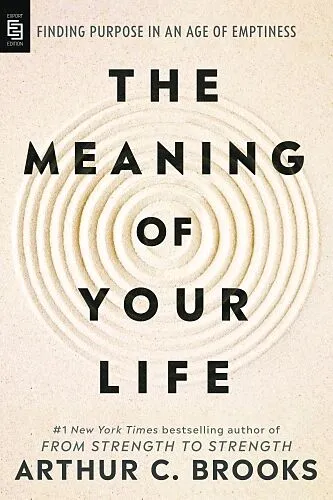
The Meaning of Your Life
Beschreibung
From the #1 Meaning in life is getting harder to find--and there’s a reason for that. In Fortunately, there''s hope. With compassion, clarity, and practicality, Brooks tells you exactly what you need to do to move toward meaning. You''ll take a test to d...Format auswählen
- Kartonierter EinbandCHF 20.00
- Fester EinbandCHF 28.20
- TaschenbuchCHF 30.50

Wird oft zusammen gekauft
Andere Kunden kauften auch
Beschreibung
From the #1 Meaning in life is getting harder to find--and there’s a reason for that. In Fortunately, there''s hope. With compassion, clarity, and practicality, Brooks tells you exactly what you need to do to move toward meaning. You''ll take a test to determine where you are on your meaning journey, learn evidence-based tactics for rewiring your brain for complex and abstract concepts, and discover a vocabulary for your desires. Most importantly, Brooks will show you “What is the meaning of my life?” is not an unanswerable question, but the road to an answer--or answers--is a long one. <The Meaning of Your Life <is your guide for the journey.
Autorentext
Arthur C. Brooks is a professor at Harvard Kennedy School and Harvard Business School, where he teaches courses on happiness and leadership. He is the creator of the popular “How to Build a Life” column at The Atlantic, an acclaimed public speaker, and the author of numerous bestselling books, including Build the Life You Want (co-authored with Oprah Winfrey), From Strength to Strength, and Love Your Enemies.
Klappentext
From the #1 New York Times bestselling author of From Strength to Strength, an account of how the modern world sets us up to fail at finding meaning—and a plan for finding what you seek.
Meaning in life is getting harder to find—and there’s a reason for that. In The Meaning of Your Life, social scientist and happiness expert Arthur Brooks explains how rapid societal and technological changes have rewired our brains, making them ill-equipped to handle questions of existential reckoning. The resulting emptiness is not imaginary, and it is life-destroying for some, especially for young people.
Fortunately, there's hope. With compassion, clarity, and practicality, Brooks tells you exactly what you need to do to move toward meaning. You'll take a test to determine where you are on your meaning journey, learn evidence-based tactics for rewiring your brain for complex and abstract concepts, and discover a vocabulary for your desires. Most importantly, Brooks will show you where to search for the transcendence, vocation, and significance that are your birthright as a human being.
“What is the meaning of my life?” is not an unanswerable question, but the road to an answer—or answers—is a long one. The Meaning of Your Life is your guide for the journey.
Leseprobe
Chapter 1
The Meaning of Meaning
At the age of fifty-one, the novelist Leo Nikolayevich Tolstoy wanted to kill himself.
You might think that, because nineteenth-century Russia was a very poor country, and writers are notoriously poorer than average, this self-destructive impulse was caused by hopeless poverty. Or because he felt his genius was unappreciated. Or because he had mental illness, which has afflicted so many great artists and writers.
But none of these was the case. On the contrary, Tolstoy was arguably the most successful and celebrated author of his time. His novel War and Peace was a huge bestseller; he lived in aristocratic luxury; he was nominated for the Nobel Prize in Literature multiple times. Nor was his despair the result of a crisis in his personal life: His marriage, though complicated, was stable and enduring and produced thirteen children. He had no addictions or ruinous personal habits.
But all this outward success left him feeling empty.
Tolstoy hoped that his work would fulfill his need for . . . well, he wasn't quite sure what. He focused on his writing obsessively, to the exclusion of everything else, but it never gave him what he craved. So he looked to science, which seemed to many in the late nineteenth century to promise the answer to every question, just as technology does today. As he studied, he expected to find the meaning of life buried in the complicated formulas of chemistry, physics, and biology. For a long time, Tolstoy assumed that not finding it was a function of his ignorance. But as the years passed, he was confronted with the reality that, as he put it, life's why was not to be found in "the laws of light, of chemical compounds, the laws of the development of organisms."
As he exhausted his intellectual options one by one, he sank deeper into despair. By the time he reached his fifties, he feared that "life [was] meaningless. . . . Now this was horrible. And in order to escape this horror I wanted to kill myself."
In so many ways, Tolstoy was way ahead of his time-including in his suffering, which is a lot like that of the people we met in the introduction. His situation sounds grim, and maybe yours feels that way, too, at least on your worst days. But in fact, life was going to get a lot better for Tolstoy, for one simple reason: he was looking hard for his life's meaning. True, he hadn't found it yet. But as desperate as he felt, he did not stop hunting, and the best predictor of finding something-including meaning-is looking for it. In the end, Tolstoy found what he was looking for.
Psychologists would say that Tolstoy was low in the presence of meaning but high in search. In this chapter, we will see where you are on these two dimensions. This is important as you set out on your meaning journey, because it creates a map of your meaning quest so you can find yourself on it. In this chapter, you will take a test of where you are in presence and search, which are your starting coordinates. But before we do that, we need to figure out the destination of the meaning journey as well. That requires defining what meaning, well, means.
The Meaning of the Meaning of Life
If you need to find something important, there are two questions you need to answer. The first is general; the second, specific. For example, if you are keen to find a spouse, the general question to answer is "What are the characteristics of an appropriate mate?" By that I mean figuring out the general features of a person with whom you would, ideally, spend the rest of your life. That means someone with the right basic demographics (who is the gender you seek, for example, and not fifty years older or younger than you), who seems sane, who more or less shares your values-that sort of thing. That's super important so you can start trying to answer the specific question "Who is my mate?" You must have an idea of what you are looking for in general to have any kind of fruitful search for the specific person. Of course, the person you wind up with will differ in many ways from what you had in your mind, but having something in mind makes it possible to start the journey toward your goal.
Similarly, while the main goal of this book is finding the meaning of your life, you first need to know what you are looking for generally-the meaning of life's meaning. If that could be anything, from a feeling to a Ferrari, you will spend your life on a wild-goose chase, going after anything and everything, and probably ending up with something silly or completely trivial.
You might even conclude that it is all some sort of cosmic joke, like in the 1983 Monty Python movie titled, appropriately, The Meaning of Life. The film opens with six fish swimming in a restaurant's tank, greeting one another. When one of them (named Howard) is taken out, cooked, and eaten in front of the others, the shocked fish begin to question the meaning of life. The movie moves through various comedic sketches that show life's absurdity and finishes a couple of hours later with a woman opening an envelope containing the answer to the question. "It's nothing very special, really," she reads blandly. "Try and be nice to people, avoid eating fat, read a good book every now and then, get some walking in, and try and live together in peace and harmony with people of all creeds and nations."
Deep down, though, none of us believes that the definitio…