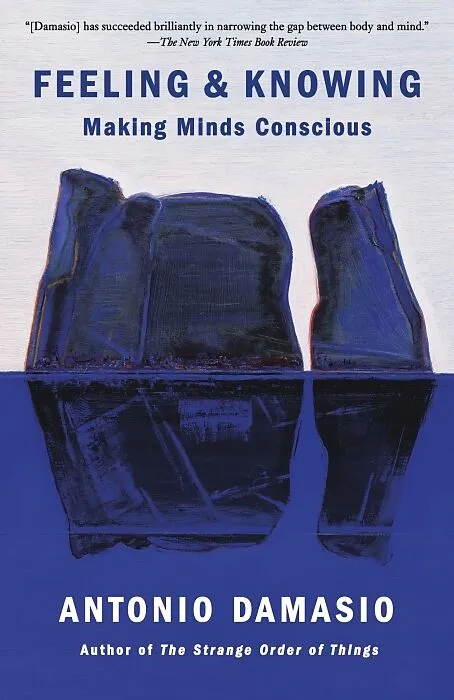
Feeling & Knowing
Beschreibung
Informationen zum Autor ANTONIO DAMASIO is University Professor, David Dornsife Professor of Neuroscience, Psychology, and Philosophy, and director of the Brain and Creativity Institute at the University of Southern California, Los Angeles. antoniodamasio.com ...Format auswählen
- Kartonierter EinbandCHF 20.00
- E-Book (epub)CHF 12.90
Wird oft zusammen gekauft
Andere Kunden kauften auch
Beschreibung
Informationen zum Autor ANTONIO DAMASIO is University Professor, David Dornsife Professor of Neuroscience, Psychology, and Philosophy, and director of the Brain and Creativity Institute at the University of Southern California, Los Angeles. antoniodamasio.com Klappentext From one of the world's leading neuroscientists: a succinct, illuminating, wholly engaging investigation of how biology, neuroscience, psychology, and artificial intelligence have given us the tools to unlock the mysteries of human consciousness One thrilling insight after another ... Damasio has succeeded brilliantly in narrowing the gap between body and mind. The New York Times Book Review In recent decades, many philosophers and cognitive scientists have declared the problem of consciousness unsolvable, but Antonio Damasio is convinced that recent findings across multiple scientific disciplines have given us a way to understand consciousness and its significance for human life. In the forty-eight brief chapters of Feeling & Knowing , and in writing that remains faithful to our intuitive sense of what feeling and experiencing are about, Damasio helps us understand why being conscious is not the same as sensing, why nervous systems are essential for the development of feelings, and why feeling opens the way to consciousness writ large. He combines the latest discoveries in various sciences with philosophy and discusses his original research, which has transformed our understanding of the brain and human behavior. Here is an indispensable guide to understanding how we experience the world within and around us and find our place in the universe. Leseprobe IN THE BEGINNING WAS NOT THE WORD In the beginning was not the word; that much is clear. Not that the universe of the living was ever simple, quite the contrary. It was complex from its inception, four billion years ago. Life sailed forth without words or thoughts, without feelings or reasons, devoid of minds or consciousness. And yet living organisms sensed others like them and sensed their environments. By sensing I mean the detection of a presenceof another whole organism, of a molecule located on the surface of another organism or of a molecule secreted by another organism. Sensing is not perceiving, and it is not constructing a pattern based on something else to create a representation of that something else and produce an image in mind. On the other hand, sensing is the most elementary variety of cognition. Even more surprising, living organisms responded intelligently to what they sensed. Responding with intelligence meant that the response helped the continuation of their life. For example, if what they sensed posed a problem, an intelligent response was one that solved the problem. Importantly, however, the smartness of these simple organisms did not rely on explicit knowledge of the sort our minds use today, the sort that requires representations and images. It relied on a concealed competence that took into account the goal of maintaining life and nothing but. This non-explicit intelligence was in charge of curating life, managing it in accordance with the rules and regulations of homeostasis. Homeostasis? Think of homeostasis as a collection of how-to rules, relentlessly executed according to an unusual manual of directions without any words or illustrations. The directions ensured that the parameters on which life dependedfor example, the presence of nutrients, certain levels of temperature or pHwere maintained within optimal ranges. Remember: in the beginning no words were spoken and no words were written, not even in the exacting manual of life regulations. THE PURPOSE OF LIFE I know that talking about the purpose of life can cause some discomfort, but considered from t...
Autorentext
ANTONIO DAMASIO is University Professor, David Dornsife Professor of Neuroscience, Psychology, and Philosophy, and director of the Brain and Creativity Institute at the University of Southern California, Los Angeles.
antoniodamasio.com
Klappentext
**From one of the world’s leading neuroscientists: a succinct, illuminating, wholly engaging investigation of how biology, neuroscience, psychology, and artificial intelligence have given us the tools to unlock the mysteries of human consciousness
“One thrilling insight after another ... Damasio has succeeded brilliantly in narrowing the gap between body and mind.” —The New York Times Book Review
**
In recent decades, many philosophers and cognitive scientists have declared the problem of consciousness unsolvable, but Antonio Damasio is convinced that recent findings across **multiple scientific disciplines have given us a way to understand consciousness and its significance for human life.
In the forty-eight brief chapters of Feeling & Knowing, and in writing that remains faithful to our intuitive sense of what feeling and experiencing are about, Damasio helps us understand why being conscious is not the same as sensing, why nervous systems are essential for the development of feelings, and why feeling opens the way to consciousness writ large. He combines the latest discoveries in various sciences with philosophy and discusses his original research, which has transformed our understanding of the brain and human behavior.
Here is an indispensable guide to understanding how we experience the world within and around us and find our place in the universe.
Leseprobe
IN THE BEGINNING WAS NOT THE WORD
In the beginning was not the word; that much is clear. Not that the universe of the living was ever simple, quite the contrary. It was complex from its inception, four billion years ago. Life sailed forth without words or thoughts, without feelings or reasons, devoid of minds or consciousness. And yet living organisms sensed others like them and sensed their environments. By sensing I mean the detection of a “presence”—of another whole organism, of a molecule located on the surface of another organism or of a molecule secreted by another organism. Sensing is not perceiving, and it is not constructing a “pattern” based on something else to create a “representation” of that something else and produce an “image” in mind. On the other hand, sensing is the most elementary variety of cognition.
Even more surprising, living organisms responded intelligently to what they sensed. Responding with intelligence meant that the response helped the continuation of their life. For example, if what they sensed posed a problem, an intelligent response was one that solved the problem. Importantly, however, the smartness of these simple organisms did not rely on explicit knowledge of the sort our minds use today, the sort that requires representations and images. It relied on a concealed competence that took into account the goal of maintaining life and nothing but. This non-explicit intelligence was in charge of curating life, managing it in accordance with the rules and regulations of homeostasis. Homeostasis? Think of homeostasis as a collection of how-to rules, relentlessly executed according to an unusual manual of directions without any words or illustrations. The directions ensured that the parameters on which life depended—for example, the presence of nutrients, certain levels of temperature or pH—were maintained within optimal ranges.
Remember: in the beginning no words were spoken and no words were written, not even in the exacting manual of life regulations.
THE PURPOSE OF LIFE
I know that talking about the purpose of life can cause some discomfort, but considered from the innocent perspective of each living organism, life is inseparable from one apparent goal: its own main­…