
IHR WARENKORB IST AKTUELL LEER.
Haben Sie noch nichts passendes gefunden? Stöbern Sie durch unser komplettes Sortiment.
Oder melden Sie sich an bzw. registrieren Sie sich.
- Kostenlose Lieferung
- Kauf auf Rechnung
- Ex Libris Tiefpreis
- Filiallieferung und 650+ Abholorte
- Rabatt-Bons als Club-Mitglied
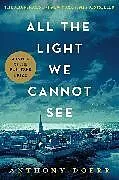
All the Light We Cannot See
Beschreibung
A blind French girl on the run from the German occupation and a German orphan-turned-Resistance tracker struggle with respective beliefs after meeting on the Brittany coast. “Sometimes a novel doesn’t merely transport. It immerses, engulfs, keeps y...Format auswählen
- Fester EinbandCHF 34.00

Wird oft zusammen gekauft
Andere Kunden kauften auch
Beschreibung
A blind French girl on the run from the German occupation and a German orphan-turned-Resistance tracker struggle with respective beliefs after meeting on the Brittany coast.
“Sometimes a novel doesn’t merely transport. It immerses, engulfs, keeps you caught within its words until the very end, when you blink and remember there’s a world beyond the pages. All the Light We Cannot See is such a book… Vibrant, poignant, delicately exquisite. Despite the careful building of time and place (so vivid you fall between the pages), it’s not a story of history; it’s a story of people living history.”
Autorentext
Anthony Doerr
Klappentext
"A blind French girl and a German boy whose paths collide in occupied France as both try to survive the devastation of World War II. Marie Laure lives with her father in Paris within walking distance of the Museum of Natural History where he works as the master of the locks (there are thousands of locks in the museum). When she is six, she goes blind, and her father builds her a model of their neighborhood, every house, every manhole, so she can memorize it with her fingers and navigate the real streets with her feet and cane. When the Germans occupy Paris, father and daughter flee to Saint-Malo on the Brittany coast, where Marie-Laure's agoraphobic great uncle lives in a tall, narrow house by the sea wall. In another world in Germany, an orphan boy, Werner, grows up with his younger sister, Jutta, both enchanted by a crude radio Werner finds. He becomes a master at building and fixing radios, a talent that wins him a place at an elite and brutal military academy and, ultimately, makes him a highly specialized tracker of the Resistance. Werner travels through the heart of Hitler Youth to the far-flung outskirts of Russia, and finally into Saint-Malo, where his path converges with Marie-Laure."--
Zusammenfassung
*Winner of the Pulitzer Prize A New York Times Book Review Top Ten Book A National Book Award finalist ***
From Anthony Doerr, the highly acclaimed, multiple award-winning author of Cloud Cuckoo Land, the beautiful, stunningly ambitious instant New York Times bestseller about a blind French girl and a German boy whose paths collide in occupied France as both try to survive the devastation of World War II.
Marie-Laure lives with her father in Paris near the Museum of Natural History, where he works as the master of its thousands of locks. When she is six, Marie-Laure goes blind and her father builds a perfect miniature of their neighborhood so she can memorize it by touch and navigate her way home. When she is twelve, the Nazis occupy Paris and father and daughter flee to the walled citadel of Saint-Malo, where Marie-Laure’s reclusive great-uncle lives in a tall house by the sea. With them they carry what might be the museum’s most valuable and dangerous jewel.
In a mining town in Germany, the orphan Werner grows up with his younger sister, enchanted by a crude radio they find. Werner becomes an expert at building and fixing these crucial new instruments, a talent that wins him a place at a brutal academy for Hitler Youth, then a special assignment to track the resistance. More and more aware of the human cost of his intelligence, Werner travels through the heart of the war and, finally, into Saint-Malo, where his story and Marie-Laure’s converge.
Doerr’s “stunning sense of physical detail and gorgeous metaphors” (San Francisco Chronicle) are dazzling. Deftly interweaving the lives of Marie-Laure and Werner, he illuminates the ways, against all odds, people try to be good to one another. Ten years in the writing, a National Book Award finalist, All the Light We Cannot See is a magnificent, deeply moving novel from a writer “whose sentences never fail to thrill” (Los Angeles Times).
Leseprobe
All the Light We Cannot See
Muséum National d’Histoire Naturelle
Marie-Laure LeBlanc is a tall and freckled six-year-old in Paris with rapidly deteriorating eyesight when her father sends her on a children’s tour of the museum where he works. The guide is a hunchbacked old warder hardly taller than a child himself. He raps the tip of his cane against the floor for attention, then leads his dozen charges across the gardens to the galleries.
The children watch engineers use pulleys to lift a fossilized dinosaur femur. They see a stuffed giraffe in a closet, patches of hide wearing off its back. They peer into taxidermists’ drawers full of feathers and talons and glass eyeballs; they flip through two-hundred-year-old herbarium sheets bedecked with orchids and daisies and herbs.
Eventually they climb sixteen steps into the Gallery of Mineralogy. The guide shows them agate from Brazil and violet amethysts and a meteorite on a pedestal that he claims is as ancient as the solar system itself. Then he leads them single file down two twisting staircases and along several corridors and stops outside an iron door with a single keyhole. “End of tour,” he says.
A girl says, “But what’s through there?”
“Behind this door is another locked door, slightly smaller.”
“And what’s behind that?”
“A third locked door, smaller yet.”
“What’s behind that?”
“A fourth door, and a fifth, on and on until you reach a thirteenth, a little locked door no bigger than a shoe.”
The children lean forward. “And then?”
“Behind the thirteenth door”—the guide flourishes one of his impossibly wrinkled hands—“is the Sea of Flames.”
Puzzlement. Fidgeting.
“Come now. You’ve never heard of the Sea of Flames?”
The children shake their heads. Marie-Laure squints up at the naked bulbs strung in three-yard intervals along the ceiling; each sets a rainbow-colored halo rotating in her vision.
The guide hangs his cane on his wrist and rubs his hands together. “It’s a long story. Do you want to hear a long story?”
They nod.
He clears his throat. “Centuries ago, in the place we now call Borneo, a prince plucked a blue stone from a dry riverbed because he thought it was pretty. But on the way back to his palace, the prince was attacked by men on horseback and stabbed in the heart.”
“Stabbed in the heart?”
“Is this true?”
A boy says, “Hush.”
“The thieves stole his rings, his horse, everything. But because the little blue stone was clenched in his fist, they did not discover it. And the dying prince managed to crawl home. Then he fell unconscious for ten days. On the tenth day, to the amazement of his nurses, he sat up, opened his hand, and there was the stone.
“The sultan’s doctors said it was a miracle, that the prince never should have survived such a violent wound. The nurses said the stone must have healing powers. The sultan’s jewelers said something else: they said the stone was the largest raw diamond anyone had ever seen. Their most gifted stonecutter spent eighty days faceting it, and when he was done, it was a brilliant blue, the blue of tropical seas, but it had a touch of red at its center, like flames inside a drop of water. The sultan had the diamond fitted into a crown for the prince, and it was said that when the young prince sat on his throne and the sun hit him just so, he became so dazzling that visitors could not distinguish his figure from light itself.”
“Are you sure this is true?” asks a girl.
“Hush,” says the boy.
“The stone came to be known as the Sea of Flames. Some believed the prince was a deity, that as long …