
IHR WARENKORB IST AKTUELL LEER.
Haben Sie noch nichts passendes gefunden? Stöbern Sie durch unser komplettes Sortiment.
Oder melden Sie sich an bzw. registrieren Sie sich.
- Kostenlose Lieferung
- Kauf auf Rechnung
- Ex Libris Tiefpreis
- Filiallieferung und 650+ Abholorte
- Rabatt-Bons als Club-Mitglied
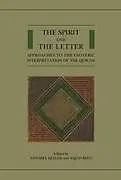
The Spirit and the Letter
Beschreibung
Zusatztext This is the first major work on the key mystics and theologians who composed esoteric commentaries on the Qur'an. Fifteen erudite contributions by some of the most eminent authorities in the field of Muslim philosophy, Shi'i exegesis, Ismaili though...Format auswählen
- Fester EinbandCHF 85.60
Wird oft zusammen gekauft
Andere Kunden kauften auch
Beschreibung
Zusatztext This is the first major work on the key mystics and theologians who composed esoteric commentaries on the Qur'an. Fifteen erudite contributions by some of the most eminent authorities in the field of Muslim philosophy, Shi'i exegesis, Ismaili thought, Akbarian theosophy and Sufism, explore over a millennium of esoteric commentators and commentaries on the Qur'an. Accompanied by an introduction that exhaustively examines the various intellectual trends, theological schools and theosophical terminology relating to mystical exegesis of the Qur'an, The Spirit and the Letter provides the most accessible treatment of the inner dimension of Muslim scriptural hermeneutics written to date. Informationen zum Autor Annabel Keeler is an Affiliated Researcher at the Faculty of Asian and Middle Eastern Studies and a Research Associate of Wolfson College, both at the University of Cambridge. Her research interests include Sufi exegesis, early to 'classical' Islamic mysticism, Persian literature and prophetology. She is the author of Sufi Hermeneutics: the Qur'an Commentary of Rash d al-D n Maybud (London, 2006) and co-translator of the commentary of Sahl al-Tustar , under the title, Tafs r al-Tustar (Kentucky, 2011). She is currently working on a monograph on the third/ninth century mystic Ab Yaz d al-Bis m and continuing her comparative study of Sufi commentaries on S rat Y suf.Sajjad Rizvi is Associate Professor of Islamic Intellectual History at the University of Exeter. Trained as a historian at Oxford and Cambridge, he has previously taught at the universities of Cambridge and Bristol. A specialist of Islamic thought in the Persianate East, he is the author of Mull adr Sh r z (Oxford, 2007) and Mull adr and Metaphysics (London, 2009), and is currently working on a study of the same thinker's noetics. His future projects include a comparative history of philosophy in the Persianate eighteenth century, and an intellectual history of Islamic philosophical traditions in India from 1500 to 1900. Klappentext This volume is the first to focus specifically on esoteric interpretation as a phenomenon in the field of Qur'anic exegesis and to show the plurality of ways it has been manifested in different Muslim traditions. Concern with the inner, spiritual implications of the Qur'an has usually been associated with mystical and Sufi trends in Islam. However, there have also been exegetes among the Shi'a, as well as among philosophers, who sought to supplement their understanding of the Qur'an's apparent meaning by eliciting deeper significations through contemplation of the verses. The Spirit and the Letter examines the multiplicity of these esoteric approaches, covering a period that extends from the third/ninth century to the present. It includes chapters on philosophical and Shi'i exegetes, such as Ibn S n (d. 428/1037) and Mull adr (d. 1045/1635-6), in addition to studies of a range of Sufi perspectives, from al-Sulam (d. 412/1021) and al-Qushayr (d. 465/1072) to R zbih n Baql (d. 606/1209), as well as representatives of the Ibn 'Arab and Kubr w schools. Considered together, the range of studies in this volume enable us to see what these approaches have in common and how they differ, and how the hermeneutics and content of exegesis are affected by doctrinal and ideological perspectives of various traditions and periods. Furthermore, they deepen our understanding of what actually constitutes esoteric interpretation and the need to look beyond the letter to the spirit of the Qur'anic word. Zusammenfassung The volume focuses on esoteric interpretation as a phenomenon in the field of Qur'anic exegesis. The work shows how it has been manifested in different Muslim traditions and explores the differences and similarities of these approaches. Inhaltsverzeichnis Notes on ContributorsIntroduction Annabel Keeler and Sajjad RizviPart I: Comparative Hermeneutics...
Autorentext
Annabel Keeler is an Affiliated Researcher at the Faculty of Asian and Middle Eastern Studies and a Research Associate of Wolfson College, both at the University of Cambridge. Her research interests include Sufi exegesis, early to 'classical' Islamic mysticism, Persian literature and prophetology. She is the author of Sufi Hermeneutics: the Qur'an Commentary of Rash d al-D n Maybud (London, 2006) and co-translator of the commentary of Sahl al-Tustar , under the title, Tafs r al-Tustar (Kentucky, 2011). She is currently working on a monograph on the third/ninth century mystic Ab Yaz d al-Bis m and continuing her comparative study of Sufi commentaries on S rat Y suf. Sajjad Rizvi is Associate Professor of Islamic Intellectual History at the University of Exeter. Trained as a historian at Oxford and Cambridge, he has previously taught at the universities of Cambridge and Bristol. A specialist of Islamic thought in the Persianate East, he is the author of Mull adr Sh r z (Oxford, 2007) and Mull adr and Metaphysics (London, 2009), and is currently working on a study of the same thinker's noetics. His future projects include a comparative history of philosophy in the Persianate eighteenth century, and an intellectual history of Islamic philosophical traditions in India from 1500 to 1900.
Klappentext
This volume is the first to focus specifically on esoteric interpretation as a phenomenon in the field of Qur'anic exegesis and to show the plurality of ways it has been manifested in different Muslim traditions. Concern with the inner, spiritual implications of the Qur'an has usually been associated with mystical and Sufi trends in Islam. However, there have also been exegetes among the Shi'a, as well as among philosophers, who sought to supplement their understanding of the Qur'an's apparent meaning by eliciting deeper significations through contemplation of the verses. The Spirit and the Letter examines the multiplicity of these esoteric approaches, covering a period that extends from the third/ninth century to the present. It includes chapters on philosophical and Shi'i exegetes, such as Ibn S n (d. 428/1037) and Mull adr (d. 1045/1635-6), in addition to studies of a range of Sufi perspectives, from al-Sulam (d. 412/1021) and al-Qushayr (d. 465/1072) to R zbih n Baql (d. 606/1209), as well as representatives of the Ibn 'Arab and Kubr w schools. Considered together, the range of studies in this volume enable us to see what these approaches have in common and how they differ, and how the hermeneutics and content of exegesis are affected by doctrinal and ideological perspectives of various traditions and periods. Furthermore, they deepen our understanding of what actually constitutes esoteric interpretation and the need to look beyond the letter to the spirit of the Qur'anic word.
Zusammenfassung
The volume focuses on esoteric interpretation as a phenomenon in the field of Qur'anic exegesis. The work shows how it has been manifested in different Muslim traditions and explores the differences and similarities of these approaches.
Inhalt
- Notes on Contributors
- Introduction Annabel Keeler and Sajjad Rizvi
- Part I: Comparative Hermeneutics
- 1: Sara Sviri: The Countless Faces of Understanding: On Istinb , Mystical Listening and Sufi Exegesis
- 2: Gerhard Böwering: The Interpretation of the Arabic Letters in Early Sufism: Sulam s Shar ma' n al- ur f
- 3: Annabel Keeler: Towards a Prophetology of Love: The Figure of Jacob in Sufi Commentaries on S rat Y suf
- 4: Kristin Zahra Sands: Making it Plain: Sufi Commentaries in English in the Twentieth Century
- Part II: Commentators and Texts in Focus
- 5: Meir M. Bar-Asher: Outlines of Early Ismaili-Fatimid Qur'an Exegesis
- 6: Peter Heath: Ibn S n 's Qur'anic Hermeneutics
- 7: Martin Nguyen: Qushayr 's Exegetical Encounter with the Mi'r j
- 8: Toby Mayer: Shahrast n 's Maf t al-Asr r: A Medieval Ismaili System of Hermeneutics?
- 9: Richar…