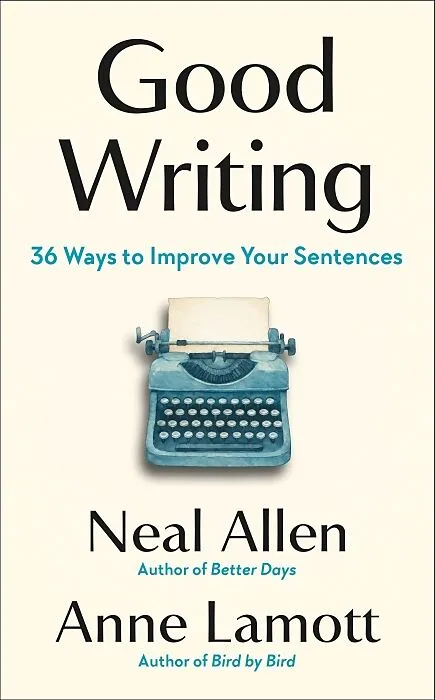
Good Writing
Beschreibung
36 ways to improve your writing Two writers show you how to turn a worthy sentence into a memorable one. Starting where Each rule is accompanied by examples and a lively pair of essays, the first by Neal Allen, who developed the list of tips over the course of...Format auswählen
- Fester EinbandCHF 27.00

Wird oft zusammen gekauft
Andere Kunden kauften auch
Beschreibung
36 ways to improve your writing Two writers show you how to turn a worthy sentence into a memorable one. Starting where Each rule is accompanied by examples and a lively pair of essays, the first by Neal Allen, who developed the list of tips over the course of his journalism and corporate careers; the second by his wife, Anne Lamott, acclaimed author of As Neal writes, “These rules economize, favor the plainspoken and the specific, keep the reader’s attention sharp, and in other ways show respect for the audience’s time and desire for novelty.” Some rules are fundamental: Whether you''re a novice writer or a seasoned author, this entertaining guide will revolutionize your approach to crafting sentences.
Autorentext
Neal Allen and Anne Lamott
Klappentext
**INSTANT NEW YORK TIMES BESTSELLER
36 ways to improve your writing**
Two writers show you how to turn a worthy sentence into a memorable one. Starting where The Elements of Style leaves off, Good Writing can improve your book, your essay, your memo, your blog post, speech, or script. These essential rules for persuasive language work on any type of writing, and anyone can learn them quickly.
Each rule is accompanied by examples and a lively pair of essays, the first by Neal Allen, who developed the list of tips over the course of his journalism and corporate careers; the second by his wife, Anne Lamott, acclaimed author of Bird by Bird and nineteen other nonfiction works and novels. The authors don’t always agree on the specifics, but they are passionate about making better sentences.
As Neal writes, “These rules economize, favor the plainspoken and the specific, keep the reader’s attention sharp, and in other ways show respect for the audience’s time and desire for novelty.”
Some rules are fundamental: Use strong verbs. Remove the boring stuff. Twist clichés. Some are more subtle: Draw on all five senses. Give your sentence a finale. Along the way, Good Writing addresses practicalities such as finishing projects despite challenges, trusting editors, and knowing when to break the rules to serve your story.
Whether you're a novice writer or a seasoned author, this entertaining guide will revolutionize your approach to crafting sentences.
Zusammenfassung
36 ways to improve your writing
Two writers show you how to turn a worthy sentence into a memorable one. Starting where The Elements of Style leaves off, Good Writing can improve your book, your essay, your memo, your blog post, speech, or script. These essential rules for persuasive language work on any type of writing, and anyone can learn them quickly.
Each rule is accompanied by examples and a lively pair of essays, the first by Neal Allen, who developed the list of tips over the course of his journalism and corporate careers; the second by his wife, Anne Lamott, acclaimed author of Bird by Bird and nineteen other nonfiction works and novels. The authors don’t always agree on the specifics, but they are passionate about making better sentences.
As Neal writes, “These rules economize, favor the plainspoken and the specific, keep the reader’s attention sharp, and in other ways show respect for the audience’s time and desire for novelty.”
Some rules are fundamental: Use strong verbs. Remove the boring stuff. Twist clichés. Some are more subtle: Draw on all five senses. Give your sentence a finale. Along the way, Good Writing addresses practicalities such as finishing projects despite challenges, trusting editors, and knowing when to break the rules to serve your story.
Whether you're a novice writer or a seasoned author, this entertaining guide will revolutionize your approach to crafting sentences.
Leseprobe
RULE 1:
Use Strong Verbs
Replace weak verbs, which are imprecise (walked, stood), with vivid verbs, which are specific (trudged, malingered).
Good old Sam Daleo. Sometimes this rule is expressed as Write with your verbs. Weak verbs are limp fish, sapped of energy by overuse: Walk, feel, think, dine, talk, tell, use, get-all colorless. "It felt bad to him" doesn't do much for the reader, nor does "He walked out of the house." Prosaic words, whether verbs or other parts of speech, leave readers unsteady about what is being conveyed. When I question my first bad attempt, more colorful actions-"His stomach churned" and "Rushing out of the house, he tripped on the last step"-magically appear.
Writing with strong, vivid verbs yields new sentence structures. It's not just bland to say, "He walked out of the house." It also doesn't lead anywhere much. But once I've got him "rushing," I imagine a consequence, the foot tripping on the last step, which gives me the puzzle of how to manage two verbs in one sentence. A more complicated but eminently readable sentence structure emerges. As I question my lackluster wordings and try new things out, my sentences mix up; some reel out longer while others sit boldly simple. The reader won't be lulled into a soporific monotony of one subject-verb-object sentence after another.
The more specific the verb, the less likely you'll need an adverb. "Raced" doesn't require "quickly." "Meandered" doesn't require "aimlessly."
By the way, don't confuse this rule with the unrelated grammatical distinction between "strong" (irregular) and "weak" (regular) verbs. Like any rule, you can take Use strong verbs too far. By avoiding the obvious verb "won," sportswriters imbue the victorious high school team with the courage and skill of Roman gladiators: The opponents typically have been slaughtered, massacred, blasted, blitzed, blown away, clobbered, thrashed, blanked, thumped, walloped, whomped, whipped, flattened, shellacked, crushed, hammered, shafted, or vanquished. Poor kids. Poor parents.
Anne's take:
A strong verb in a sentence instantly improves your writing. If no word springs to mind to vividly describe the action in your sentence, use your online thesaurus. Don't use "run" when you can use "sprint," "race," or "scurry." A verb describes what the subject of your sentence is doing: "The dog ate our Thanksgiving turkey." (This really happened ten years ago.) But Bodhi did not "eat" the turkey. He devoured, gobbled, wolfed down, and inhaled our Thanksgiving turkey. Bad dog.
"His grandfather sat on the porch, carving a figure out of a thick twig." OK, close your eyes and look at the screen on the backs of your eyelids. You see the old man-the noun-and what he is doing-the verb: carving something, holding it in one hand, slicing off thin layers of wood into a shape he has in his mind, to be revealed. But what if your sentence read "His grandfather slouched on the porch, whittling"?
Or "We tried to handle a week without Internet" could be "We hunkered down for a week without Internet." "Hunker" is a great verb. Try to use it more often. "The gorilla lowered her body to the ground" could also be "The gorilla hunkered down."
Here's another one: "She could not stop thinking about eating an entire chocolate cake." What about "She craved chocolate cake"? "Crave" is a great verb because it is so precise, so psycho-visual. You know that exact feeling when you've been in that state, longing for and obsessed with eating your body weight in cake, and then doing that-gobbling or devouring or wolfing it down. Cake is to me as turkey is to Bodhi.
Or "She went out to the garden and got a lot of vegetables for the meal she was cooking that night." Why not "She gathered vegetables for dinner"? "Gathered" rings with its suggestion of arms embracing lovely things-vegetables, flowers, little kids.
"Slouch," "whittle," "hunker", "crave", "gather"-these verbs are exact and rich. The reader immediately sees and understands the action you are des…