
IHR WARENKORB IST AKTUELL LEER.
Haben Sie noch nichts passendes gefunden? Stöbern Sie durch unser komplettes Sortiment.
Oder melden Sie sich an bzw. registrieren Sie sich.
- Kostenlose Lieferung
- Kauf auf Rechnung
- Ex Libris Tiefpreis
- Filiallieferung und 650+ Abholorte
- Rabatt-Bons als Club-Mitglied
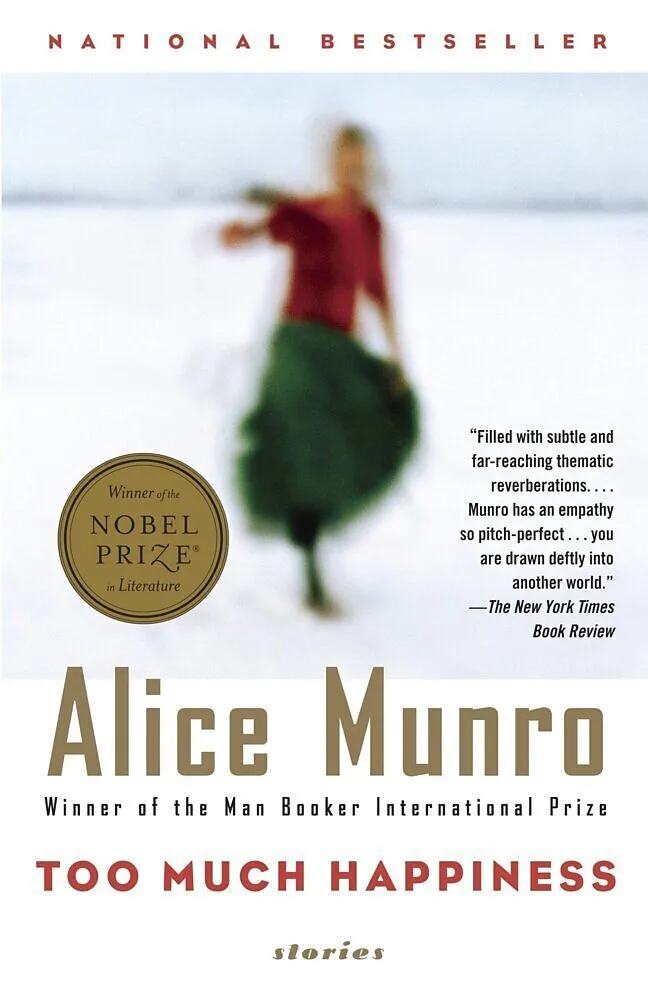
Too Much Happiness
Beschreibung
Nine short works include the stories of a grieving mother who is aided by a surprising source, a woman's response to a humiliating seduction and a 19th-century Russian émigré's winter journey to the Riviera. Zusatztext 41786119 Informationen zum Auto...Format auswählen
- Kartonierter EinbandCHF 24.70

Wird oft zusammen gekauft
Andere Kunden kauften auch
Beschreibung
Nine short works include the stories of a grieving mother who is aided by a surprising source, a woman's response to a humiliating seduction and a 19th-century Russian émigré's winter journey to the Riviera.
Zusatztext 41786119 Informationen zum Autor Alice Munro is the author of thirteen collections of storiesincluding Dear Life, Runaway , and Too Much Happiness as well as a novel, Lives of Girls and Women . Among the many awards and prizes she received are three Governor General's Literary Awards and two Giller Prizes in Canada; the Rea Award; the Lannan Literary Award; the National Book Critics Circle Award; and the International Booker Prize. Her stories have appeared in The New Yorker , The Atlantic , The Paris Review , and other publications, and her collections have been translated into thirteen languages. She was awarded the Nobel Prize in Literature in 2013. Alice Munro died in 2024. Klappentext WINNER OF THE NOBEL PRIZE® IN LITERATURE 2013 Ten superb new stories by one of our most beloved and admired writers-the winner of the 2009 Man Booker International Prize. With clarity and ease! Alice Munro once again renders complex! difficult events and emotions into stories about the unpredictable ways in which men and women accommodate and often transcend what happens in their lives. In the first story a young wife and mother! suffering from the unbearable pain of losing her three children! gains solace from a most surprising source. In another! a young woman! in the aftermath of an unusual and humiliating seduction! reacts in a clever if less-than-admirable fashion. Other tales uncover the "deep-holes" in a marriage! the unsuspected cruelty of children! and! in the long title story! the yearnings of a nineteenth-century female mathematician. Too Much Happiness Many persons who have not studied mathematics confuse it with arithmetic and consider it a dry and arid science. Actually, however, this science requires great fantasy. Sophia Kovalevsky i On the first day of January, in the year 1891, a small woman and a large man are walking in the Old Cemetery, in Genoa. Both of them are around forty years old. The woman has a childishly large head, with a thicket of dark curls, and her expression is eager, faintly pleading. Her face has begun to look worn. The man is immense. He weighs 285 pounds, distributed over a large frame, and being Russian, he is often referred to as a bear, also as a Cossack. At present he is crouching over tombstones and writing in his notebook, collecting inscriptions and puzzling over abbreviations not immediately clear to him, though he speaks Russian, French, English, Italian and has an understanding of classical and medieval Latin. His knowledge is as expansive as his physique, and though his speciality is governmental law, he is capable of lecturing on the growth of contemporary political institutions in America, the peculiarities of society in Russia and the West, and the laws and practices of ancient empires. But he is not a pedant. He is witty and popular, at ease on various levels, and able to live a most comfortable life, due to his properties near Kharkov. He has, however, been forbidden to hold an academic post in Russia, because of being a Liberal. His name suits him. Maksim. Maksim Maksimovich Kovalevsky. The woman with him is also a Kovalevsky. She was married to a distant cousin of his, but is now a widow. She speaks to him teasingly. You know that one of us will die, she says. One of us will die this year. Only half listening, he asks her, Why is that? Because we have gone walking in a graveyard on the first day of the New Year. Indeed. There are still a few things you don't know, she says in her pert but anxious way. I knew that before I was eight years old. Girls spend more time with kitchen maids and boys in the stablesI suppose that is why. Boys in the stables do not hear about death? Not so much. Concentration is on o...
ldquo;Filled with subtle and far-reaching thematic reverberations. . . . [Munro has] an empathy so pitch-perfect. . . . You [are] drawn deftly into another world.” —The New York Times Book Review
"Profound and beautiful.” —Francine Prose, O, The Oprah Magazine
“Alice Munro has done it again. . . . [She] keeps getting better. . . . Her brush strokes are fine, her vision encompasses humanity from its most generous to its most corrupt, and the effect is nothing short of masterful.” —The San Francisco Chronicle
“Richly detailed and dense with psychological observation. . . . Munro exhibit[s] a remarkable gift for transforming the seemingly artless into art . . . [She] concentrate[s] upon provincial, even backcountry lives, in tales of domestic tragicomedy that seem to open up, as if by magic, into wider, deeper, vaster dimensions.” —Joyce Carol Oates, New York Review of Books
“A perfect 10. . . . With this collection of surprising short stories, Munro once again displays the fertility of her imagination and her craftsmanship as a writer.” —USA Today
“Masterly. . . . [A] remarkable new book.” —The Los Angeles Times
“Daring and unpredictable. . . . Reading Munro is an intensely personal experience. Her focus is so clear and her style so precise. . . . Each [story is] dramatically and subtly different.” —The Miami Herald
“A brand-new collection of short stories from Alice Munro—winner of a Man Booker Prize—is always cause for celebration, and Too Much Happiness doesn’t disappoint. It dazzles. The 10 spare, lovely tales are . . . brimming with emotion and memorable characters. . . . Munro’s are stories that linger long after you turn the last page.” —Entertainment Weekly, Grade A
“Finely, even ingeniously, crafted. . . . Deliver[ed] with instinctive acuity.” —The Seattle Times
“Rich. . . . Truthful, in the deepest sense of the word. . . . Reading an Alice Munro short story is like sinking into a reverie. She expertly captures the shadings and byways of associative thought. . . . [Munro] will surely be remembered as the writer who took the short story to the depth of what short fiction can plumb.” —The Kansas City Star, Best 100 Books of 2009
“Rich and satisfying. . . . A commanding collection and one of her strongest. . . . Short fiction of this caliber should be on everyone’s reading list. Munro’s stories are accessible; she simply writes about life. . . . Honest, intuitive storytelling that gives the short story a good name.” —Chicago Sun-Times
“There's never too much happiness in a Munro collection, just sentence after sentence to die for.” —Louisville Courier-Journal
“[Munro is] universally acknowledged as one of the greatest short-story writers of our time. . . . [Her] work [is] at such a high level. . . . These stories are extraordinary, ample with the shrewdness and empathy that we have come to take for granted in Munro. . . . Her most distinguishing characteristic as a writer is . . . her extraordinary intimacy with her characters.” —The New Republic
“Coherent and compelling. . . . Munro manages to turn the sentimental into the existential.” —The Philadelphia Inquirer
“Stunning. . . . An unexpected gift. . . . Here we have 10 perfectly honed pieces, each a study of the human psyche in hard-to-imagine circumstances that Munro presents, seemingly effortlessly, in an economy of words and sentences.” —The Buffalo News
“As always in her distinctive stories, Alice Murno’s style is vivid, her attention tireless, her curiosity omnivorous, and her sentences drawn from the freshest of springs.” …