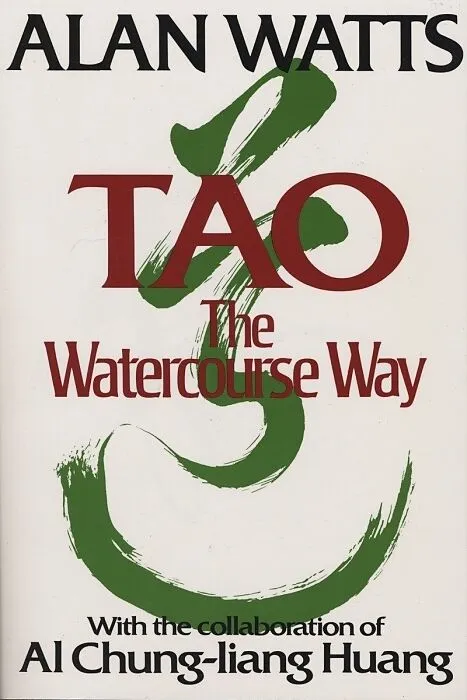
Tao
Beschreibung
Zusatztext "A gem to remember Watts by . . . There is a flamboyant and fascinating display of learning and complex indications of a personality that seems to have resisted inner pacification." Kirkus Reviews "Perhaps the foremost interpreter of Eastern discipl...Format auswählen
- Kartonierter EinbandCHF 21.10

Wird oft zusammen gekauft
Andere Kunden kauften auch
Beschreibung
Zusatztext "A gem to remember Watts by . . . There is a flamboyant and fascinating display of learning and complex indications of a personality that seems to have resisted inner pacification." Kirkus Reviews "Perhaps the foremost interpreter of Eastern disciplines for the contemporary West! Alan Watts had the rare gift of 'writing beautifully the unwritable' . . . Watts begins with scholarship and intellect and proceeds with art and eloquence to the frontiers of the spirit . . . This is a profound and worthy work! left by a teacher to echo and re-echo." Los Angeles Times "A remarkable book because of Alan Watts's talent for communicating Eastern ways of thought . . . not only the last of his works! but the best . . . This book is a 'must.'" Shambhala Review "Watts's last book is in the category of his finest work! a lucid discussion of Taoism and the Chinese language . . . profound! reflective! and enlightening. Moreover! the text supplies a sense of his ebullient spirit behind the revelation of Tao." Boston Globe Informationen zum Autor Alan Watts Klappentext "A lucid discussion of Taoism and the Chinese language . . . profound, reflective, and enlightening" (Boston Globe) Drawing on ancient and modern sources, Watts treats the Chinese philosophy of Tao in much the same way as he did Zen Buddhism in his classic The Way of Zen. Critics agree that this last work stands as a perfect monument to the life and literature of Alan Watts. "Perhaps the foremost interpreter of Eastern disciplines for the contemporary West, . . . Watts begins with scholarship and intellect and proceeds with art and eloquence to the frontiers of the spirit."-Los Angeles Times Zusammenfassung Drawing on ancient and modern sources, "a lucid discussion of Taoism and the Chinese language [that's] profound, reflective, and enlightening." Boston Globe According to Deepak Chopra, "Watts was a spiritual polymatch, the first and possibly greatest." Watts treats the Chinese philosophy of Tao in much the same way as he did Zen Buddhism in his classic The Way of Zen . Critics agree that this last work stands as a perfect monument to the life and literature of Alan Watts. "Perhaps the foremost interpreter of Eastern disciplines for the contemporary West, . . . Watts begins with scholarship and intellect and proceeds with art and eloquence to the frontiers of the spirit." Los Angeles Times Inhaltsverzeichnis Foreword, by Al Chung-liang Huang vii Preface xiv Prolegomena xvii The Pronunciation of Chinese Words xxi 1. The Chinese Written Language 2 2. The Yin-Yang Polarity 18 3. Tao 37 CHINESE CALLIGRAPHY 56 4. We-wei 74 CHINESE CALLIGRAPHY 99 5. TeVirtuality 106 Once Again: A New Beginning, by Al Chung-liang Huang 123 Note on My Calligraphy 128 Bibliography 129...
Autorentext
Alan Watts
Klappentext
"A lucid discussion of Taoism and the Chinese language . . . profound, reflective, and enlightening" (Boston Globe)
Drawing on ancient and modern sources, Watts treats the Chinese philosophy of Tao in much the same way as he did Zen Buddhism in his classic The Way of Zen. Critics agree that this last work stands as a perfect monument to the life and literature of Alan Watts.
"Perhaps the foremost interpreter of Eastern disciplines for the contemporary West, . . . Watts begins with scholarship and intellect and proceeds with art and eloquence to the frontiers of the spirit."-Los Angeles Times
Zusammenfassung
Drawing on ancient and modern sources, "a lucid discussion of Taoism and the Chinese language [that's] profound, reflective, and enlightening." —Boston Globe
According to Deepak Chopra, "Watts was a spiritual polymatch, the first and possibly greatest." Watts treats the Chinese philosophy of Tao in much the same way as he did Zen Buddhism in his classic The Way of Zen. Critics agree that this last work stands as a perfect monument to the life and literature of Alan Watts.
"Perhaps the foremost interpreter of Eastern disciplines for the contemporary West, . . . Watts begins with scholarship and intellect and proceeds with art and eloquence to the frontiers of the spirit."—Los Angeles Times
Leseprobe
2. The Yin-Yang Polarity
At the very roots of Chinese thinking and feeling there lies the principle of polarity, which is not to be confused with the ideas of opposition or conflict. In the metaphors of other cultures, light is at war with darkness, life with death, good with evil, and the positive with the negative, and thus an idealism to cultivate the former and be rid of the latter flourishes throughout much of the world. To the traditional way of Chinese thinking, this is as incomprehensible as an electric current without both positive and negative poles, for polarity is the principle that + and –, north and south, are different aspects of one and the same system, and that the disappearance of either one of them would be the disappearance of the system.
People who have been brought up in the aura of Christian and Hebrew aspirations find this frustrating, because it seems to deny any possibility of progress, an ideal which flows from their linear (as distinct from cyclic) view of time and history. Indeed, the whole enterprise of Western technology is “to make the world a better place”—to have pleasure without pain, wealth without poverty, and health without sickness. But, as is now becoming obvious, our violent efforts to achieve this ideal with such weapons as DDT, penicillin, nuclear energy, automotive transportation, computers, industrial farming, damming, and compelling everyone, by law, to be superficially “good and healthy” are creating more problems than they solve. We have been interfering with a complex system of relationships which we do not understand, and the more we study its details, the more it eludes us by revealing still more details to study. As we try to comprehend and control the world it runs away from us. Instead of chafing at this situation, a Taoist would ask what it means. What is that which always retreats when pursued? Answer: yourself. Idealists (in the moral sense of the word) regard the universe as different and separate from themselves—that is, as a system of external objects which needs to be subjugated. Taoists view the universe as the same as, or inseparable from, themselves—so that Lao-tzu could say, “Without leaving my house, I know the whole universe.” This implies that the art of life is more like navigation than warfare, for what is important is to understand the winds, the tides, the currents, the seasons, and the principles of growth and decay, so that one’s actions may use them and not fight them. In this sense, the Taoist attitude is not opposed to technology per se. Indeed, the Chuang-tzu writings are full of references to crafts and skills perfected by this very principle of “going with the grain.” The point is therefore that technology is destructive only in the hands of people who do not realize that they are one and the same process as the universe. Our overspecialization in conscious attention and linear thinking has led to neglect, or ignore-ance, of the basic principles and rhythms of this process, of which the foremost is polarity.
In Chinese the two poles of cosmic energy are yang (positive) and yin (negative), and their conventional signs are respectively — and – – . The ideograms indicate the sunny and shady sides of a hill, fou, and they are associated with the masculine and the feminine, the firm and the yielding, the strong and the weak, the light and the dark, the rising and the falling, heaven and earth, and they are even recognized in such everyday matters as cooking as the spicy and the bland. Thus the art of life is not seen as holding to yang and banishing yin, but as keeping the two i…