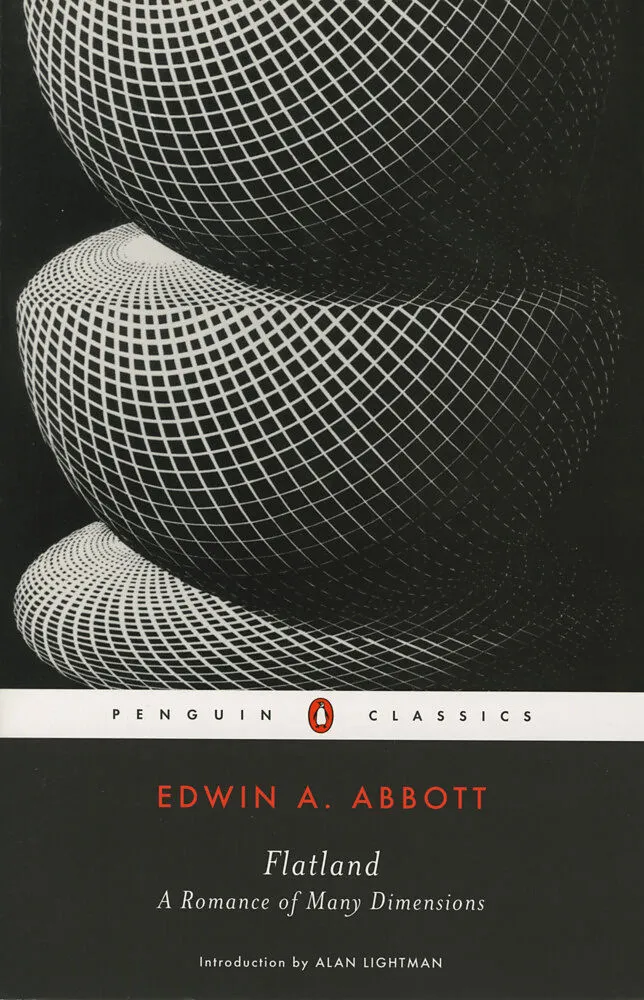
Flatland
Beschreibung
Zusatztext At once a classic of science fiction! a playful brainteaser about geometry! a pointed satire of Victorian mannersand! finally! a strangely compelling argument about reason! faith! and the greatest mysteries of the universe. The Wall Street Journal I...Format auswählen
- Kartonierter EinbandCHF 13.80

Wird oft zusammen gekauft
Andere Kunden kauften auch
Beschreibung
Zusatztext At once a classic of science fiction! a playful brainteaser about geometry! a pointed satire of Victorian mannersand! finally! a strangely compelling argument about reason! faith! and the greatest mysteries of the universe. The Wall Street Journal Informationen zum Autor Edwin A. Abbott (1838 - 1926) was a leading scholar of the Victorian period. A schoolmaster from the age of 26, Abbott oversaw the education of many luminaries of the Edwardian era and beyond, including Prime Minister H. H. Asquith. In his retirement, Abbott devoted himself to writing theological discussions and biographies. In 1884, he wrote Flatland, a highly original work of satirical science-fiction that is now considered a canonical example of the genre. Klappentext A romance in many dimensions that has fascinated generations of readers with its clever blend of social satire and mathematical theory A Penguin Classic A work that continues to pose provocative questions about perception and reality, Flatland is a brilliant parody of Victorian society where all existence is limited to length and breadthits inhabitants unable even to imagine a third dimension. The amiable narrator, A Square, provides an overview of this fantastic worldits physics and metaphysics, its history, customs and religious beliefs. But when a strange visitor mysteriously appears and transports the incredulous Flatlander to the Land of Three Dimensions, his world view is forever shattered. Written more than a century ago, Flatland conceals within its brilliant parody of Victorian society speculations about the universe that resonate in Einstein's theory of relativity as well as the current string-theory of nature. For more than seventy years, Penguin has been the leading publisher of classic literature in the English-speaking world. With more than 1,700 titles, Penguin Classics represents a global bookshelf of the best works throughout history and across genres and disciplines. Readers trust the series to provide authoritative texts enhanced by introductions and notes by distinguished scholars and contemporary authors, as well as up-to-date translations by award-winning translators. FLATLAND A Romance of Many Dimensions ------------------------------ BY A. SQUARE (EDWIN A. ABBOTT) WITH ILLUSTRATIONS BY THE AUTHOR AND AN INTRODUCTION BY ALAN LIGHTMAN PENGUIN BOOKS INTRODUCTION In the summer of 1973, I went on a camping trip in Sequoia National Park. I was a graduate student in physics at the time, and my two companions were also physicists. Carved out of granite by retreating glaciers, Sequoia National Park lies in the southern end of the great Sierra Nevada mountain range of California and is most famous for its giant sequoia trees, which attain heights of several hundred feet and ages of two thousand years. In Sequoia, one's senses are overwhelmed. The land tilts and swerves from the ancient shifting of subterranean faults, snow-covered mountains jut into space, shady forests suddenly give way to bright meadows. During this barrage of sensation, in which it seemed to me that every cubic inch of the world was filled to its maximum capacity, one of my fellow campers, John Schwarz, was at work formulating a new theory of naturea theory that required seven additional dimensions beyond the usual three. Schwarz's pioneering calculations, called string theory and later extended by other theoretical physicists, are now regarded as the best attempt to develop a quantum theory of gravity and to unify all the forces of nature. For technical reasons, such a theory demands more than length, width, and breadth. Fortunately, the extra dimensions are curled up in such tiny circles that they cannot ...
ldquo;At once a classic of science fiction, a playful brainteaser about geometry, a pointed satire of Victorian manners—and, finally, a strangely compelling argument about reason, faith, and the greatest mysteries of the universe.” —The Wall Street Journal
Autorentext
Edwin A. Abbott (1838 - 1926) ****was a leading scholar of the Victorian period. A schoolmaster from the age of 26, Abbott oversaw the education of many luminaries of the Edwardian era and beyond, including Prime Minister H. H. Asquith. In his retirement, Abbott devoted himself to writing theological discussions and biographies. In 1884, he wrote Flatland, a highly original work of satirical science-fiction that is now considered a canonical example of the genre.
Klappentext
**A “romance in many dimensions” that has fascinated generations of readers with its clever blend of social satire and mathematical theory
A Penguin Classic**
A work that continues to pose provocative questions about perception and reality, Flatland is a brilliant parody of Victorian society where all existence is limited to length and breadth—its inhabitants unable even to imagine a third dimension. The amiable narrator, A Square, provides an overview of this fantastic world—its physics and metaphysics, its history, customs and religious beliefs. But when a strange visitor mysteriously appears and transports the incredulous Flatlander to the Land of Three Dimensions, his world view is forever shattered. Written more than a century ago, Flatland conceals within its brilliant parody of Victorian society speculations about the universe that resonate in Einstein’s theory of relativity as well as the current “string-theory” of nature.
For more than seventy years, Penguin has been the leading publisher of classic literature in the English-speaking world. With more than 1,700 titles, Penguin Classics represents a global bookshelf of the best works throughout history and across genres and disciplines. Readers trust the series to provide authoritative texts enhanced by introductions and notes by distinguished scholars and contemporary authors, as well as up-to-date translations by award-winning translators.
Leseprobe
FLATLAND
A Romance of Many Dimensions
BY A. SQUARE
(EDWIN A. ABBOTT)
WITH ILLUSTRATIONS BY THE AUTHOR
AND
AN INTRODUCTION BY ALAN LIGHTMAN
PENGUIN BOOKS
INTRODUCTION
In the summer of 1973, I went on a camping trip in Sequoia National Park. I was a graduate student in physics at the time, and my two companions were also physicists. Carved out of granite by retreating glaciers, Sequoia National Park lies in the southern end of the great Sierra Nevada mountain range of California and is most famous for its giant sequoia trees, which attain heights of several hundred feet and ages of two thousand years. In Sequoia, one’s senses are overwhelmed. The land tilts and swerves from the ancient shifting of subterranean faults, snow-covered mountains jut into space, shady forests suddenly give way to bright meadows.
During this barrage of sensation, in which it seemed to me that every cubic inch of the world was filled to its maximum capacity, one of my fellow campers, John Schwarz, was at work formulating a new theory of nature—a theory that required seven additional dimensions beyond the usual three. Schwarz’s pioneering calculations, called “string theory” and later extended by other theoretical physicists, are now regarded as the best attempt to develop a quantum theory of gravity and to unify all the forces of nature. For technical reasons, such a theory demands more than length, width, and breadth. Fortunately, the extra dimensions are curled up in such tiny circles that they cannot be experienced by macroscopic creatures who are already strained by a mere three.
Almost a century before that excursion into the sequoias of California, in 1884, there quietly appeared in England a little book titled Flatland, which invited its readers to consider the outrageous possibility of four dimensions and mo…