Medium Rare
Beschreibung
From the author of Phil is;ordinary. A mid-level Washington lobbyist for a decidedly unsexy organization, unhappy in the way all mildly successful, minimally influential men are. That is until the spring of 2019, when Phil’s picks for the NCAA March Madn...Format auswählen
- Kartonierter Einband (Kt)CHF 18.15

Wird oft zusammen gekauft
Andere Kunden kauften auch
Beschreibung
From the author of Phil is;ordinary. A mid-level Washington lobbyist for a decidedly unsexy organization, unhappy in the way all mildly successful, minimally influential men are. That is until the spring of 2019, when Phil’s picks for the NCAA March Madness Tournament start panning out, and heads begin to turn his way. He really may do it: predict a perfect bracket, for a billion-dollar prize. ; At first, Cassandra is just along for Phil’s soaring rise--she Dazzling in its absurd comedy, <Medium Rare< is not only a gambol through the upper echelon, but also a shrewd examination of madness, desire, and credibility--why don’t we listen when prophetic women speak? A. Natasha Joukovsky delivers a story as layered and incisive as it is high-flying fun.
Autorentext
A. NATASHA JOUKOVSKY is the author of The Portrait of a Mirror. Her writing has been published in Literary Hub, Electric Lit, The Common, and Still Alive. Natasha holds a BA in English from the University of Virginia and an MBA from New York University’s Stern School of Business. She lives in Washington, DC.
Klappentext
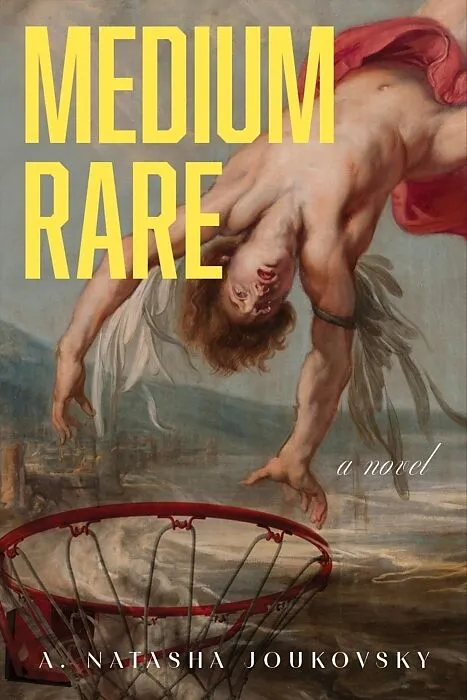
From the author of The Portrait of a Mirror, a modern tragicomedy transforms the myth of Icarus into a blazing romp through bureaucracy, B-list fame, and college basketball…
Phil is ordinary. A mid-level Washington lobbyist for a decidedly unsexy organization, unhappy in the way all mildly successful, minimally influential men are. That is until the spring of 2019, when Phil’s picks for the NCAA March Madness Tournament start panning out, and heads begin to turn his way. He really may do it: predict a perfect bracket, for a billion-dollar prize.
At first, Cassandra is just along for Phil’s soaring rise—she had foreseen it happening, after all. Despite moving in different circles since their shared university days and Cassandra never much liking him, she recognizes in Phil the making of a legend worthy of the highest art. What Cassandra fails to predict, though, is just how much she’d grow to care about Phil’s wife, Raleigh—and that the grandest narrative arcs sometimes unfold at the steepest of personal costs.
Dazzling in its absurd comedy, Medium Rare is not only a gambol through the upper echelon, but also a shrewd examination of madness, desire, and credibility—why don’t we listen when prophetic women speak? A. Natasha Joukovsky delivers a story as layered and incisive as it is high-flying fun.
Leseprobe
**Chapter 1: "First Four"**
I see Phil. And when I now see Phil? I see a man with a ball. Not just any ball: a basketball. But any man. You might even call him every man—though I do want to be fair to him. The everyman figure is a composite of specific ones, and fairness and truth close enough acquaintances a dispassionate observer would almost certainly call them friends. When I say I see a man, I mean I see a human being: singular like any other. Nothing more—but also nothing less. Something ordinary and something amazing. A world and a grain of sand.
000
The odds of filling out a perfect March Madness bracket are so infinitesimal statisticians disagree just how infinitesimal they are. Disregarding the “First Four” play-in games—because honestly, who doesn’t—proponents of treating every game as a fair coin flip will tell you one in nine quintillion, two hundred twenty-three quadrillion, three hundred seventy-two trillion, thirty-six billion, eight hundred fifty-four million, seven hundred seventy-five thousand, eight hundred and eight. This was, indeed, the estimate favored by Phil Fayeton himself, not just for its magnitude but also its precision; for its neat, edgy literalness—the way it accounted for every possible eventuality, from our alma mater’s landmark loss the previous season to their poetic redemption in 2019.
The best sixty-four college basketball programs in the country score invitations to the “the big dance” each year; it takes sixty-three single-elimination games to crown a tournament champion. That’s two to the sixty-third power, mathematically speaking, Phil would explain, rattling off each digit with memorial pride. After his first few public appearances, he googled a series of analogies to help contextualize a number of that size, as if to improve its marketability—almost like he was lobbying for it. Pick a single grain of sand from anywhere in the world, he’d say, and you’d be twenty-three percent more likely to find it again at random than to fill out a perfect March Madness bracket. He relayed such anecdotes with a specious kind of authority in his voice; Phil unironically trusted the internet in that natural, unexamined way it is easy to trust generally helpful things.