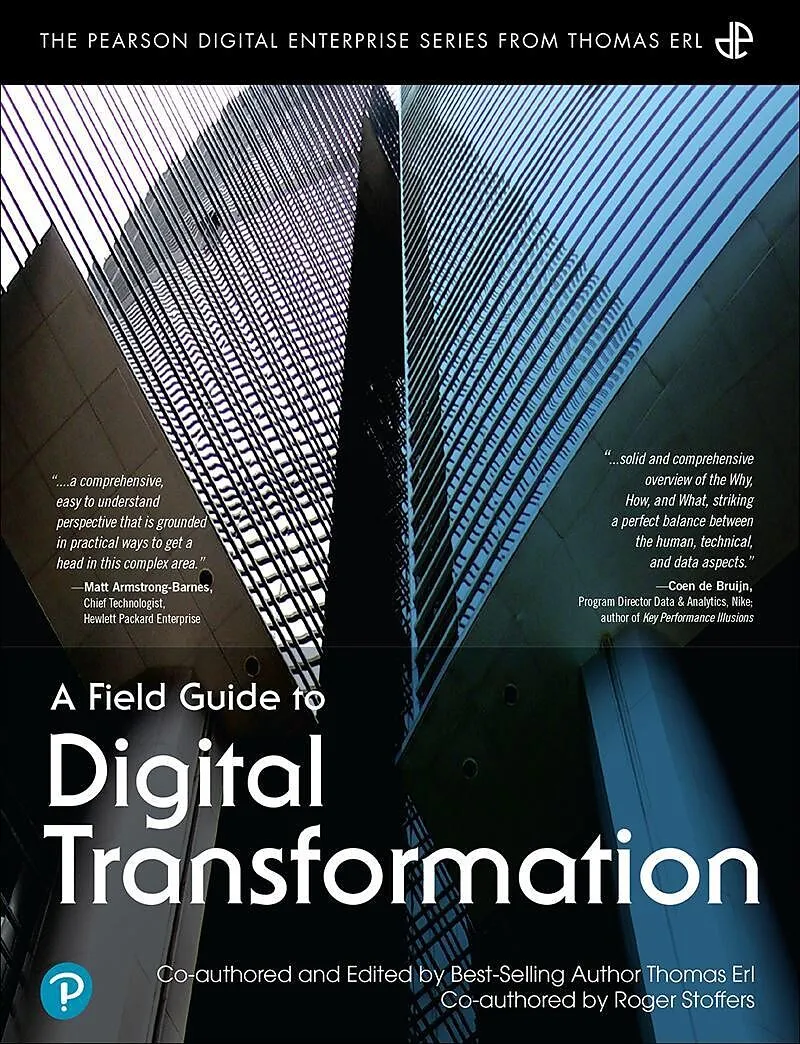
Field Guide to Digital Transformation, A
Beschreibung
Your Complete Guide to Digital Transformation A Field Guide to Digital Transformation is the definitive book on digital transformation. Top-selling IT author Thomas Erl and long-time practitioner Roger Stoffers combine to provide comprehensive, yet easy-to-un...Format auswählen
- E-Book (epub)CHF 23.90

Wird oft zusammen gekauft
Andere Kunden kauften auch
Beschreibung
Your Complete Guide to Digital Transformation A Field Guide to Digital Transformation is the definitive book on digital transformation. Top-selling IT author Thomas Erl and long-time practitioner Roger Stoffers combine to provide comprehensive, yet easy-to-understand coverage of essential digital transformation concepts, practices, and technologies in the format of a plain-English tutorial written for any IT professionals, students, or decision-makers. With more than 160 diagrams, this guide provides a highly visual exploration of what digital transformation is, how it works, and the techniques and technologies required to successfully build modern-day digital transformation solutions. Learn from the experts and:
- Discover what digital transformation is, why it emerged and when to apply it
- Identify the significant business benefits that successful digital transformations can deliver and how to turn your organization into a "disruptive" force
- Prepare for and overcome the common challenges associated with digital transformation initiatives
- Understand the data-driven nature of digital transformation solutions and how they use and continually accumulate data intelligence
- Understand how digital transformation solutions can utilize AI technology for intelligent automated decision-making
- Gain insight into customer-centricity and how its practices are applied as part of digital transformations
- Explore key digital transformation automation technologies, such as Robotic Process Automation (RPA), Internet of Things (IoT), Blockchain. and Cloud Computing
- Explore key digital transformation data science technologies, such as Artificial Intelligence (AI), Machine Learning, and Big Data Analysis and Analytics The book concludes with a uniquely detailed and highly visual real-world business scenario that provides step-by-step insights into how a digital transformation solution works, how it utilizes data intelligence to improve customer relationship building, and how it collects new data intelligence in support of enhancing future business capabilities.
Autorentext
Thomas Erl is a best-selling IT author who has authored and co-authored 15 books published by Prentice Hall and Pearson Education and dedicated to topics focused on contemporary information technology and practices. These titles were delivered for the Pearson Digital Enterprise Series from Thomas Erl (formerly the Prentice Hall Service Technology Series from Thomas Erl) for which Thomas also acts as series editor.
As founder and president of Arcitura Education (www.arcitura.com), Thomas also leads the development of curricula for internationally recognized, vendor-neutral training and accreditation programs. Arcitura's portfolio currently consists of over 100 courses, over 90 Pearson VUE exams, and over 40 certification tracks, covering topics such as Digital Transformation, Robotic Process Automation (RPA), DevOps, Blockchain, IoT, Containerization, Machine Learning, Artificial Intelligence (AI), Cybersecurity, Service-Oriented Architecture (SOA), Cloud Computing and Big Data Analytics.
Roger Stoffers is a TOGAF-certified Enterprise Architect passionate about Digital Transformation and Integration. Roger has worked for (and with) organizations in Telecommunication, Government and Finance industries, building 25 years of experience in multinational organizations. He has served as principal and lead Enterprise Domain Architect for digital business transformation initiatives, with strong focus for customer relationships and sustainable organizational agility in distributed environments.
Presently Roger works as Enterprise Architect for de Volksbank, fostering Customer Centricity and the organization's Sustainability & Social Responsibility goals with Data-Driven Customer Engagement and Decisioning. Independently, Roger is a worldwide consulting architect for digital transformation and integration, and a senior trainer for (enterprise) architecture topics and contemporary vendor-neutral technology and next-generation IT topics. He is a speaker at conferences about Digital Transformation, SOA and Microservices and Enterprise Architecture. He is a contributor for the Service-Oriented Architecture: Analysis and Design for Service and Microservices book from the Pearson Digital Enterprise Series from Thomas Erl.
Inhalt
About This Book xxvii PART I: DIGITAL TRANSFORMATION FUNDAMENTALS Chapter 1: Understanding Digital Transformation 3 (What is Digital Transformation?) 3 Business, Technology, Data and People 5 Digital Transformation and Business 6 Digital Transformation and Technology 7 Digital Transformation and Data 9 Digital Transformation and People 10 Digital Transformation and Organizations and Solutions 11 Chapter 2: Common Business Drivers 13 (What Led to Digital Transformation?) 13 Losing Touch with Customer Communities 14 Inability to Grow in Stale Marketplaces 16 Inability to Adapt to Rapidly Changing Marketplaces 16 Cold Customer Relationships 19 Inefficient Operations 19 Inefficient Decision-Making 21 Chapter 3: Common Technology Drivers 23 (What Enables Digital Transformation?) 23 Enhanced and Diverse Data Collection 25 Contemporary Data Science 27 Sophisticated Automation Technology 29 Autonomous Decision-Making 29 Centralized, Scalable, Resilient IT Resources 31 Immutable Data Storage 33 Ubiquitous Multiexperience Access 34 Chapter 4: Common Benefits and Goals 37 (Why Undergo a Digital Transformation?) 37 Enhanced Business Alignment 39 Enhanced Automation and Productivity 42 Enhanced Data Intelligence and Decision-Making 44 Improved Customer Experience and Customer Confidence 44 Improved Organizational Agility 48 Improved Ability to Attain Market Growth 50 Chapter 5: Common Risks and Challenges 53 (What Are the Pitfalls?) 53 Poor Data Quality and Data Bias 55 Increased Quantity of Vulnerable Digital Data 55 Resistance to Digital Culture 58 Risk of Over-Automation 59 Difficult to Govern 61 Chapter 6: Realizing Customer-Centricity 63 What Is a Product? 64 What Is a Customer? 65 Product-Centric vs. Customer-Centric Relationships 67 Transaction-Value vs. Relationship-Value Actions 69 Customer-Facing vs. Customer-Oriented Actions 71 Relationship Value and Warmth 71 Warmth in Communication 71 Warmth in Proactive Accommodation 74 Warmth in Customer Rewards 76 Warmth in Exceeding Customer Expectations 76 Single vs. Multi vs. Omni-Channel Customer Interactions 77 Customer Journeys 81 Customer Data Intelligence 84 Chapter 7: Data Intelligence Basics 89 Data Origins (Where Does the Data Come From?) 90 Corporate Data 92 Third-Party Data 92 Creating New Corporate Data Intelligence 92 Common Data Sources (Who Produces the Data?) 93 Operations Data 95 Customer Data 95 Social Media Data 95 Public Sector Data 96 Private Sector Data 97 Data Collection Methods (How Is the Data Collected?) 97 Manual Data Entry 98 Automated Data Entry or Collection 98 Telemetry Data Capture 98 Digitization 99 Data Ingress 101 Data Utilization Types (How Is the Data Used?) 101 Analysis and Reporting 101 Automated Decision-Making 102 Solution Input 103 Bot-Driven Automation 103 Model Training and Retraining 103 Historical Record Keeping 104 Chapter 8: Intelligent Decision-Making 105 Manual Decision-Making 107 Computer-Assisted Manual Decision-Making 107 Conditional Automated Decision-Making 108 Intelligent Manual Decision-Making 109 Intelligent Automated Decision-Making 112 Direct-Driven Automated Decision-Making 113 Periodic Automated Decision-Making 114 Realtime Au…