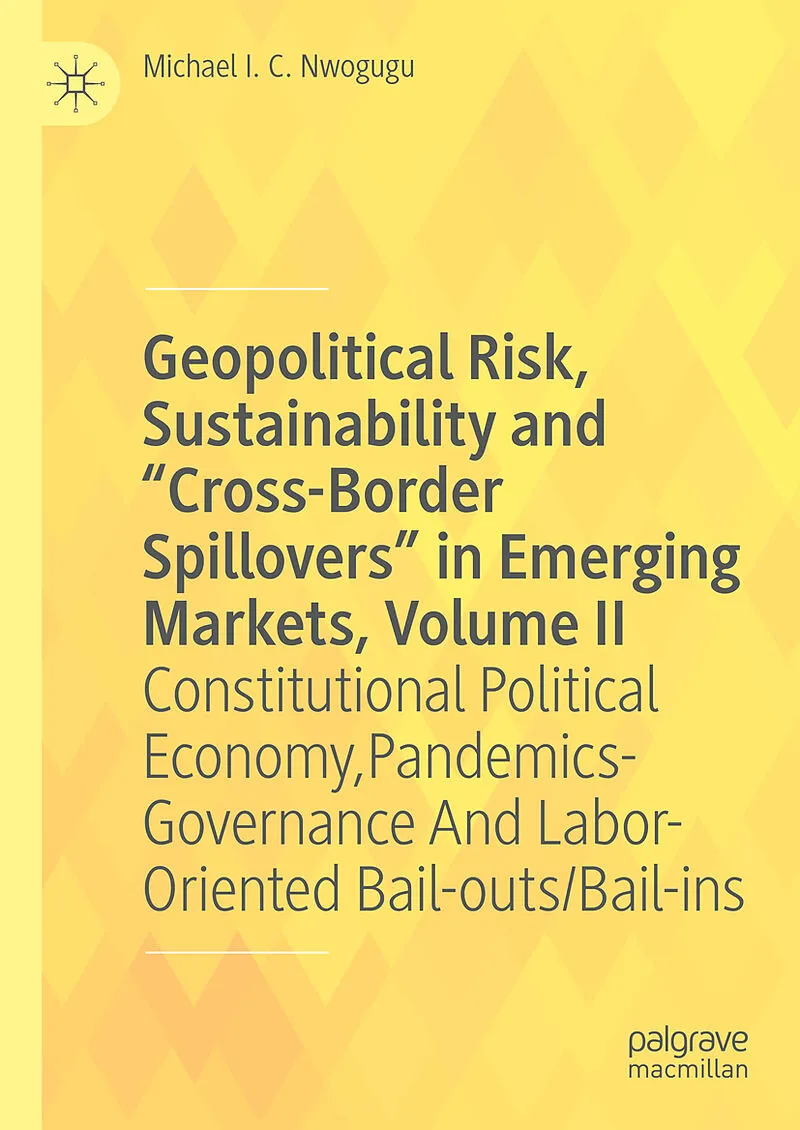
Geopolitical Risk, Sustainability and "Cross-Border Spillovers" in Emerging Markets, Volume II
Beschreibung
Many emerging market countries are increasingly affected by their "informal economies", geopolitical risks, U.S. dollar dynamics, legal/regulatory institutions, preferential trade agreements (PTAs), social networks, international labor dynamics, cross-border ...Format auswählen
- E-Book (pdf)CHF 95.10
- Fester EinbandCHF 155.20
- Kartonierter EinbandCHF 121.20

Wird oft zusammen gekauft
Andere Kunden kauften auch
Beschreibung
Many emerging market countries are increasingly affected by their "informal economies", geopolitical risks, U.S. dollar dynamics, legal/regulatory institutions, preferential trade agreements (PTAs), social networks, international labor dynamics, cross-border spillovers (from developed countries to emerging markets; including Regulatory Spillovers), constitutional political economy crises (such as those that occurred in Europe, Asia, Africa and the U.S. during 2007-2020, including the COVID-19 pandemic) and inefficient microfinance. Due to these phenomena, enforcement commitment, compliance costs, sustainable growth, quality-of-life, political stability, financial stability, household economics, inequality and international trade outcomes can vary drastically across emerging markets countries. The COVID-19 pandemic has exposed many problems inherent in political systems, economic policy, Sustainability Policy, Social Welfare systems and governments' emergency powers during pandemics/epidemics and economic/financial crisis.
These foregoing issues are the geopolitical risk context of this second volume. This book also introduces complex systems theories of the "Beliefs" of government and corporate actors. Thus, this book can help researchers to develop better Artificial Intelligence, Complex Systems and decision-theory models of geopolitical risk, public policy, asset-pricing, corporate strategy, labor markets and international capital flows, all of which can be critical decision factors for investment managers, corporate executives and government officials.
Michael I. C. Nwogugu is an author, serial entrepreneur and consultant who has held senior management, Board of Director and Advisory Board Member positions in companies in the U.S., Barbados, France, India and Nigeria. Mr. Nwogugu has written eight books: Risk In the Global Real Estate Market (2012); Illegal File-sharing Networks, Digital Goods Pricing And Decision Analysis (2016); Anomalies In Net Present Value, Returns And Polynomials; And Regret Theory In Decision-Making (2017); Indices, Index Funds And ETFs - Exploring HCI, Nonlinear Risk And Homomorphisms (2019); Complex Systems, Multi-Sided Incentives And Risk Perception In Organizations (2019); Earnings Management, Fintech-Driven Incentives and Sustainable Growth: On Complex Systems, Legal and Mechanism Design Factors (2020) and Complex Systems and Sustainability in the Global Auditing, Consulting, and Credit Rating Agency Industries (2021). Mr. Nwogugu's research articles have been cited in more than 20 top science journals. Mr. Nwogugu earned degrees from the University of Nigeria (Nigeria); City College of New York (USA); and Columbia University's Graduate Business School (USA).
Autorentext
Michael I. C. Nwogugu is an author, serial entrepreneur and consultant who has held senior management, Board of Director and Advisory Board Member positions in companies in the U.S., Barbados, France, India and Nigeria. Mr. Nwogugu has written eight books: Risk In the Global Real Estate Market (2012); Illegal File-sharing Networks, Digital Goods Pricing And Decision Analysis (2016); Anomalies In Net Present Value, Returns And Polynomials; And Regret Theory In Decision-Making (2017); Indices, Index Funds And ETFs - Exploring HCI, Nonlinear Risk And Homomorphisms (2019); Complex Systems, Multi-Sided Incentives And Risk Perception In Organizations (2019); Earnings Management, Fintech-Driven Incentives and Sustainable Growth: On Complex Systems, Legal and Mechanism Design Factors (2020) and Complex Systems and Sustainability in the Global Auditing, Consulting, and Credit Rating Agency Industries (2021). Mr. Nwogugu's research articles have been cited in more than 20 top science journals. Mr. Nwogugu earned degrees from the University of Nigeria (Nigeria); City College of New York (USA); and Columbia University's Graduate Business School (USA).
Klappentext
Many emerging market countries are bank-based economies and are increasingly affected by geopolitical risks, U.S. dollar dynamics, regulations, preferential trade agreements (PTAs), MNCs (that often function like international organizations), social networks, labor dynamics, cross-border spillovers and the inefficient expansion of formal/informal microfinance. Country risks, informal economies (that account for 20-50 percent of the national economy of many emerging market countries), investor protection, enforcement commitment, compliance costs, sustainability (environmental, social, economic and political sustainability), economic growth, political stability, financial stability, geopolitical risk, social networks, household economics, inequality and international trade outcomes can vary dramatically across many DECs and LDECs due to these phenomena. The COVID-19 pandemic has illustrated the many problems inherent in political systems, economic policy and governments' emergency powers during pandemics/epidemics and economic/financial crisis. This second volume focuses on geopolitical risks that are intertwined with constitutional political economy and labor issues, alongside addressing some of the financial and constitutional crises that occurred in Europe, Asia and the U.S. during 2007-2020. This book provides analysis of complex systems and the preferences and reasoning of state/government and corporate actors in order to develop better artificial intelligence and decision-system models of geopolitical risk, public policy and international capital flows, all of which are increasingly important decision factors for investment managers, boards-of-directors and government officials.
Inhalt
Chapter 1. IntroductionChapter 2. Sustainable Growth, Financial Stability and the Failure/Unconstitutionality of the Dodd-Frank Act (USA) (and Similar Statutes Such as the Pre-2020 European Union Sustainable Growth Regulations)Chapter 3. Economic Psychology, Geopolitical Risk and The Unconstitutionality of Private-Sector Credit RatingAgencies, Ratings Opinions and Government Bailouts/Bail-insChapter 4. International Constitutional Political Economy and Sustainability Issues Inherent in Accounting andDerivatives Standards-Setting OrganizationsChapter 5. Unconstitutionality and Failure of Sarbanes-Oxley Act, and the PCAOB (USA) and Similar InstitutionsChapter 6. Complex Systems, Pandemics/Epidemics and the Welfare-State,Part-1: "Policy-Contagion" And Cross-Border SpilloversChapter 7. Complex Systems, Pandemics and the Welfare State,Part-2: Constitutional Political Economy, Complianceand Constitutional Contagion Issues