Beschreibung
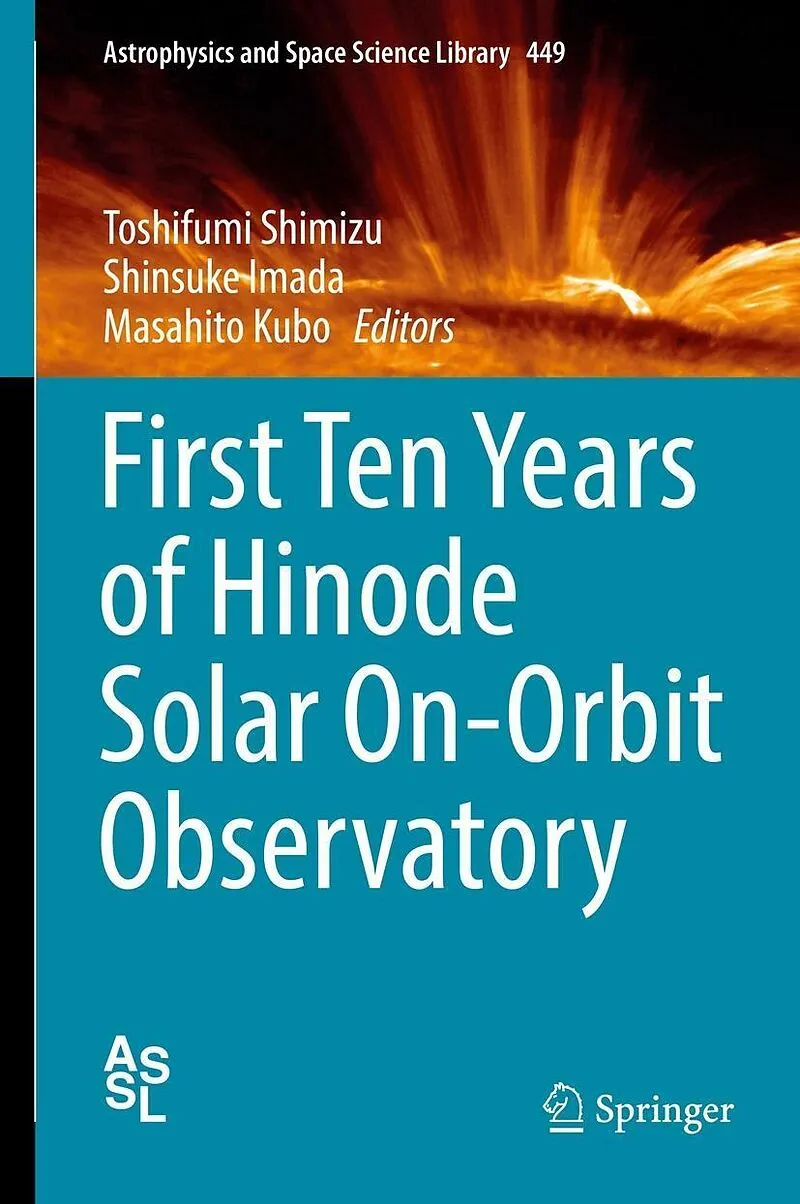
This book provides the latest scientific understanding of the Sun, sharing insights gleaned from the international solar physics project Hinode. The authors (who are the main project contributors) review, from the various viewpoints, the discoveries and advan...This book provides the latest scientific understanding of the Sun, sharing insights gleaned from the international solar physics project Hinode. The authors (who are the main project contributors) review, from the various viewpoints, the discoveries and advances made by the on-orbit operations of the Hinode spacecraft in its first decade. Further, they present a wealth of scientifically important photographs and data from Hinode.Launched in September 2006, Hinode is the third Japanese solar observatory on orbit, and employs three highly advanced telescopes jointly developed and operated with international partners. The book describes the background of these research topics, how the Hinode telescopes have tackled various challenges, and the scientific achievements and impacts in the first 10 years. Furthermore, it explores future perspective of researches in Japan.
The book will benefit undergraduate students interested in recent advance in the solar research, as well as graduate students and researchers working in solar physics, the space sciences, astronomy, and plasma physics.
Autorentext
Professor Toshifumi Shimizu
Toshifumi Shimizu is an associate professor at the Institute of Space and Astronautical Science, Japan Aerospace Exploration Agency. He received his doctor of science degree from the University of Tokyo in 1995 and was awarded the Zeldovich Medal in 2002 by the Russian Academy of Science and Committee on Space Research.
His work primarily focuses on solar physics and the development of space-borne instruments and spacecrafts. In particular, his research interest is in the phenomena on solar atmosphere such as solar flares and corona heating. Professor Shinsuke Imada Shinsuke Imada is an assistant professor at the Institute for Space-Earth Environmental Research, Nagoya University. He received his Ph.D. from the University of Tokyo's Department of Earth and Planetary Science in 2006. After serving as a researcher at National Astronomical Observatory of Japan, and as a project researcher at Institute of Space and Astronautical Science, Japan Aerospace Exploration Agency, he was appointed to his present position in 2012.
Prof. Imada's work mainly focuses on magnetic reconnection in the solar corona and also geomagnetic tail. Dr. Masahito Kubo Masahito Kubo is an assistant professor at the National Astronomical Observatory of Japan. He received his Ph.D. from the University of Tokyo's Department of Astronomy in 2005. After serving as a project researcher at the Institute of Space and Astronautical Science, Japan Aerospace Exploration Agency, and as a Post Graduate Scientist at the High Altitude Observatory, he was appointed to his present position in 2010.
Dr. Kubo's research mainly focuses on the solar magnetism as well as the development of space-born instruments.
Inhalt
Part I Reviews on 10 Years of Hinode
A Brief History of Hinode Toward the Success in Orbit
1 Birth of Hinode
2 Instrument Overview
3 Science Achievements
4 International Collaboration
5 As On-Orbit Solar Observatory
6 Ups and Downs in Operations
7 Future Prospects
References
Hinode's Contributions to Solar Physics
1 High Resolution Observation of the Sun in the Visible Wavelengths
2 Discovery of Various Waves and Corona Heating 3 Active Region Outflows and the Solar Wind
4 Outlook for the Future
References
Ten-Year Results of Solar Optical Telescope (SOT) Onboard Hinode
1 Scientific Objectives of Solar Optical Telescope
2 Resolution of Photospheric Magnetic Structures in Quiet Sun 3 Resolution of Dynamical Phenomena in the Chromosphere
4 Summary
References
X-ray Telescope (XRT) aboard Hinode: Key instrumental features and scientific highlights
1 Scientific Background of XRT and Key Instrumental Features
2 Some Scientific Highlights from XRT 3 Summary
References
Solar Extreme Ultraviolet Spectroscopy: zur NachEISzeit
1 EISberg before Hinode (Sunrise)
2 Ice-breaking (EISbrechend) scientific problems
3 Scientific objectives for post-gracial age (NachEISzeit)
References
Part II Coronal Heating and Solar Wind
Coronal Heating: issues revealed from Hinode observations
1 Introduction
2 Before the birth of Hinode
3 From Yohkoh to Hinode 4 Achievements by Hinode on Coronal Heating
5 Concluding Remarks
References
Importance of MHD Waves Observed with Hinode
1 Introduction
2 Discoveries of waves
3 Energy flux estimation using numerical simulation
4 Estimation of magnetic field using MHD waves
5 Waves or mass loss?
6 Summary
References
Hinode Investigations of Microflares and Nanoflares
1 Small flares in the Sun
2 Physical processes of microflares and nanoflares
3 Investigating signatures of unresolved nanoflares
4 Summary and future observations
References
The Origin of the Solar Wind
1 Introduction
2 Fast Wind
3 Slow Wind
4 Future Prospects
References
Part III Magnetism of Solar Atmosphere
New Insights into Sunspots through Hinode Observations
1 Sunspot Studies before Hinode
2 Sunspot Fine-scale Structures
3 Sunspot Formation
4 Sunspot Decay
5 Future Works
References
Three-Dimensional Coronal Magnetic Field Based on the Photospheric Magnetic Field by Hinode/SP Observation
1 Introduction 2 Nonlinear Force-Free Field Extrapolation
3 NLFFF Extrapolation Based on the Observed Magnetic Field
4 Current State and Future
References
New Approach to Solar Flare Trigger Process with Hinode/Solar Optical Telescope
1 Solar Flare Trigger Problem 2 Flare-triggering Structure Observed by Hinode/SOT
3 Future Direction
References
Hinode Observations of Flows and Heating Associated with Magnetic Reconnection during Solar Flares
1 Introduction
2 Flows
3 Heating
4 Conclusions and Future Prospects
References
The First Decade of Hinode: understanding Coronal Mass Ejections
1 Introduction 2 The build-up to a CME</p&g...