Beschreibung
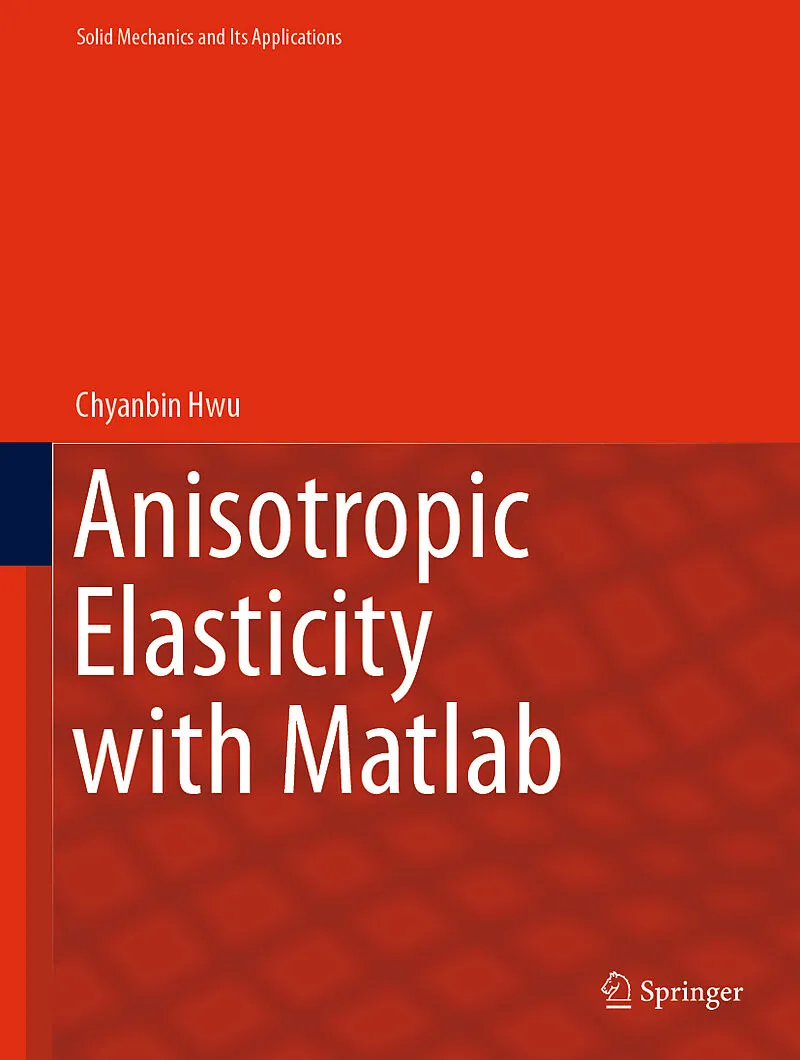
This book provides the theory of anisotropic elasticity with the computer program for analytical solutions as well as boundary element methods. It covers the elastic analysis of two-dimensional, plate bending, coupled stretching-bending, and three-dimensional...This book provides the theory of anisotropic elasticity with the computer program for analytical solutions as well as boundary element methods. It covers the elastic analysis of two-dimensional, plate bending, coupled stretching-bending, and three-dimensional deformations, and is extended to the piezoelectric, piezomagnetic, magnetic-electro-elastic, viscoelastic materials, and the ones under thermal environment. The analytical solutions include the solutions for infinite space, half-space, bi-materials, wedges, interface corners, holes, cracks, inclusions, and contact problems. The boundary element solutions include BEMs for two-dimensional anisotropic elastic, piezoelectric, magnetic-electro-elastic, viscoelastic analyses, and their associated dynamic analyses, as well as coupled stretching-bending analysis, contact analysis, and three-dimensional analysis. This book also provides source codes and examples for all the presenting analytical solutions and boundary element methods. Theprogram is named as AEPH (Anisotropic Elastic Plates - Hwu), which contains 204 MATLAB functions.
Autorentext
Chyanbin Hwu obtained his B.S. degree of Civil Engineering from National Taiwan University in 1981, M.S. degree of Power Mechanical Engineering from National Tsing-Hua University in 1985, and Ph.D. degree of engineering mechanics from University of Illinois at Chicago in 1988. He joined Department of Aeronautics and Astronautics, National Cheng Kung University, Taiwan, as an associate professor in 1988, became a full professor in 1992 and a distinguished professor in 2003, and a chair professor since 2008. He was elected to be the president of the Society of Theoretical and Applied Mechanics (R.O.C.) in 2008. He is a fellow of the Aeronautical and Astronautical Society (R.O.C.), and the Society of Theoretical and Applied Mechanics (R.O.C.). He was the recipient of academic award (Ministry of Education, R.O.C.) in 2014, Sun Fang-Duo medal in 2011, and outstanding research awards (National Science Council, R.O.C.) in 1995-1996, 1998-1999, 2002-2004. He served as member of editorial board for International Journal of Solids and Structures in 2000-2005, editorial advisor for Journal of Mechanics of Materials and Structures in 2005-2015, and associated editor for Transactions of JSASS (The Japan Society for Aeronautical and Space Sciences) in 2014-present. He has published 114 referred journal papers, authored 1 book and 3 book chapters, edited 4 books, and presented 151 conference papers. His current research interests include mechanics of composite materials, fracture mechanics, anisotropic elasticity, and nanomaterials.
Inhalt
Chapter 1: Anisotropic Elasticity
1.1 Theory of Elasticity
1.2 Linear Anisotropic Elastic Materials
1.2.1 Three-Dimensional Constitutive Relations
1.2.2 Two-Dimensional Constitutive Relations
1.2.3 Laminate Constitutive Relations
1.3 Thermoelastic Problems 1.4 Piezoelectric Materials
Chapter 2: Complex Variable Formalism
2.1 Two-Dimensional Analysis
2.1.1 Lekhnitskii Formalism 2.1.2 Stroh Formalism
2.1.3 Extended Stroh Formalism for Thermoelastic Problems
2.1.4 Expanded Stroh Formalism for Piezoelectric Materials
2.2 Plate Bending Analysis 2.2.1 Lekhnitskii Bending Formalism
2.2.2 Stroh-Like Bending Formalism
2.3 Coupled Stretching-Bending Analysis
2.3.1 Stroh-Like Formalism
2.3.2 Extended Stroh-Like Formalism for Thermal Stresses in Laminates
2.3.3 Expanded Stroh-Like Formalism for Electro-Elastic Laminates
2.4 Explicit Expressions 2.4.1 Fundamental Matrix N
2.4.2 Material Eigenvector Matrices A and B
2.4.3 Barnett-Lothe Tensors S, H and L
2.5 General Remarks
2.5.1 Degeneracy of Material Eigenvectors
2.5.2 Units, Scaling Factors, and Dimensions 2.5.3 Sign Convention
2.5.4 Common Symbols
2.5.5 Extended Symbols
**** Chapter 3: Computer Program with Matlab 3.1 Program Structures
3.1.1 Computational Procedure
3.1.2 Control Parameters
3.1.3 Global Variables
3.1.4 Input
3.1.5 Output
3.2 Main Program and Functions
3.2.1 Main program
3.2.2 Function Description
3.3 Input and Calculation of Material Properties
3.3.1 Function - elastic
3.3.2 Function - thermal
3.3.3 Function - piezoM
3.4 Calculation of Material Eigenvalues and Eigenvectors
3.4.1 Function - material_eigen
3.4.2 Function - thermal_eigen
3.5 Calculation of Analytical Solutions
3.5.1 Function - internal, positionTime
3.5.2 Function - uphi_bank
3.6 Functions for Double Check
3.6.1 Function piezo2, piezoM2
3.6.2 Function - fundamental_N
3.6.3 Function - eigen_muAB
3.6.4 Function identities
3.7 Functions for Output
3.7.1 Function output_caption
3.7.2 Function - printTF
3.7.3 Function TableFig, TableFig3D
3.8 Examples
3.8.1 Elastic Properties
3.8.2 Thermal Properties
3.8.3 Piezoelastic Properties Chapter 4: Infinite Space, Half Space and Bi-materials 4.1 Infinite Space
4.1.1 Uniform Load - s411infUL
4.1.2 Inplane Bending - s412infIB
4.1.3 Point Force - s413infPF
4.1.4 Point Moment - s414infPM 4.1.5 Dislocation - s415infD...