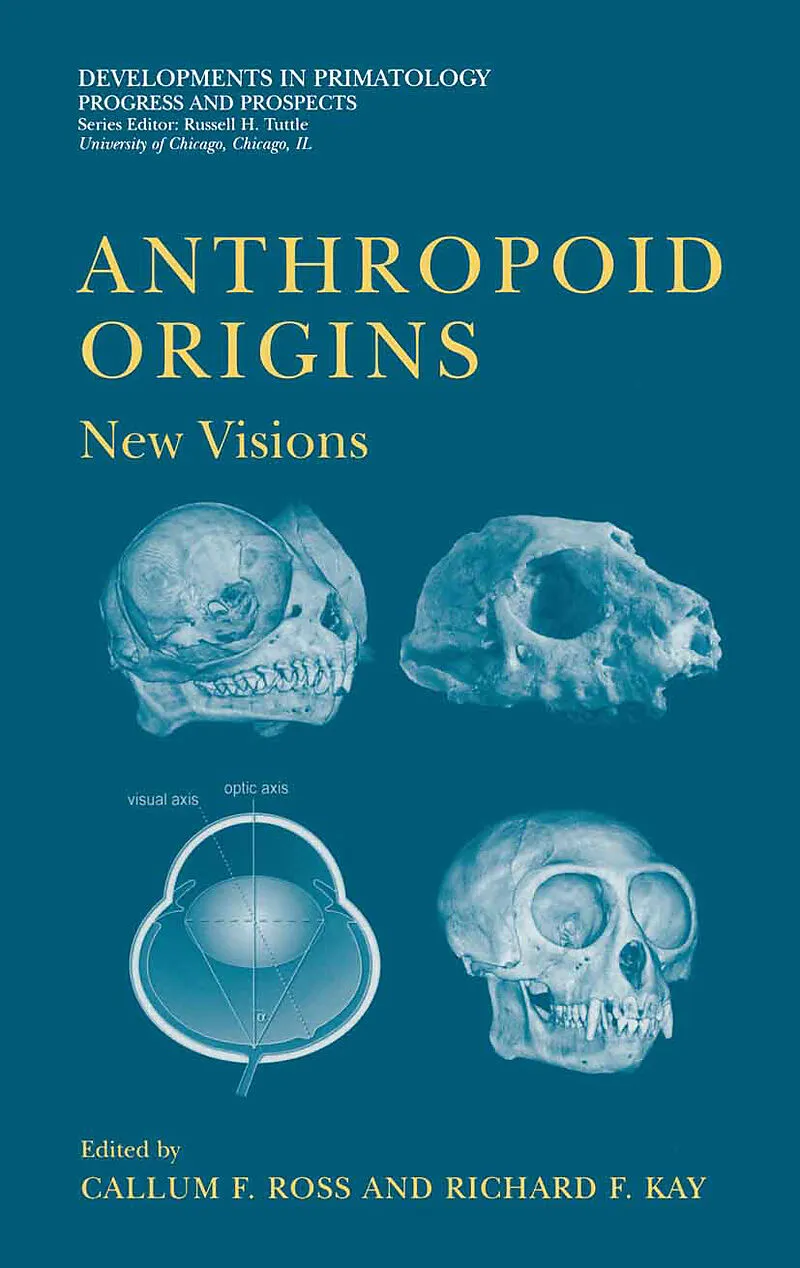
Anthropoid Origins
Beschreibung
Zur Zeit liegt uns keine Inhaltsangabe vor. Klappentext Zur Zeit liegt uns keine Inhaltsangabe vor. Inhalt 1: Introduction.- 1. Evolving Perspectives of Anthropoidea.- Essentialism.- Rationalism.- Parallelism.- "Intentional Vagueness".- Phylogenetic Hypothese...Format auswählen
- E-Book (pdf)CHF 59.90
- Kartonierter EinbandCHF 105.10

Wird oft zusammen gekauft
Andere Kunden kauften auch
Beschreibung
Zur Zeit liegt uns keine Inhaltsangabe vor.
Klappentext
Zur Zeit liegt uns keine Inhaltsangabe vor.
Inhalt
1: Introduction.- 1. Evolving Perspectives of Anthropoidea.- Essentialism.- Rationalism.- Parallelism.- "Intentional Vagueness".- Phylogenetic Hypotheses: From Vagueness to Precision.- Is Anthropoidea a Monophyletic Group, and what are its Synapomorphic Features?.- To which Group of Fossil or Extant Primates is Anthropoidea most Closely Related?.- Are there Asian Eocene Anthropoids?.- Origins of Crown Anthropoids.- Adaptive Explanations for Anthropoid Origins.- Cartmill.- Cachel.- Rosenberger.- Ross.- Hylander and Ravosa.- Function and Phylogeny in Anthropoid Evolution.- Acknowledgments.- References.- 2: Anthropoid Evolutionary Relationships.- Molecular Phylogeny and Dating of Early Primate Divergences.- The Position of Primates in the Mammalian Tree.- Phylogeny and Dating of Early Primate Divergences.- Methods.- Results and Discussion.- Phylogenetic Position of Tarsiers.- Dating of Early Primate Divergences.- Conclusions.- Acknowledgments.- References.- Molecular Cladistic Markers and the Infraordinal Phylogenetic Relationships of Primates.- Tarsins: A Disputed Split in Primate Phylogeny.- Retropositions as Molecular, Cladistic, Phylogenetic Markers.- Mechanism of SINE Retroposition.- Functional Consequences of SINE Retropositions.- Chromosomal Target Sites.- Reversal of Retropositions.- SINE Fixation and Lineage Sorting.- SINEs as Evolutionary Landmarks.- Direct Repeats.- Alu-SINE Markers and Primate Evolution.- Origin and Nomenclature.- Alu Subfamilies: Successive Waves of Fixation.- Alu-SINEs and Primate Infraorders.- Screening of Human GenBank Entries.- PCR-Amplification and Sequencing.- Verification of Orthology and Independence.- Infraordinal Relationships of Primates and Alu-SINE Distribution.- References.- The Ancestral Genomes in Primate Phylogeny and Origins: A Molecular Cytogenetic Perspective.- Chromosome Painting in Primates.- Old World Monkeys and Apes.- New World Monkeys.- Strepsirrhines.- Tree Shrews.- Conclusions.- Ancestral Placental Mammalian Karyotype.- Ancestral Primate Karyotype.- Genomic Landmarks for the Origin of the Principal Divisions of Higher Primates.- The Genome of the Tarsier and Anthropoid Origins.- Comparative Chromosome Painting and Gene Mapping.- References.- Anthropoid Origins: A Phylogenetic Analysis.- Questions Surrounding Anthropoid Origins.- Is Anthropoidea a Monophyletic Group, and if so what are its Synapomorphic Features?.- To which Group of Fossil or Extant Primates is Anthropoidea most Closely Related?.- How do Asian Eocene Taxa (Eosimiidae and Amphipithecidae) Relate to Anthropoidea?.- How do Eocene and Oligocene African Anthropoids Relate to Platyrrhini and Catarrhini?.- Materials and Methods.- Characters.- Taxa.- Analyses.- Assumptions and Data Combinations.- Taxonomic Terminology.- Results.- Is Anthropoidea a Monophyletic Group?.- To which Group of Fossil or Extant Primates is Anthropoidea most Closely Related?.- How do Asian Eocene Amphipithecidae Relate to Anthropoidea?.- Other Problematic Anthropoids.- How do Parapithecidae, Propliopithecidae, and Oligopithecidae Relate to the Platyrrhini and Catarrhini?.- Preferred Tree.- Comparisons with Other Phylogenetic Analyses.- Geography.- Timing of the Branching of the Primate Clades.- Character Evolution.- Acknowledgments.- References.- 3: Fossil Anthropoids and the Biogeography of Anthropoid Origins.- Does Overlap Among the Adaptive Radiations of Omomyoids, Adapoids, and Early Anthropoids Cloud our Understanding of Anthropoid Origins?.- Adaptive Diversity of Early Primate Radiations.- Omomyoid Adaptive Radiation.- Adapoid Adaptive Radiation.- Eocene Anthropoid Adaptive Radiation.- Early Oligocene Anthropoids.- Discussion.- Tarsal Anatomy and Anthropoid Origins.- Evaluating Newly Proposed Anthropoid Synapomorphies.- Conclusions.- Acknowledgments.- References.- 7. Phylogenetic, Biogeographic, and Adaptive Implications of New Fossil Evidence Bearing on Crown Anthropoid Origins and Early Stem Catarrhine Evolution.- Oligopithecus, Catopithecus, and the Perennial Problem of Catarrhine Origins : A Brief History.- New Phylogenetic Evidence from Fayum Anthropoid Postcrania.- Changing Conceptions of the Crown Anthropoid Morphotype.- Character Transformation and Adaptation in Early Catarrhine Evolution.- Biogeography of Early Crown Anthropoid Evolution.- Anthropoid Origins: Comments on the Role of Afro-Arabia.- Acknowledgments.- Appendix 1: Step-Matrix for Biogeographic Character.- References.- 8. The Cranium and Adaptations of Parapithecus grangeri a Stem Anthropoid from the Fayum Oligocene of Egypt.- The Material.- Cranium.- Convergence.- Frontation.- Basicranial Flexion.- Postorbital Closure.- Mandible, Dentition, and Dental function.- Postcranium.- Body Size and Brain Volume.- Discussion and Conclusions.- Acknowledgments.- References.- 9. The Primate-Bearing Pondaung Formation in the Upland Area, Northwest of Central Myanmar.- Stratigraphy.- Pondaung Formation.- The Lower Member.- The Upper Member.- Summary on the Age of the Pondaung Formation.- Evidence from Microfauna and Flora.- Stratigraphic and Faunal Evidences.- Magnetostratigraphic Results.- Dating by Fission-Track Analysis.- The Primate Horizons of the Pondaung Formation.- Acknowledgments.- References.- 10. A Review of the Large-Bodied Pondaung Primates of Myanmar.- The Pondaung Formation.- Pondaungia.- History of Discovery.- History of Study.- Pondaungia cotteri.- Pondaungia minuta.- Amphipithecus.- History of Discovery.- History of Study.- Age of the Pondaung Primates.- Phylogenetic Relationships.- Conclusions.- References.- 11. Eocene Large-Bodied Primates of Myanmar and Thailand: Morphological Considerations and Phylogenetic Affinities.- Who, Where, and When.- Myanmar.- Primates.- Biochronology and Geochronology.- Thailand.- Primates.- Biochronology and Geochronology.- Morphology.- Dental Characteristics.- Cranial Morphology.- Postcranial Morphology.- Postcranial Comparisons.- Functional Convergence.- Hard-Object Feeding.- Phylogenetic Implications.- Acknowledgments.- References.- 12. The Pondaung Primates, Enigmatic "Possible Anthropoids" from the Latest Middle Eocene, Central Myanmar.- Geological Ages and Fossil Localities.- Recently Discovered Specimens of the Pondaung Primates.- Maxillary Specimen of Pondaungia.- First Maxillary and Frontal Specimens of Amphipithecus.- Myanmarpithecus yarshensis.- "Paukkaung molar," a New Primate or Miacid Carnivore?.- Discussion.- Definition of the Amphipithecidae.- Phyletic Position of the Amphipithecidae: Is it a Notharctine?.- The Validity of the "Amphipithecidae": Are They Closely Related to Each Other?.- East Asia as a Stage for the Evolution of Eocene Primates.- Summary.- Acknowledgments.- References.- The Morphology of Two Maxillae of Pondaung Primates (Pondaungia cotteri and Amphipithecus mogaungensis) (middle Eocene, Myanmar).- Morphology of the Maxilla.- Pondaungia cotteri (NMMP-KU0003).- Maxillary Body.- Maxillary Sinus.- Amphipithecus mogaungensis (NMMP-KU0228 a).- Maxillary Body.- Maxillary Sinus.- The Comparative Morphology of the Maxilla in Primates.- Prosimians.- Extant Prosimians.- Fossil Prosimians.- Anthropoids.- Platyrrhines.- Catarrhines.- Comparison and Discussion.- Acknowledgments.- References.- Siamopithecus eocaenus, Anthropoid Primate from the Late Eocene of Krabi, Thailand.- Geology, Fauna, and Age of Krabi Locality.- Siamopithecus eocaenus Chaimanee et al. (1997).- TF 3635: Right Maxilla with P3-M3.- TF 3634: Right Lower Jaw Fragment with Distal, ml-m3.- TF 7624: Right Lower Jaw with Canine, P3-M3.- Comparison.- Siamopithecus Compared to Pondaungia.- Siamopithecus Compared to Amphipithecus.- Siamopithecus Compared to Bahinia.- Siamopithecus Compared to Myanmarpithecus.- Phylogenetic Relationships.- Conclusion.- Acknowledgments.- References.- 15. Anthropoid Origins: Postcranial Evidence from the E…


