Beschreibung
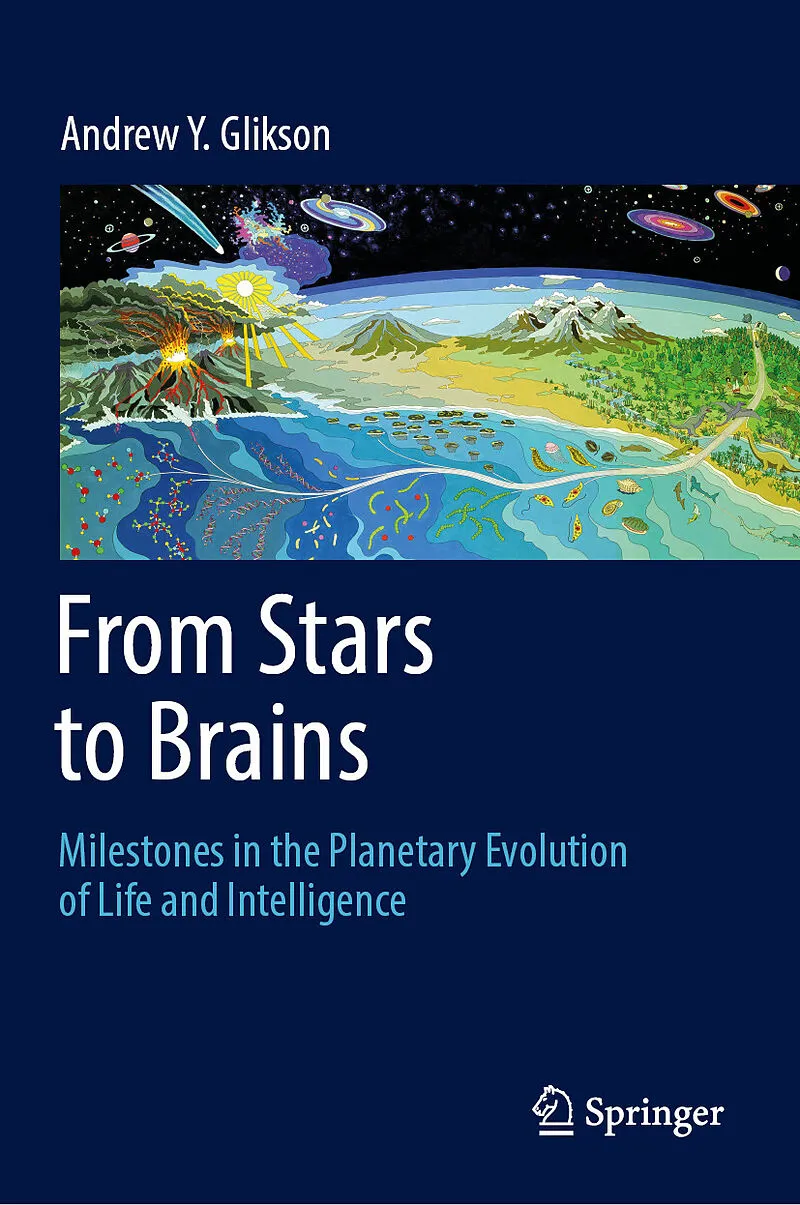
The permutation of basic atoms-nitrogen, hydrogen, oxygen, carbon and phosphorus into the biomolecules DNA and RNA, subsequently evolved in cells and brains, defining the origin of life and intelligence, remains unexplained. Equally the origin of the genetic ...The permutation of basic atoms-nitrogen, hydrogen, oxygen, carbon and phosphorus into the biomolecules DNA and RNA, subsequently evolved in cells and brains, defining the origin of life and intelligence, remains unexplained. Equally the origin of the genetic information and the intertwined nature of 'hardware' and 'software' involved in the evolution of bio-molecules and the cells are shrouded in mystery. This treatise aims at exploring individual and swarm behaviour patterns which potentially hint at as yet unknown biological principles. It reviews theories of evolution with perspectives from the earth sciences, commencing with the earliest observed records of life. This is followed by reviews and discussion of the building blocks of life, marine and terrestrial communities, the arthropods, birds and finally humans. It is suggested that, further to the mutation/natural selection processes established by Darwin and Wallace, an understanding of the evolution of intelligence remains little understood. A directionality of evolutionary trajectories is evident, not least the purposeful thinking process of humans as well as animals. It is not clear how directional intelligence, manifested for example by the collective intelligence of arthropod colonies, has evolved from mutation/natural selection processes. Potential clues for the understanding of life and evolution are provided by Aristotle's dictum of "the whole being greater than the sum of the parts", Niels Bohr's principle of quantum complementarity and George Ellis' theory of top-down causality. Inherent in the question of the origin of life is an anthropocentric bias, related to the self-referential Anthropic Principle and theological paradigms of man's supposed dominion over all other species. The Anthropic Principle, however, should be capable of being circumvented using the scientific falsification method, assuming universal verified constants of physics. The phenomenon of thehuman mastery of fire and the splitting of the atom, leading to the seventh major mass extinction of species, remains incomprehensible.
Autorentext
Andrew Yoram Glikson, an Earth and paleo-climate scientist at the Australian National University, studied geology at the University of Jerusalem and graduated at the University of Western Australia. He conducted geological surveys of the oldest geological formations in Australia, South Africa, India and Canada, underpinning the effects of large asteroid impacts, including their effects on the atmosphere and oceans and the mass extinction of species. Since 2005 he studied the relations between climate and human evolution.
Klappentext
The permutation of basic atomsnitrogen, hydrogen, oxygen, carbon and phosphorus?into the biomolecules DNA and RNA, subsequently evolved in cells and brains, defining the origin of life and intelligence, remains unexplained. Equally the origin of the genetic information and the intertwined nature of 'hardware' and 'software' involved in the evolution of bio-molecules and the cells are shrouded in mystery. This treatise aims at exploring individual and swarm behaviour patterns which potentially hint at as yet unknown biological principles. It reviews theories of evolution with perspectives from the earth sciences, commencing with the earliest observed records of life. This is followed by reviews and discussion of the building blocks of life, marine and terrestrial communities, the arthropods, birds and finally humans. It is suggested that, further to the mutation/natural selection processes established by Darwin and Wallace, an understanding of the evolution of intelligence remains little understood. A directionality of evolutionary trajectories is evident, not least the purposeful thinking process of humans as well as animals. It is not clear how directional intelligence, manifested for example by the collective intelligence of arthropod colonies, has evolved from mutation/natural selection processes. Potential clues for the understanding of life and evolution are provided by Aristotle's dictum of the whole being greater than the sum of the parts, Niels Bohr's principle of quantum complementarity and George Ellis' theory of top-down causality. Inherent in the question of the origin of life is an anthropocentric bias, related to the self-referential Anthropic Principle and theological paradigms of man's supposed dominion over all other species. The Anthropic Principle, however, should be capable of being circumvented using the scientific falsification method, assuming universal verified constants of physics. The phenomenon of the human mastery of fire and the splitting of the atom, leading to the seventh major mass extinction of species, remains incomprehensible.
Inhalt
The Building blocks of intelligence
1.1 From a singularity to a bio-friendly universe
1.2 The second law of thermodynamics
1.3 The living enigma
1.4 Panspermia and transpermia
1.5 Evolution: Charles Darwin and Alfred Wallace
Milestones in early evolution
2.1 Early atmospheres and oceans
2.2 Early records of life
2.3 Mass extinctions of species
From the genetic code to collective brains 3.1 From amino acids to nucleic acids
3.2 The intelligent cell
3.3 The phylogenetic scheme
3.4 Marine and hydrothermal communities
3.5 Multicellular and colonial life
3.6 Evolution of the eye
4. Intelligent communities
4.1 Arthropod civilizations
4.2 The world of birds
4.3 Fire and the human mind
Directional thought and evolution
5.1 The anthropic principle
5.2 Swarm intelligence and collective minds
5.3 Evolution of the brain
5.4 The directional thought process
6. EpilogueFrom stars to brains