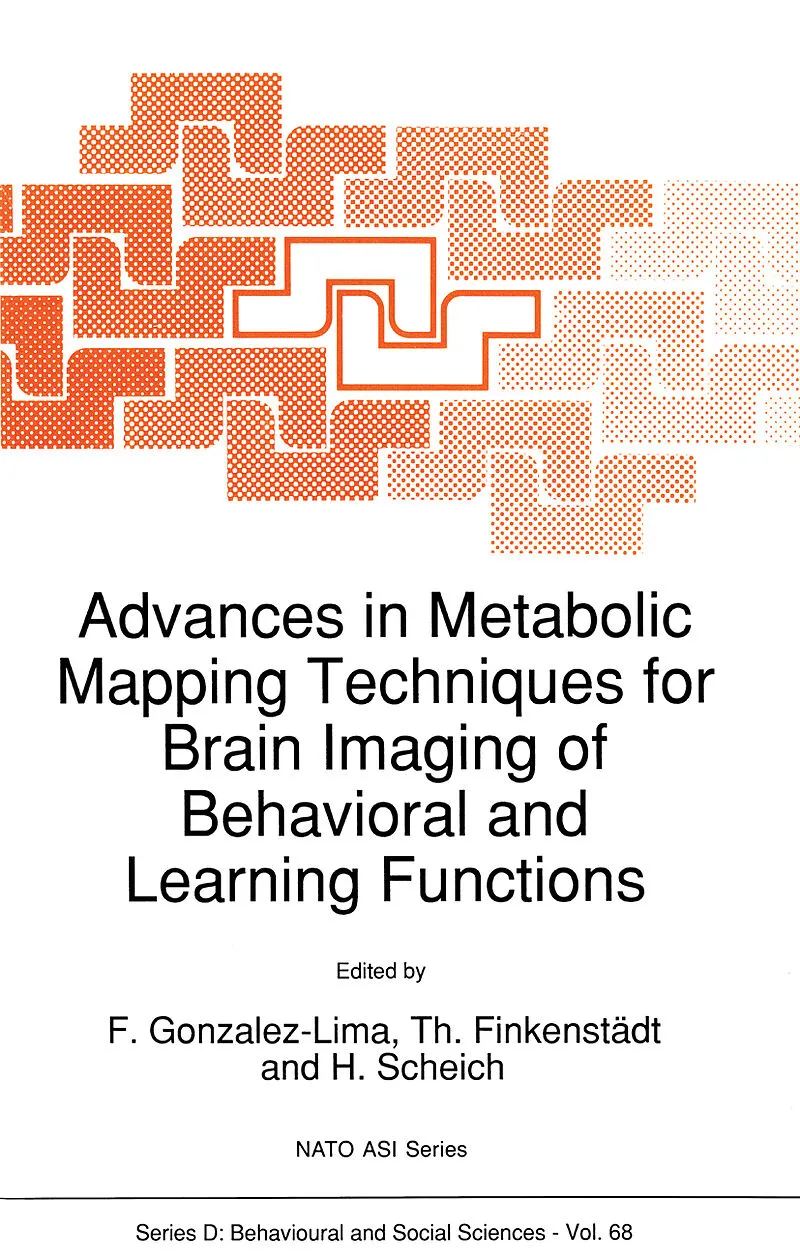
Advances in Metabolic Mapping Techniques for Brain Imaging of Behavioral and Learning Functions
Beschreibung
In recent years, revolutionary technical advances have permitted neuroscientists to map the functioning of the brain in exquisite detail. Of interest are the new techniques that visually display cell energy metabolism which is coupled to functional brain acti...Format auswählen
- E-Book (pdf)CHF 59.90
- Kartonierter EinbandCHF 112.80
Wird oft zusammen gekauft
Andere Kunden kauften auch
Beschreibung
In recent years, revolutionary technical advances have permitted neuroscientists to map the functioning of the brain in exquisite detail. Of interest are the new techniques that visually display cell energy metabolism which is coupled to functional brain activity in behaving animals.
This is the first book dealing with the application of 2-deoxyglucose and related metabolic mapping techniques for brain imaging of behavioral and learning functions. Quantitative autoradiographic techniques based on the use of exogenous markers include radiolabeled glucose and its analogs, especially 2-deoxyglucose and fluorodeoxyglucose. Other mapping techniques are based on the histochemical staining of endogenous metabolic markers such as cytochrome oxidase, as well as immunohistochemistry for expression of c-fos genes. In spite of the great potential capabilities of the new imaging techniques, relatively few neuroscientists are using this approach to study brain functions related to behavior. There is a need to review state-of-the-art applications of these methods in behavioral neuroscience, and to formulate recommendations for future research in this area. This book is intended to fulfill these needs by bringing together leading neuroscientists using metabolic mapping approaches to elucidate brain mechanisms of behavior. Discussions are not limited to one animal species, but they cover a broad range of vertebrates with unique behavioral capabilities.
Inhalt
I: Techniques.- Imaging Techniques in Studies of Neural Functions.- 1. Introduction.- 2. Local Cerebral Blood Flow.- 3. Local Cerebral Glucose Utilization.- 3.1. Theoretical Basis of Radioactive Deoxyglucose Method.- 3.2. Considerations in Design of Procedure.- 3.3. Experimental Procedure.- 3.4. Local Rates of Cerebral Glucose Utilization.- 3.5. The [18F]Fluorodeoxyglucose Technique.- 3.6. Metabolic Mapping of Local Functional Activity.- 4. Local Cerebral Protein Synthesis.- 4.1. Theory.- 4.2. Determination of ?i.- 4.3. Local Rates of Protein Synthesis in the Conscious Rat Brain.- 4.4. Applications of Autoradiographic L-[1-14C]Leucine Method.- 5. Miscellaneous Imaging Methods.- 6. References.- Brain Imaging of Auditory Learning Functions in Rats: Studies with Fluorodeoxyglucose Autoradiography and Cytochrome Oxidase Histochemistry.- 1. Introduction.- 1.1. Brain Imaging with Metabolic Mapping Techniques.- 1.2. Neuronal Activity in Sensory Systems is Modified by Learning.- 1.3. Metabolic Mapping Studies show Learning-Related Modifications in the Activity of the Auditory System.- 2. Principles of Fluorodeoxyglucose Autoradiography and their Applications for Neuroimaging of Learning Functions.- 2.1. Goals for FDG Autoradiographic Experiments.- 2.2. Transport and Uptake of FDG as a Glucose Analog.- 2.3. Tracer Specific Activity and Testing Conditions.- 2.4. Tissue Processing for FDG Autoradiography.- 2.5. Quantitative Analysis of FDG Autoradiographs.- 2.6. Procedure for FDG Quantitative Autoradiography.- 3. Application of FDG to the Study of Behavioral Habituation to an Auditory Stimulus.- 3.1. Short and Long-Term Habituation of the Acoustic Startle Reflex.- 3.2. Experimental Design and Methods.- 3.3. Effects on the Auditory System.- 3.4. Effects Outside the Auditory System.- 3.5. Model of the Neural Circuitry Related to Long-Term Habituation of the Acoustic Startle Reflex.- 4. Application of FDG to the Study of Differential Conditioning of Auditory Stimuli.- 4.1. Neural Effects of Sounds Differentially Associated with Appetitive and Aversive Unconditioned Stimuli.- 4.2. Experimental Design and Methods.- 4.3. Effects on the Auditory System.- 4.4. Effects Outside the Auditory System.- 4.5. Model of the Neural Circuitry Related to Differential Conditioning of Auditory Stimuli.- 5. Principles of Cytochrome Oxidase Histochemistry and their Applications for Neuroimaging of Learning Functions.- 5.1. Goals for CO Histochemical Experiments.- 5.2. The use of CO as an Endogenous Marker for Neuronal Function.- 5.3. CO Enzymology and Quantitative Histochemistry.- 5.4. Procedure for CO Quantitative Histochemistry.- 6. Application of CO Histochemistry to the Study of Learning Functions.- 6.1. Interassay Variability and Linearity for Group Comparisons.- 6.2. Learning-Related Increase in Metabolic Capacity.- 7. Conclusions.- 7.1. Application of FDG Autoradiography to Long-Term Habituation Revealed the Functional Brain Circuitry Mediating this Simple Form of Learning.- 7.2. Application of FDG Autoradiography to Differential Conditioning Revealed the Functional Brain Circuitry Mediating this Form of Discrimination Learning.- 7.3. Application of CO Histochemistry Revealed Long-Lasting Modifications in Metabolic Capacity Related to Chronic Learning.- 7.4. Learning-Related Changes are Distributed in Neural Systems with Specific Functional Contributions to Modify Behavior.- 8. Acknowledgements.- 9. References.- Mapping Sensorimotor Pathways in Rat Brain Using 2-Deoxyglucose Autoradiography and C-Fos Immunocytochemistry.- 1. Introduction-2-DG Studies of Thalamus.- 2. 2-DG Methods-Whisker Stimulation Following Cortical Lesions.- 3. Conclusions of 2-DG Studies.- 4. Introduction- c-fos Studies.- 5. Methods-Cortical Stimulation with c-fos and 2-DG.- 6. Results- c-fos and 2-DG.- 7. Conclusions.- 8. Comments on Quantitation of 2-DG and c-fos Studies.- 9. Acknowledgements.- 10. References.- Brain Metabolic Mapping and Behavior: Assessing the Effects of Early Developmental Experiences in Adult Animals.- 1. General Introduction.- 1.1. General Methodological Aspects.- 2. Study I: 14C-2-DG Autoradiography Under Normal vs. Challenge Conditions: Effects of Neonatal 6-OHDA Lesions and Rearing Environment.- 2.1. Methods.- 2.2. Results.- 2.3. Discussion.- 3. Study II: Effects of Prenatal Cocaine Exposure on Regional Brain Glucose Metabolism and Cytochrome Oxidase Histochemistry.- 3.1. Methods.- 3.2. Results.- 3.3. Discussion.- 4. General Conclusions.- 5. Acknowledgements.- 6. References.- High Resolution Autoradiographic Imaging of Brain Activity Patterns With 2-Deoxyglucose: Regional Topographic and Cellular Analysis.- 1. Introduction.- 2. Methods and Examples of Results.- 2.1. Animal Preparation for Injection of 2-DG.- 2.2. Improvement of Regional Topographic Resolution in 2-DG Studies.- 2.3. Cellular Resolution in 2-DG Studies.- 3. Consideration of the Time Course of 2-DG Studies.- 4. Quantitative Considerations in 5 Minutes 2-DG Studies.- 5. Summary and Conclusions.- 6. Acknowledgements.- 7. References.- Metabolic Mapping in the Hippocampus. Patterns of (14C)2-Deoxyglucose Uptake Within Different Fields of the Hippocampal Slice.- 1. Introduction.- 2. Material and Methods.- 2.1. Tissue Preparation.- 2.2. Electrophysiology.- 2.3. [14C]2-Deoxyglucose Incubation.- 2.4. Potassium Stimulation.- 2.5. Histology.- 2.6. Densitometric Analysis.- 3. Results.- 3.1. Comparison with Previous in vivo Results.- 3.2. Potassium Stimulation.- 4. Discussion.- 4.1. Potassium Stimulation.- 5. Acknowledgements.- 6. References.- Covariance Analysis of Functional Interactions in the Brain Using Metabolic and Blood Flow Data.- 1. Introduction.- 2. Methods.- 3. Examples of Correlational Analyses.- 3.1. Nucleus Basalis Magnocellularis Lesions in the Rat.- 3.2. Obsessive-Compulsive Disorder.- 3.3. Object and Spatial Vision in Humans.- 4. What are the Neurobiological Substrates ofInterregional Correlations?.- 5. Brain Network Modeling of Metabolic Data.- 5.1. The Model.- 5.2. Examples of Simulations.- 5.3. Data-Fitting and Combinations of Neural Models.- 6. Acknowledgements.- 7. References.- The Application of Structural Modeling to Metabolic Mapping of Functional Neural Systems.- 1. Introduction.- 2. General Method.- 2.1. Building a Model.- 2.2. Preparation of Data.- 2.3. Running the Analysis.- 2.4. Stacked Models.- 2.5. Theoretical Interpretation of the Model.- 3. Auditory System Model of Long-Term Habituation.- 3.1. Results.- 3.2. Discussion of Auditor…


