Beschreibung
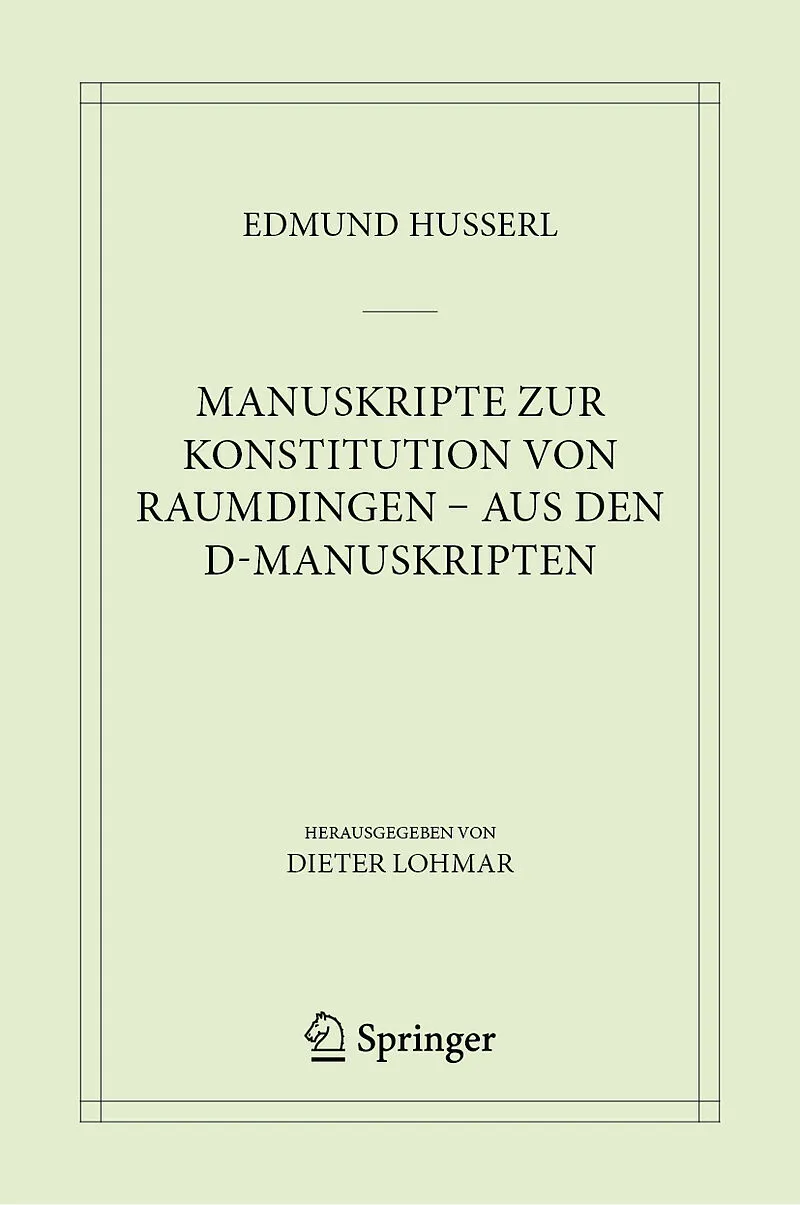
GERMAN INFOTEXT: Der vorliegende Band enthält Forschungsmanuskripte Husserls zur Konstitution von Raumdingen aus den Jahren 1909-1934, die aus der Manuskriptgruppe D unter thematischen und qualitativen Gesichtspunkten ausgewählt wurden. Die meisten Analysen s...
GERMAN INFOTEXT:
Der vorliegende Band enthält Forschungsmanuskripte Husserls zur Konstitution von Raumdingen aus den Jahren 1909-1934, die aus der Manuskriptgruppe D unter thematischen und qualitativen Gesichtspunkten ausgewählt wurden. Die meisten Analysen sollen die Themen der Vorlesung Ding und Raum (1906/07) vertiefen und weiterführen. Wie in dieser Vorlesung bilden die visuellen und taktuellen Sinnesfelder mit den regelhaft dazu gehörigen kinästhetischen Empfindungen den Ausgangspunkt der Analysen. Daran schließen sich Untersuchungen über die höheren Stufen der Konstitution des Raumes, des Phantoms und des Dinges in Abhängigkeit von den aufgestuften kinästhetischen Systemen an. Die Ordnung der Konstitution führt von einfachen zu komplexeren Kinästhesen: der Augen, des Kopfes, des Oberkörpers bis zum Gehen, das die entscheidende Leistung zur Konstitution des Ferndings darstellt. Die Manuskripte D 17 und D 18 bieten eine dezidierte anti-kopernikanische und kontra-naturalistische Interpretation der Sinngenese von Raum und Bewegung. Die Physik sagt: Wir rasen durchs Universum während sich für uns die Erde, auf der wir stehen und gehen, nicht bewegt: Die Ur-Arche Erde dreht sich nicht!. Unsere Vorstellung von Raum und von Bewegung im Raum beruhen sinngenetisch auf der Erfahrung des Bewegens und Gehens auf der von uns als unbewegt' erlebten Erde. Dieser Text richtet sich an Absolventen und Forscher, die im Bereich der phänomenologischen Forschung von Edmund Husserl tätig sind.
ENGLISH INFOTEXT:
The present volume presents research manuscripts of Edmund Husserl from the years 1909-1934 stemming from the manuscript group D selected under thematic and qualitative points of view. Most of the analyses supplement and deepen the themes of the Lecture on Thing and Space (1906/07), Husserliana Vol. XVI. Similar to the aforementioned Lecture, the starting point in this text is Husserl's analysis of visual and tactual sensibility followed by higher levels of the constitution of space, phantom and things. Depending upon the level of complexity of the very kinaesthetic systems (of eyes, torso, walking body), the analysis evolves up to the constitution of distant things.
The manuscripts D 17 and D 18 offer a decided contra-naturalistic and seemingly anti-Copernican reading of the genesis of sense of space, and movement in general where physics tells us that we are rapidly navigating through the universe where for our own experience the earth does not move: Die Ur-Arche Erde bewegt sich nicht.. Husserl finds that ideas of space and movement in space are resting on the point of view of sense-genesis on the experience of a stationary earth. This text appeals to graduates and researchers working in Edmund Husserl's phenomenological scholarship.
Autorentext
Sara Heinämaa is a Professor of Philosophy at the University of Jyväskylä and an Academy Professor (2017-2021). She specializes in classical and contemporary phenomenology, existentialism, and the history of philosophy, and has published extensively in these fields, especially on normativity, emotion, embodiment, and intersubjectivity. She is co-author of Birth, Death, and Femininity (Indiana UP, 2010), and author of Toward a Phenomenology of Sexual Difference (Rowman & Littlefield, 2003), and has co-edited several volumes, including Contemporary Phenomenologies of Normativity (Routledge, 2022), Phenomenology as Critique (Routledge 2022), and Phenomenology and the Transcendental (Routledge, 2014) and Consciousness (Springer, 2007). Anthony J. Steinbock is Professor of Philosophy, at Stony Brook University and Director, of the Phenomenology Research Center. He works in the areas of phenomenology, social ontology, aesthetics, and religious philosophy. His publications include works on generative phenomenology, religious experience, and emotions. He is the author of six books, most recently, Knowing by Heart: Loving as Participation and Critique (Northwestern University Press, 2021) and is the translator of Edmund Husserl's Analyses Concerning Passive and Active Synthesis (Kluwer, 2001). He is Editor-in-Chief, of Continental Philosophy Review, and General Editor, of Northwestern University Press "SPEP" Series. Andrew D. Barrette is currently an Assistant Professor of the Practice in the Philosophy Department at Boston College. He wrote his dissertation on Edmund Husserl's analyses of inquiry and history at Southern Illinois University Carbondale. During that research, he studied at the Husserl-Archives in Leuven, first as a Fulbright Scholar, then again as an International Research Fellow. He then did post-doctorate work at the Lonergan Institute and the Institute for Advanced Jesuit Studies, both at Boston College.
Inhalt