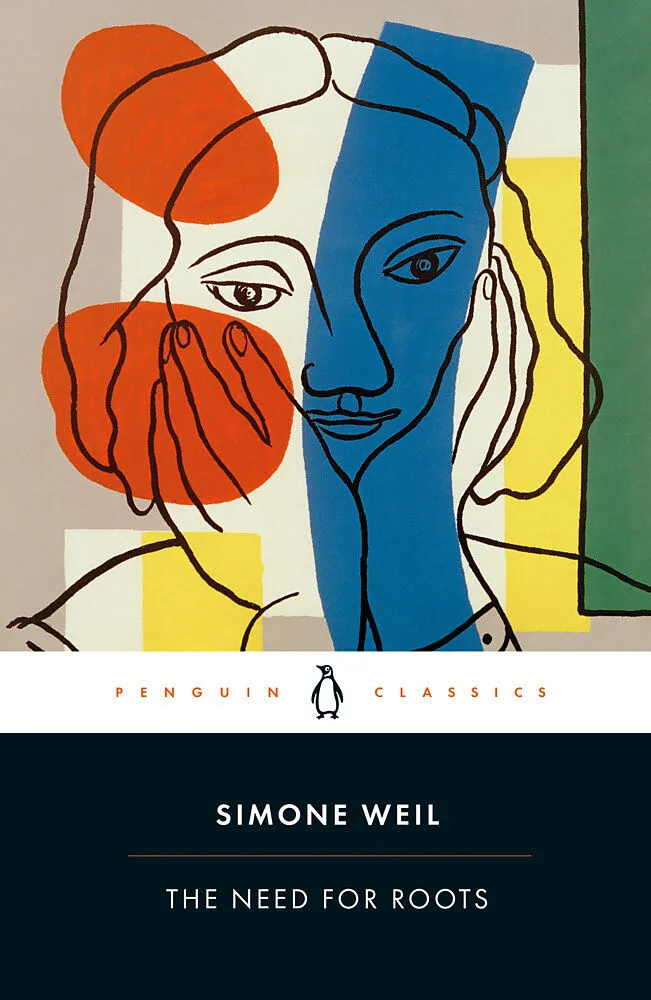
The Need for Roots
Beschreibung
French philosopher Simone Weil's best known work that promotes mindful living and instructs readers how they can once again feel rooted, in a cultural and spiritual sense, to their environment A Penguin Classic One of the foremost French philosophers of t...Format auswählen
- Kartonierter EinbandCHF 20.30

Wird oft zusammen gekauft
Andere Kunden kauften auch
Beschreibung
**French philosopher Simone Weil's best known work that promotes mindful living and instructs readers how they can once again feel rooted, in a cultural and spiritual sense, to their environment
A Penguin Classic**
One of the foremost French philosophers of the last century, Simone Weil has been described by André Gide as "the patron saint of all outsiders" and by Albert Camus as "the only great spirit of our time." In this, her most famous work, she diagnoses the malaise at the heart of modern life: uprootedness, from the past and from community. Written towards the end of World War II for the Free French Army, Weil's work is an indispensable and perpetually intriguing text for readers and students of philosophy everywhere. The book discusses the political, cultural and spiritual currents that ought to be nurtured so that people have access to sources of energy which will help them lead fulfilling, joyful and morally good lives.
Autorentext
Simone Weil (1909-43) was a French political activist, mystic and a singular figure in French philosophy. She studied at the elite École Normale Supérieure, obtained her agrégation (teaching diploma) in philosophy in 1931, worked at Renault from 1934 to 1935, enlisted in the International Brigades in 1936 and worked as a farm labourer in 1941. She left France in 1942 for New York and then London, where she worked for General de Gaulle's Free French movement. Most of her works, published posthumously, consist of some notebooks and a collection of religious essays. They include, in English, Waiting for God (1951), Gravity and Grace (1952), The Need for Roots (1952), Notebooks (two volumes, 1956), Oppression and Liberty (1958) and Selected Essays, 1934-1943 (1962).
Ros Schwartz is an award-winning translator from French. Acclaimed for her new version of Antoine de Saint-Exupéry's The Little Prince, published in 2010, she has over 100 fiction and non-fiction titles to her name.
The French government made Ros a Chevalier de l'Ordre des Arts et des Lettres in 2009, and in 2017 she was awarded the Institute of Translation and Interpreting's John Sykes Memorial Prize for Excellence.
Kate Kirkpatrick is Fellow in Philosophy at Regent's Park College, University of Oxford. She is the author of several books and articles on twentieth-century French philosophy, including Sartre on Sin: Between Being and Nothingness (Oxford University Press, 2017), Sartre and Theology (Bloomsbury, 2017), and the internationally acclaimed biography of Simone de Beauvoir, Becoming Beauvoir: A Life (Bloomsbury, 2019).
Klappentext
French philosopher Simone Weil's best known work that promotes mindful living and instructs readers how they can once again feel rooted, in a cultural and spiritual sense, to their environment
A Penguin Classic
One of the foremost French philosophers of the last century, Simone Weil has been described by André Gide as "the patron saint of all outsiders" and by Albert Camus as "the only great spirit of our time." In this, her most famous work, she diagnoses the malaise at the heart of modern life: uprootedness, from the past and from community. Written towards the end of World War II for the Free French Army, Weil's work is an indispensable and perpetually intriguing text for readers and students of philosophy everywhere. The book discusses the political, cultural and spiritual currents that ought to be nurtured so that people have access to sources of energy which will help them lead fulfilling, joyful and morally good lives.