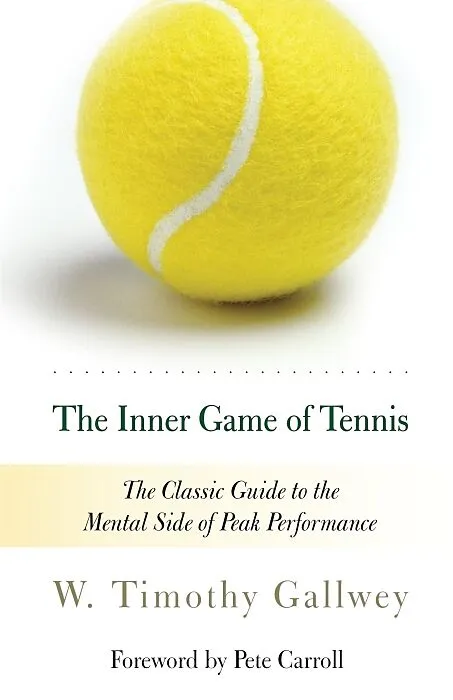
The Inner Game of Tennis
Beschreibung
Informationen zum Autor W. Timothy Gallwey Klappentext The timeless guide to achieving the state of relaxed concentration that's not only the key to peak performance in tennis but the secret to success in life itselfnow in a 50th anniversary edition with an up...Format auswählen
- Poche format BCHF 22.70

Wird oft zusammen gekauft
Andere Kunden kauften auch
Beschreibung
Informationen zum Autor W. Timothy Gallwey Klappentext The timeless guide to achieving the state of relaxed concentration that's not only the key to peak performance in tennis but the secret to success in life itselfnow in a 50th anniversary edition with an updated epilogue, a foreword by Bill Gates, and an updated preface from NFL coach Pete Carroll This phenomenally successful guide to mastering the game from the inside out has become a touchstone for hundreds of thousands of people. Billie Jean King has called the book her tennis bible; Al Gore has used it to focus his campaign staff; and Itzhak Perlman has recommended it to young violinists. Based on W. Timothy Gallwey's profound realization that the key to success doesn't lie in holding the racket just right, or positioning the feet perfectly, but rather in keeping the mind uncluttered, this transformative book gives you the tools to unlock the potential that you've possessed all along. The Inner Game is the one played within the mind of the player, against the hurdles of self-doubt, nervousness, and lapses in concentration. Gallwey shows us how to overcome these obstacles by trusting the intuitive wisdom of our bodies and achieving a state of relaxed concentration. With chapters devoted to trusting the self and changing habits, it is no surprise then, that Gallwey's method has had an impact far beyond the confines of the tennis court. Whether you want to play music, write a novel, get ahead at work, or simply unwind after a stressful day, Gallwey shows you how to tap into your utmost potential. In this fiftieth-anniversary edition, the principles of the Inner Game shine through as more relevant today than ever before. No matter your goals, The Inner Game of Tennis gives you the definitive framework for long-term success. Leseprobe Chapter One Reflections on the Mental Side of Tennis The problems which most perplex tennis players are not those dealing with the proper way to swing a racket. Books and professionals giving this information abound. Nor do most players complain excessively about physical limitations. The most common complaint of sportsmen ringing down the corridors of the ages is, It's not that I don't know what to do, it's that I don't do what I know! Other common complaints that come constantly to the attention of the tennis pro: I play better in practice than during the match. I know exactly what I'm doing wrong on my forehand, I just can't seem to break the habit. When I'm really trying hard to do the stroke the way it says to in the book, I flub the shot every time. When I concentrate on one thing I'm supposed to be doing, I forget something else. Every time I get near match point against a good player, I get so nervous I lose my concentration. I'm my own worst enemy; I usually beat myself. Most players of any sport run into these or similar difficulties frequently, but it is not so easy to gain practical insight into how to deal with them. The player is often left with such warmed-over aphorisms as Well, tennis is a very psychological game, and you have to develop the proper mental attitudes or You have to be confident and possess the will to win or else you'll always be a loser. But how can one be confident or develop the proper mental attitudes? These questions are usually left unanswered. So there seems to be room for comment on the improvement of the mental processes which translate technical information about how to hit a ball into effective action. How to develop the inner skills, without which high performance is impossible, is the subject of The Inner Game of Tennis. The Typical Tennis Lesson Imagine what goes on inside the head of an eager student taking a lesson from an equally eager new tennis pro. Suppose that the student is a middle-aged businessman bent on imp...
Autorentext
W. Timothy Gallwey
Klappentext
The timeless guide to achieving the state of “relaxed concentration” that’s not only the key to peak performance in tennis but the secret to success in life itself—now in a 50th anniversary edition with an updated epilogue, a foreword by Bill Gates, and an updated preface from NFL coach Pete Carroll
This phenomenally successful guide to mastering the game from the inside out has become a touchstone for hundreds of thousands of people. Billie Jean King has called the book her tennis bible; Al Gore has used it to focus his campaign staff; and Itzhak Perlman has recommended it to young violinists. Based on W. Timothy Gallwey’s profound realization that the key to success doesn’t lie in holding the racket just right, or positioning the feet perfectly, but rather in keeping the mind uncluttered, this transformative book gives you the tools to unlock the potential that you’ve possessed all along.
“The Inner Game” is the one played within the mind of the player, against the hurdles of self-doubt, nervousness, and lapses in concentration. Gallwey shows us how to overcome these obstacles by trusting the intuitive wisdom of our bodies and achieving a state of “relaxed concentration.” With chapters devoted to trusting the self and changing habits, it is no surprise then, that Gallwey’s method has had an impact far beyond the confines of the tennis court.
Whether you want to play music, write a novel, get ahead at work, or simply unwind after a stressful day, Gallwey shows you how to tap into your utmost potential. In this fiftieth-anniversary edition, the principles of the Inner Game shine through as more relevant today than ever before. No matter your goals, The Inner Game of Tennis gives you the definitive framework for long-term success.
Leseprobe
Chapter One
Reflections on the Mental Side of Tennis
The problems which most perplex tennis players are not those dealing with the proper way to swing a racket. Books and professionals giving this information abound. Nor do most players complain excessively about physical limitations. The most common complaint of sportsmen ringing down the corridors of the ages is, “It’s not that I don’t know what to do, it’s that I don’t do what I know!” Other common complaints that come constantly to the attention of the tennis pro:
I play better in practice than during the match.
I know exactly what I’m doing wrong on my forehand, I just can’t seem to break the habit.
When I’m really trying hard to do the stroke the way it says to in the book, I flub the shot every time. When I concentrate on one thing I’m supposed to be doing, I forget something else.
Every time I get near match point against a good player, I get so nervous I lose my concentration.
I’m my own worst enemy; I usually beat myself.
Most players of any sport run into these or similar difficulties frequently, but it is not so easy to gain practical insight into how to deal with them. The player is often left with such warmed-over aphorisms as “Well, tennis is a very psychological game, and you have to develop the proper mental attitudes” or “You have to be confident and possess the will to win or else you’ll always be a loser.” But how can one “be confident” or develop the “proper mental attitudes”? These questions are usually left unanswered.
So there seems to be room for comment on the improvement of the mental processes which translate technical information about how to hit a ball into effective action. How to develop the inner skills, without which high performance is impossible, is the subject of The Inner Game of Tennis.
The Typical Tennis Lesson
Imagine what goes on inside the head of an eager student taking a lesson from an equally eager new tennis pro. Suppose that the student is a middle-aged businessman bent on improving his position on the club la…