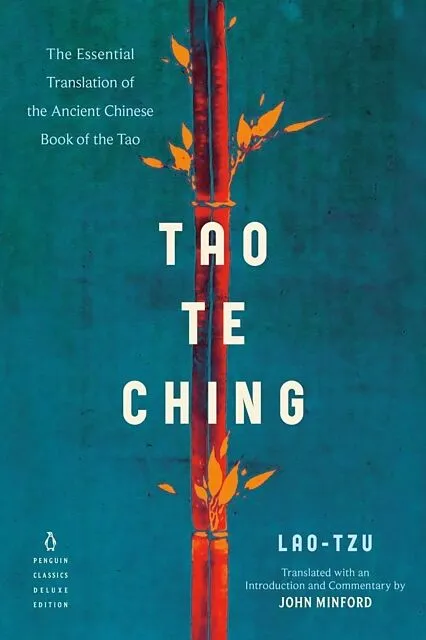
Tao Te Ching
Beschreibung
The original mindfulness book, in a landmark new translation by the award-winning translator of the I Ching and The Art of War A Penguin Classics Deluxe Edition, with flaps and deckle-edged paper The most translated book in the world after the Bible, the Tao T...Format auswählen
- Kartonierter EinbandCHF 23.50

Wird oft zusammen gekauft
Andere Kunden kauften auch
Beschreibung
The original mindfulness book, in a landmark new translation by the award-winning translator of the I Ching and The Art of War A Penguin Classics Deluxe Edition, with flaps and deckle-edged paper The most translated book in the world after the Bible, the Tao Te Ching , or “Book of the Tao,” is a guide to cultivating a life of peace, serenity, and compassion. Through aphorisms and parable, it leads readers toward the Tao, or the “Way”: harmony with the life force of the universe. Traditionally attributed to Lao-tzu, a Chinese philosopher thought to have been a contemporary of Confucius, it is the essential text of Taoism, one of the three great religions of ancient China. As one of the world's great works of wisdom literature, it still has much to teach us today, offering a practical model based on modesty and self-restraint for living a balanced existence and for opening your mind, freeing your thoughts, and attaining enlightenment and self-awareness. With its emphasis on calm, simplicity, purity, and non-action, it provides a time-tested refuge from the busyness of modern life. This new translation seeks to understand the Tao Te Ching as a guide to everyday living and encourages a slow, meditative reading experience. The Tao Te Ching 's eighty-one brief chapters are accompanied by illuminating commentary, interpretation, poems, and testimonials by the likes of Margaret Mead, Ursula K. Le Guin, and Dr. Wayne W. Dyer. Specially commissioned calligraphy for more than two hundred Chinese characters illustrates the book's essential themes.
“A lucid translation [by] one of the most famous translators of Chinese into English.” —The New York Review of Books
“Ancient wisdom for those facing twenty-first-century perplexities . . . Minford writes for ordinary people seeking guidance in everyday life. . . . In simple but resonantly phrased language, [he] somehow does unfold [the Tao’s] message.” —Booklist, starred review
“A wonderful translation—clear and deep.” —********Vikram Seth
********“My first reaction as a Sinologist to a new translation of the Tao Te Ching is always: ‘Another one?! Whatever for?’ But then I began to read John Minford’s translation, and it immediately seduced me. . . . It has the mark of the craftsman: Its choice of words is not just judicious but also poetic, refreshing the at once limpid and ambiguous original and making it new. . . . The result is a metaphysical feast for those willing to slow down and read this text as it was meant to be read: meditatively.” —********John Lagerwey, The Chinese University of Hong Kong
********“A wonder and a delight. The simplicity and purity of this translation resonate directly with the original. It conveys the innermost essence of Chinese culture, drawing the reader deep into its enchantment and wisdom. Every word is charged with effortless energy—a radiant union of form and spirit.” —Tang Yuen-ha, Chinese opera artist
“Meditative reading, known as lectio divina, is a Benedictine tradition going back a millennium and a half. John Minford, using the term lectio Sinica, has creatively suggested such an approach as an essential way to read the Tao Te Ching.” —Nicholas Koss, Order of Saint Benedict
“Elegant and poetic, John Minford’s translation of the Tao Te Ching probably comes the closest of any to the essence of the mystical, ineffable Taoist classic. Minford wisely avoids providing one authoritative voice, instead introducing a rich tapestry of historical resonances that induce a meditative experience, as if harmonizing with an ensemble singing an ancient song.” —********Yue Zhuang, University of Exeter
Autorentext
Lao Tzu, illustrated by Translated by John Minford
Klappentext
The acclaimed translation of Taoism's founding text in a beautiful Penguin Classics Deluxe edition
The most translated book in the world after the Bible, the Tao Te Ching, or 'Book of the Way', is the essential text of Taoism, one of the three great religions of China. Through aphorisms and parable, it guides its readers toward the Tao, or the 'Way': living in harmony with the life force of the universe. Traditionally attributed to Lao Tzu, a Chinese philosopher who was a contemporary of Confucius, it offers a practical model for living based on modesty, self-restraint and balance and is an insightful guide for anyone seeking to open their minds, free their thoughts, and attain greater self-awareness.
John Minford's celebrated translation emphasises the calm, meditative quality of the Tao Te Ching, as well as its use as a guide to everyday living. This edition is accompanied by illuminating commentary and interpretation, as well as beautifully illustrated Chinese characters.
Leseprobe
1
Gateway to All Marvels
The Tao that can be Told
Is not the True Tao;
Names that can be Named
Are not True Names.
The Origin of Heaven and Earth
Has no Name.
The Mother of the Myriad Things
Has a Name.
Free from Desire,
Contemplate the Inner Marvel;
With Desire,
Observe the Outer Radiance.
These issue from One Source,
But have different Names.
They are both a Mystery.
Mystery of Mysteries,
Gateway to All Marvels.
The River Master
The Tao that can be Told is the mundane Tao of the Art of Government, as opposed to the True Tao of Nature, of the So-of-Itself, of Long Life, of Self-Cultivation through Non-Action. This is the Deep Tao, which cannot be Told in Words, which cannot be Named. The Names that can be Named are such worldly things as Wealth, Pomp, Glory, Fame, and Rank.
The Ineffable Tao
Emulates the Wordless Infant,
It resembles
The Unhatched Egg,
The Bright Pearl within the Oyster,
The Beauteous Jade amongst Pebbles.
It cannot be Named.
The Taoist glows with Inner Light, but seems outwardly dull and foolish. The Tao itself has no Form, it can never be Named.
The Root of the Tao
Proceeds from Void,
From Non-Being,
It is the Origin,
The Source of Heaven and Earth,
Mother of the Myriad Things,
Nurturing All-under-Heaven,
As a Mother Nurtures her Children.
Magister Liu
The single word Tao is the very Core of this entire Classic, its lifeblood. Its Five Thousand Words speak of this Tao and of nothing else.
The Tao itself
Can never be
Seen.
We can but witness it
Inwardly,
Its Origin,
Mother of the Myriad Things.
The Tao itself can never be
Named,
It cannot be Told.
And yet we resort to Words, such as Origin, Mother, and Source.
Every Marvel
Contemplated,
Every Radiance
Observed,
Issues from this One Source.
They go by different Names,
But are part of the same
Greater Mystery,
The One Tao, the Origin, the Mother.
In freedom from Desire,
We look within
And Contemplate
The Inner Marvel,
Not with eyes
But inwardly
By the Light of Spirit.
We look outward
With the eyes of Desire,
And Obse…