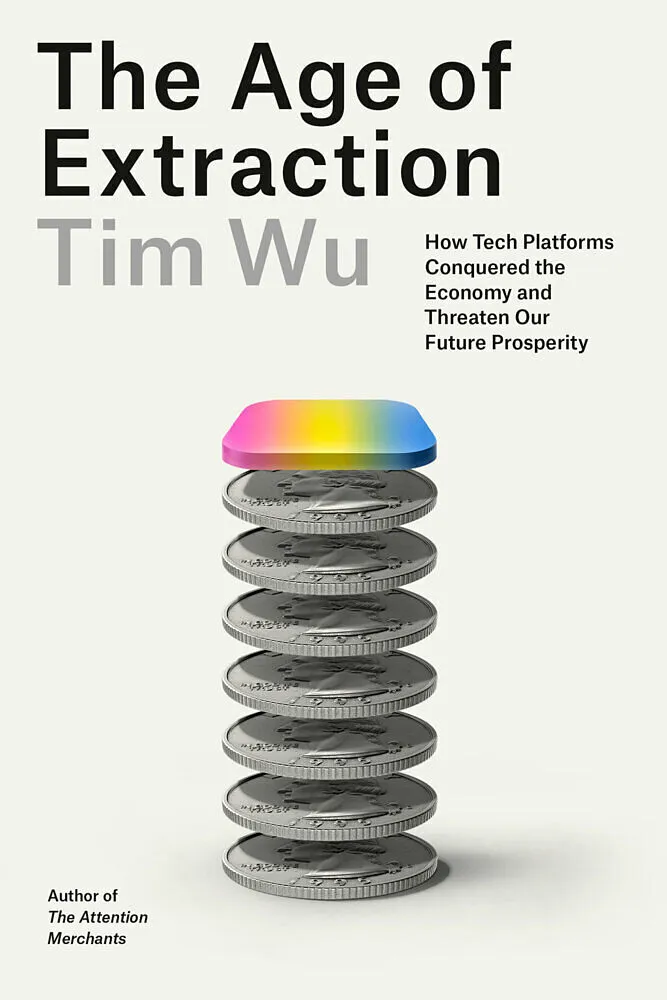

The Age of Extraction
Beschreibung
A concise yet century-spanning exploration of the power of platforms, what the future of capitalism will look like, and how to build economies that provide equality and lasting prosperity. In every society, there has been an essential platform--a central marke...Format auswählen
- Kartonierter EinbandCHF 20.30
- Fester EinbandCHF 33.20

Wird oft zusammen gekauft
Andere Kunden kauften auch
Beschreibung
A concise yet century-spanning exploration of the power of platforms, what the future of capitalism will look like, and how to build economies that provide equality and lasting prosperity. In every society, there has been an essential platform--a central marketplace--where people come to buy, sell, and make their living. While each culture and era are distinct, all have such a platform to serve as the beating heart of the economy. Over most of human history, these platforms have been public and physical: city centers, ports, shopping streets, and stock markets. Today, however, these arenas are more sophisticated, largely privatized, and virtual: they are digital, accessible anywhere, and anchored by the Internet itself. The way these platforms operate determines how the economy works, who it benefits and fails, and how society functions. Now, Tim Wu--the preeminent legal scholar who coined the phrase “net neutrality”--explores what these platforms tell us about our worlds, and why it is so crucial that they are fair and equal.
Autorentext
Tim Wu
Leseprobe
Chapter 1
The Genius of the Ancient City Square
Everything needs to happen somewhere. That is why every civilization has had specialized spaces that facilitate commerce, speech, and other activities. In ancient Greece, the town square, or “agora,” served not just for buying and selling stuff but also for religious festivals, entertainment, and government.1 The bazaar was invented in the Middle East and much of commerce in ancient China centered on the market-town, or 市. These are the ancestors of today’s tech platforms, and we need to understand what gave them their economic significance.
It might help to better define what we mean by a “platform.” (The English word comes from the French platte fourme or “flat form.”) It can be described as any space or structure that in one way or another brings together two or more groups to transact or interact while reducing the costs of doing so. They can be buyers and sellers, but also readers and publishers, listeners and speakers. And as the French word suggests, a platform usually implied a certain evenhandedness.
This definition of a platform covers a lot of ground. It covers the most ancient form of transactional platform just described: the city marketplace. The term encompasses more, including stock exchanges, suburban shopping malls, and the Tokyo fish market, all of which bring together buyers and sellers. And as we shall see later, it also includes so-called enabling platforms that allow their buyers and sellers to do things they otherwise could not.
A Catalytic Space
In chemistry, a catalyst is anything that initiates or accelerates a chemical reaction without being affected itself. The operation of many complex natural systems—like most of the biochemistry that keeps us alive—is largely a story of catalysis.
The same is true in the economy: it is the catalysts that matter most. Selling does not simply “happen” if the price is right. The conditions must be right. It is this power—a catalytic power—that platforms harness.
Stated more formally, the most basic function of the platform is to enable mutually beneficial transactions—and thereby generate wealth or the satisfaction of human wants and needs. Platforms do so by solving not just one but several barriers that otherwise prevent transactions from occurring. Consider four major challenges that a successful platform addresses.
First Problem: Matching
I used to have a fig tree in my backyard, and when the time came, it bore a lot of fruit. A good fig tree will actually produce far more output than any one family can eat. In economic terms, a fig tree creates a surplus. In fact, most agricultural holdings create a surplus relative to family consumption.
The existence of a surplus creates the potential for trade—here, selling excess produce to buyers. In a basic economics class, it is common to assume that the matching of buyers and sellers happens automatically, if the buyer values it more than the seller. If so, the transaction happens, as if by magic.
In real life, as it isn’t always easy to match buyers and sellers, extra produce is often just left to rot. It is the facilitation of such transactions—the existence of marketplaces—that makes all the difference. The successful matching of buyers and sellers is required to make transactions happen. That is why platforms and marketplaces are so key to successful economies.
In this matchmaking function lies much of the value in a platform. In the language of platform economics popularized by French economist Jean Tirole, the platform exists to bring two “sides” of a market together.2 The more buyers and sellers a platform can muster, the more valuable it is. More buyers and more sellers attract more of each, in a version of what is sometimes called “network effects.” As economist David Evans writes in Matchmakers, platform businesses have as “raw materials [. . .] the different groups of customers that they help bring together.”
Think how often advertising for a business conference relies on who will be there. Social media start-ups that fail to reach a critical mass don’t make it; this is one of the reasons that a site like Facebook, despite the many scandals, whistleblowers, and privacy violations, keeps chugging along, as it still has everyone on it.
Sometimes a platform may have trouble attracting enough members of one side of a transactional pair. Often it is buyers who are scarce: when I worked in industry, I recall going to trade shows that were all sellers of equipment and no buyers and were therefore considered a bust. In the old days, a party with too many guys was called a “sausage fest.” Sophisticated platform operators often try to subsidize the missing side, or even pay one group to show up. Hence the practice of paying celebrities to appear at parties, or the old practice—banned in some cities—of offering a gender-based discount (“ladies’ night”) to attract more women to a bar.
Jumping ahead a little, it is clear that in our times matching remains a core function of tech platforms. Every tech platform is at some level in the business of connecting people and businesses. It can be worth losing money on one side or—even for a time—both sides of the transaction. For years, Uber gave everyone rides that were effectively below cost so as to build up the network. And now you can understand one reason that there’s so much “free” stuff on platforms like Google and Facebook: it is the free drink that draws in users so they might meet . . . advertisers.
Second Problem: Information and Trust
Ever consider buying a Persian rug only to be put off by the difficulty of ascertaining what, exactly, you might be getting? Or want to purchase something but have no idea how to get started? Information gaps also prevent transactions from happening in more than one way. To buy something, you need to know, at a minimum, that the product exists and what its price is. For more significant purchases, a buyer also needs to know that the product is of acceptable quality. In a farmers market, the appearance of the product, red tomatoes or green lettuce, conveys a lot. But observing quality can be a subtle thing. Does that used car have an engine that is about to quit? Is that Persian carpet actually from Persia? Is that company selling stock about to go bankrupt?
The seller almost always knows more than the buyer, creating an imbalance (technically, an asymmetry). The owner of an apartment with a train line nearby knows that passing tr…