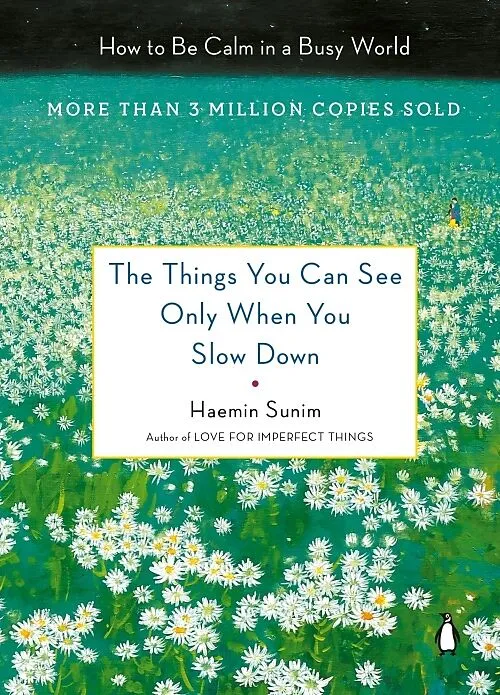
The Things You Can See Only When You Slow Down
Beschreibung
Zusatztext 57309855 Informationen zum Autor Haemin Sunim Klappentext The multimillion-copy bestselling book of spiritual wisdom about the importance of slowing down in our fast-paced world, by the Buddhist author of Love for Imperfect Things "Wise advice on ho...Format auswählen
- Fester EinbandCHF 25.60

Wird oft zusammen gekauft
Andere Kunden kauften auch
Beschreibung
Zusatztext 57309855 Informationen zum Autor Haemin Sunim Klappentext The multimillion-copy bestselling book of spiritual wisdom about the importance of slowing down in our fast-paced world, by the Buddhist author of Love for Imperfect Things "Wise advice on how to reflect and slow down." -Elle Is it the world that's busy, or is it my mind? The world moves fast, but that doesn't mean we have to. This bestselling mindfulness guide by Haemin Sunim (which means "spontaneous wisdom"), a renowned Buddhist meditation teacher born in Korea and educated in the United States, illuminates a path to inner peace and balance amid the overwhelming demands of everyday life. By offering guideposts to well-being and happiness in eight areas-including relationships, love, and spirituality-Haemin Sunim emphasizes the importance of forging a deeper connection with others and being compassionate and forgiving toward ourselves. The more than twenty full-color illustrations that accompany his teachings serve as calming visual interludes, encouraging us to notice that when you slow down, the world slows down with you.Why Am I So Busy? When everything around me is moving so fast, I stop and ask, "Is it the world that's busy, or is it my mind?" We usually think of "mind" and "world" existing independently of each other. If someone asks where our mind is, most of us would point to either our head or our heart, but not to a tree or the sky. We perceive a clear boundary between what goes on inside our minds and what happens in the outside world. Compared to the vast world outside, the mind nestled inside the body can feel small, vulnerable, and sometimes powerless. According to the Buddha's teaching, however, the boundary between the mind and the world is actually thin, porous, and ultimately illusory. It is not that the world is objectively joyful or sad and produces a corresponding feeling in us. Rather, feelings originate with the mind projecting its subjective experience onto the world. The world isn't inherently joyful or sad; it just is. Perhaps we can better understand this through a conversation I had with a dear friend of mine, a responsible and meticulous Buddhist nun. She recently oversaw the construction of a meditation hall in her temple. After relating the ordeal of obtaining various permits and finding the right contractor, among other things, she described the construction process in the following way: "When it came time to place tiles on the roof, I saw tiles everywhere I went. I noticed the material they were made of, their thickness, their design. And then, when it was time to install the floor, all I could see were floors. I naturally zeroed in on the color, origin, pattern, and durability of a hardwood floor. And then it suddenly dawned on me: When we look at the outside world, we are looking at only a small part that interests us. The world we see is not the entire universe but a limited one that the mind cares about. However, to our minds, that small world is the entire universe. Our reality is not the infinitely stretching cosmos but the small part we choose to focus on. Reality exists because our minds exist. Without the mind, there would be no universe." The more I reflected on this, the more her insight made sense to me. The world comes to exist because we are aware of it. We cannot live in a reality of which we are unaware. The world depends on our minds in order to exist, just as our minds depend on the world as the subject of our awareness. Put differently, our mind's awareness can be said to bring the world into being. What our mind focuses on becomes our world. Seen this way, the mind does not seem so insignificant in relation to the world out there, does it? We neither can nor want to know every single thing that happens in the world. If we did, we would go crazy from the overload of information. If we look ...
ldquo;Wonderful . . . They read almost like haikus.” —Lakshmi Singh, NPR’s All Things Considered
“Ancient Buddhist philosophy for the modern age . . . Profound but relatable wisdom on coping with the daily grind—and on keeping sight of what really matters. Leave this book on your nightstand to clear your head before bed.” —Real Simple
“Wise advice on how to reflect and slow down.” —Elle, “10 Books Kim Kardashian’s Book Club Should Read”
“Its short teachings are the perfect length for fitting into a fast-paced life. . . . It’s just the thing for a quick hit of dharma right after you wake up or before you go to sleep.” —Tricycle, “Top 9 Buddhist Books of the Year*****”*****
“ ‘What I’m trying to do,’ says Sunim, ‘Marie [Kondo] is doing through a material and hands-on approach.’ When people ‘stop and pause,’ says Sunim, they ‘realize the state of their minds.’ . . . They can appreciate the joy that they are experiencing in the moment.” —KonMari Newsletter
“Ingeniously simple tips from a zen monk that’ll boost your mood, career—and relationships.” —Daily Mail
* *
“What could have simply been a collection of homilies instead read like haiku . . . sparingly but beautifully illustrated.” —The Telegraph
“[A] lovely, illustrated Buddhist guide to staying present. Reminiscent of The Prophet and worthy of a place on my nightstand, this book offers a calm in life’s storm.” —Allison K. Hill, Los Angeles Daily News
“I both cried and laughed while reading this bite-sized book of wisdom. . . . Sunim’s words are profound but familiar, simple but artful, and each chapter feels more like a conversation with a thoughtful, loving friend than reading another book on mindfulness.” —Emma Koonse, Publishers Weekly “Staff Pick”
“His reminders to simply pause and breathe are welcome to anyone caught up in the hecticness of daily life.” —Metro
“Offers practical advice on everything from handling setbacks to relationships. Best for reclaiming your zen.” —Stylist
“Loving, practical, and kind, The Things You Can See Only When You Slow Down is a beautiful reminder of the rewards of living wisely.” —Jack Kornfield, bestselling author of A Path with Heart and The Wise Heart
“This book is wonderful—straight from the heart of a wise, kind teacher. Written simply and with gentle humor, it will help you find lasting happiness in a changing world.” —Rick Hanson, Ph.D., New York Times bestselling author of Buddha’s Brain and Hardwiring Happiness
“Filled with gems of wisdom, this book will lift up your heart and enliven your spirit.” —**Tara Brach, bestselling author of Radical Acceptance and True Refuge
“Not only a useful and practical book, it’s a beautiful one as well. Everyone who wants to thrive more in their life should have it on their nightstand.” —Arianna Huffington
“I believe this elegant book will help heal a river of grief that runs through our entire nation, just below the surface, everywhere I go. People ache for time with those they love, with friends and family, with nature. My hope is that everyone who opens this book will immediately find some passage, some way into a secret garden of slow time, where things of great beauty and truth grow, and blossom, in effortless abundance. It is a glorious refuge—a timely, welcome escape from the pervasive trance of ordinary, relentlessly productive time.” —Wayne Muller, bestselling author of Sabbath and A Life of Being, Having, and Doing Enough
&ldqu…