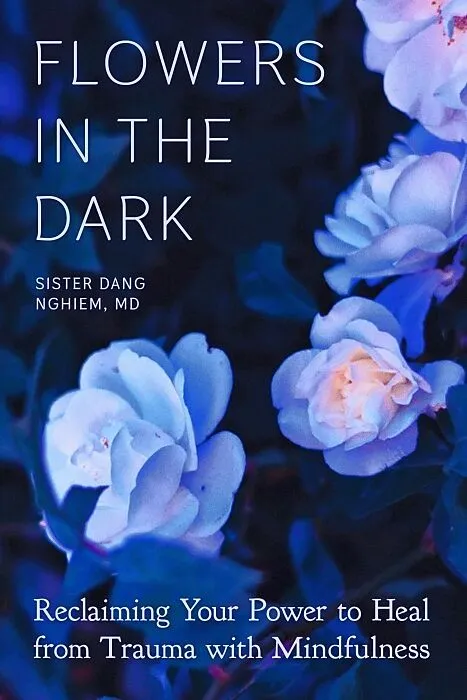
Flowers in the Dark
Beschreibung
Zusatztext What a profound and hopeful book! It offers the best practical wisdom for life's worst experiences. Sister Dang Nghiem integrates the neuroscience of trauma, effective treatments, and the penetrating insights of mindfulness training. She writes with...Format auswählen
- BroschiertCHF 21.90

Wird oft zusammen gekauft
Andere Kunden kauften auch
Beschreibung
Zusatztext What a profound and hopeful book! It offers the best practical wisdom for life's worst experiences. Sister Dang Nghiem integrates the neuroscience of trauma, effective treatments, and the penetrating insights of mindfulness training. She writes with such clarity and heart that you feel comforted and supported by her presence on every page. A beautiful book, and highly recommended. Rick Hanson, PhD , author of Buddha's Brain: The Practical Neuroscience of Happiness, Love, and Wisdom "Through her own story and those of many others, Sister Dang Nghiem, MD, offers a path to healing from childhood sexual abuse through mindfulness a path that allows one to reclaim their childhood and move forward in their lives and to heal what for many is a very deep wound. A book that every victim of childhood sexual abuse should read. Powerful and poignant." James R. Doty, MD , founder and director of the Center for Compassion and Altruism Research and Education (CCARE) at Stanford University School of Medicine and New York Times best-selling author of Into the Magic Shop: A Neurosurgeon's Quest to Discover the Mysteries of the Brain and the Secrets of the Heart "In this accessible and insightful work, Buddhist nun and former physician Dang Nghiem ( Healing ) outlines an approach to healing from trauma by using Buddhism-inspired mindfulness. Nghiem instructs readers in meditation, breathing techniques, and self-love affirmations that address the emotional and physical aftereffects of traumatic experiences. Nghiem supplements the book's theoretical principles with scientific information from her training as a physician and personal stories both from her own life and of those pursuing healing at her monastery. These small vignettes deepen the book's emotional impact, especially when Nghiem shares her own experiences as a survivor of sexual and physical abuse. While Nghiem's techniques can be valuable to anyone seeking personal growth or comfort for pain, those who have experienced severe traumas will find those treated here with sensitivity and compassion, and may find reasons to hope." Publishers Weekly Informationen zum Autor Sister Dang Nghiem, MD Klappentext Profound and hopeful . . . Sister Dang Nghiem integrates the neuroscience of trauma, effective treatments, and mindfulness training. Highly recommended. Rick Hanson, PhD, author of Buddha's Brain Learn the accessible and deeply compassionate practices for healing trauma, known as the Five Strengths of applied Zen Buddhism. More than a philosophy, these body-based practices are backed by modern neuroscience research, and they can be applied by anyone suffering from trauma to begin experiencing relief. Mindfulness teacher Sister Dang Nghiem, MD, is an inspiration for anyone who has ever suffered from abuse, life-changing loss, severe illness, or the aftermath of war. In Flowers in the Dark , she brings together her lived experience as a survivor, certified MD, and ordained Buddhist teacher to offer a body-based, practical approach to healing from life's most difficult and painful experiences. Offering insights from Buddhist psychology and simple somatic practices for tapping into our Five Strengthsour inner faculties of self-trust, diligence, mindfulness, concentration, and insightSister Dang Nghiem's approach to trauma is radically accessible; it begins with awareness of our breathing. With each chapter containing a progression of guided reflections and exercises, this book can be read as an adjunct to therapy and a helpful guide for moving through trauma in the body. With the practice of mindfulness, we can access our strength as survivors and our joy in being alive. Leseprobe Preface Look, my love, look at the innumerable flowers and leaves. Look, my love, look at yo...
Autorentext
Sister Dang Nghiem, MD
Klappentext
“Profound and hopeful . . . Sister Dang Nghiem integrates the neuroscience of trauma, effective treatments, and mindfulness training. Highly recommended.” —Rick Hanson, PhD, author of Buddha's Brain
Learn the accessible and deeply compassionate practices for healing trauma, known as the Five Strengths of applied Zen Buddhism. More than a philosophy, these body-based practices are backed by modern neuroscience research, and they can be applied by anyone suffering from trauma to begin experiencing relief.
Mindfulness teacher Sister Dang Nghiem, MD, is an inspiration for anyone who has ever suffered from abuse, life-changing loss, severe illness, or the aftermath of war. In Flowers in the Dark, she brings together her lived experience as a survivor, certified MD, and ordained Buddhist teacher to offer a body-based, practical approach to healing from life's most difficult and painful experiences.
Offering insights from Buddhist psychology and simple somatic practices for tapping into our Five Strengths—our inner faculties of self-trust, diligence, mindfulness, concentration, and insight—Sister Dang Nghiem’s approach to trauma is radically accessible; it begins with awareness of our breathing. With each chapter containing a progression of guided reflections and exercises, this book can be read as an adjunct to therapy and a helpful guide for moving through trauma in the body. With the practice of mindfulness, we can access our strength as survivors and our joy in being alive.
Leseprobe
Preface
Look, my love, look at the innumerable flowers and leaves.
Look, my love, look at yourself,
Your wonderful manifestations are all these.
The spring is coming, from the heart of the winter.
The inspiration to write this book came to me at the end of a weekend retreat in which I had been teaching in Atlanta, Georgia, in 2017. The organizers invited my monastic sisters and me to come to a garden behind their church to see the evening primroses bloom that night. Admittedly, I was not enthusiastic at the prospect since I was already quite tired after a long day at the retreat, but out of a sense of gratitude to our hosts, I still showed up.
At eight o’clock, about ten of us gathered in the church garden around the long stems of a tall, slender plant, covered in drying, wilted yellow flowers. A friend began to pluck away these old flowers, so that the new blossoms, indicated by tightly furled, spike-like buds, would be more visible to us. I stood politely, quiet and patient for what seemed like an interminable length of time. It began to get dark. Nothing seemed to happen. Suddenly, although there was no wind, the entire plant began to vibrate and tremble before us. Lo and behold, a flower bud suddenly and forcefully burst open, the petals unfolding one by one and then all at once, simultaneously, right in front of my eyes. This entire process took place within the space of a breath!
My mouth fell open and tears began streaming down my cheeks. As a somewhat poetic-minded lover of literature, I had heard so much about flowers bursting into bloom; I had sung songs about them, written poetry about them, and mentioned them in Dharma talks, cleverly using the metaphor to make my points. Yet in that moment, on that day in front of this evening primrose plant, I woke up to the fact that I had never directly experienced how a flower blooms! Seeing these delicate yellow evening flowers spring open in the darkness awoke in me the realization that healing from trauma—the recovery from painful experiences so that we can flourish and grow—is both simple and miraculous, a process that will unfold naturally, when enough of the right conditions are there.
For thirty years of my life, I had seen myself as a victim, isolated in my suffering. The facts of my upbringing and life story are now known—I’ve written about them in a memoir and frequently mentioned them in public talks, and I recount some parts in this book as well—but less known a…