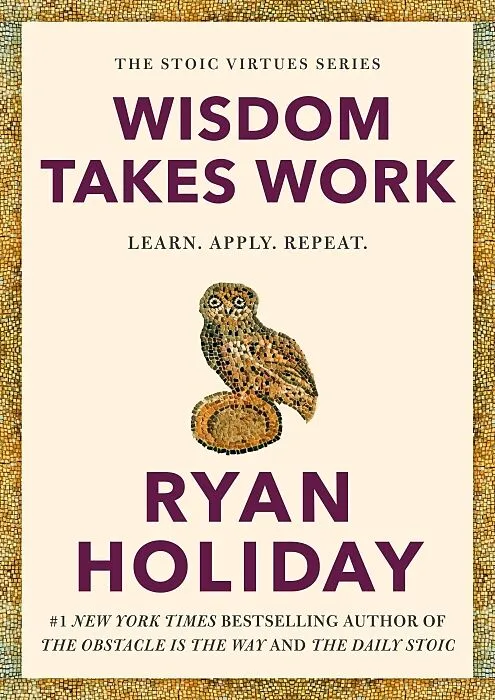
Wisdom Takes Work
Beschreibung
In this much-anticipated final installment in the Of all the stoic virtues - courage, discipline, justice, and wisdom - wisdom is the most elusive. This is especially apparent in an age where reaction and idle chatter are rewarded, and restraint and thoughtful...Format auswählen
- Fester EinbandCHF 30.30
- Kartonierter Einband (Kt)CHF 34.00

Wird oft zusammen gekauft
Andere Kunden kauften auch
Beschreibung
In this much-anticipated final installment in the Of all the stoic virtues - courage, discipline, justice, and wisdom - wisdom is the most elusive. This is especially apparent in an age where reaction and idle chatter are rewarded, and restraint and thoughtfulness are unfashionable.;The great statesman and philosophers of the past would not be fooled, as we are, by headlines or appearances or the primal pull of tribalism. They knew too much of history, of their own flaws, of the need for collaboration to do any of that. That''s wisdom - and we need it more than ever. Wisdom is Ryan Holiday''s guiding principle, and An absence of curiosity and prudence is a catastrophe for all of us, argues Ryan Holiday. This incredibly timely book both diagnoses the greatest problem of our current moment and offers solutions for the way forward. Wisdom is work - but it''s worth it.
Autorentext
Ryan Holiday
Klappentext
In this much-anticipated final installment in the Stoic Virtues series, Ryan Holiday makes the case for the virtue on which all other virtues depend.
Of all the stoic virtues - courage, discipline, justice, and wisdom - wisdom is the most elusive. This is especially apparent in an age where reaction and idle chatter are rewarded, and restraint and thoughtfulness are unfashionable. The great statesman and philosophers of the past would not be fooled, as we are, by headlines or appearances or the primal pull of tribalism. They knew too much of history, of their own flaws, of the need for collaboration to do any of that. That's wisdom - and we need it more than ever.
Wisdom is Ryan Holiday's guiding principle, and Wisdom Takes Work is the culmination of all his work. Drawing on fascinating stories of the ancient and modern figures alike, Holiday shows how to cultivate wisdom through reading, self-education, and experience. Through the lives of Montaigne, Seneca, Joan Didion, Abraham Lincoln, and others, Holiday teaches us how to listen more than we talk, to think with nuance, to ruthlessly question our own beliefs, and to develop a method of self-education. He argues convincingly for the necessity of mental struggle and warns against taking shortcuts that deprive us of real knowledge. And he shows us how dangerous power and intelligence can be without the tempering influence of wisdom.
An absence of curiosity and prudence is a catastrophe for all of us, argues Ryan Holiday. This incredibly timely book both diagnoses the greatest problem of our current moment and offers solutions for the way forward. Wisdom is work - but it's worth it.
Leseprobe
A Most Unusual Education . . .
As the scion of a noble family, Michel de Montaigne should have spent his early days surrounded by servants and coddled in luxury. Instead, his parents sent their boy to live with a local peasant family-not out of neglect, but to give him something priceless. Most wealthy children in the sixteenth century were handed over to wet nurses and nannies, but Montaigne, within sight of but a world away from the enormous estate that bore his name, was, in his words, "formed by fortune under the laws of the common people and of nature."
It was an unusual beginning to an unusual education, one that would continue until Montaigne took his last breath, at age fifty-nine.
After those early days in the bosom of his surrogate family, Montaigne was brought home, where his father decreed that no one would speak any language around his son but Latin. Instead of their local dialect of French, Montaigne lived in the world of Seneca and Cato, coming naturally to the language the same way the ancients had.
Even residents of the village went along with the plan, and years later, Montaigne was surprised to hear one of them casually refer to a tool by its Latin name, so ingrained had the habit become for his sake. With no other languages allowed within earshot-his Latin tutor was German and didn't even know French-the mother tongue of philosophy came to the boy quickly and painlessly. The Romans had first come to Bordeaux around 60 BC, and Rome had fallen in the centuries since, but for Montaigne, Urbs Aeterna still stood eternal.
Soon enough, Montaigne was more fluent than his parents and more proficient than his tutor. "As for me," Montaigne would later recall, "I was over six before I understood any more French . . . than Arabic."
One might expect that an education this strict and directed-not to mention strange-would be joyless. Montaigne was lucky, for he was formed as much by love and tenderness as he was by these experiments. He would be taught Greek later, a bit more traditionally, but his father envisioned it as a game. Montaigne would recall the fun of volleying "conjugations back and forth" with his instructors, not even aware that he was learning. Montaigne recalled that in his father's travels abroad, educational experts advised him to shape his son's soul "entirely through gentleness and freedom," that his choices should be respected and that he should love to learn. Is it any surprise that Montaigne would go to his deathbed believing that he had the best father there ever was?
Only twice in his life was Montaigne ever physically disciplined-gently, he noted-something that many children today could not say and few could have said in the sixteenth century. Most mornings, he was awakened not by a nagging parent or a stern schoolmaster, but by beautiful songs of the musicians whom his father had hired. It was a way to teach his son music, but it was also a way to address a rather touching concern-startling the "tender brains of children" awake with a shake or a shout, his father believed, was borderline cruel.
At seven, Montaigne was reading Ovid for fun, already tired of patronizing kids' stories. But he wasn't just a bookworm. In the Montaigne household, everything was an opportunity to learn-even pranks or mistakes were material for discussions or lessons. Everything was designed to "serve as an excellent book," every situation provided a takeaway, even "some cheating by a page, some stupidity on the part of a lackey, something said at table," was a chance to discuss, to debate, to analyze. Everything was to be questioned. Every idea to be traced back to its original source. Great thinkers were turned to for advice and for answers, but they were not exempt from challenges. "Pass everything through a sieve," Montaigne would later say about how to educate a child, "and lodge nothing in his head on mere authority or trust."
He was taught not to be precious about mistakes, even encouraged to admit he'd made them. The important thing to teach kids, he said of the real lesson he'd learned in his youth, was "that confessing an error which he discovers in his own argument even when he alone has noticed it is an act of justice and integrity, which are the main qualities he pursues." In Montaigne's family, stubbornness was a vice, belief in one's infallibility or superiority the only screwup to be ashamed of.
It must have been strange the first time Montaigne stepped into a classroom, at the Collège de Guyenne, which his father had helped start. To suddenly be surrounded by other students, doing this thing called "school." As Montaigne would have known, the root of that word is the Greek word meaning "leisure." Then, as now, how distant the etymology is from reality.
Montaigne did not love how often he and his fellow students were "left to the melancholy humor of a furious schoolmaster." There was so much schoolwork, the days were interminable; he and his fellow students found it excruciating "slaving away for fourteen and fifteen hours a day like a porter." They were forced to memorize and recite and translate passages as if these noises and sounds and symbols were a replacement for understanding. It is tragic, Montaigne felt, but not a surprise, how many kids hate going…