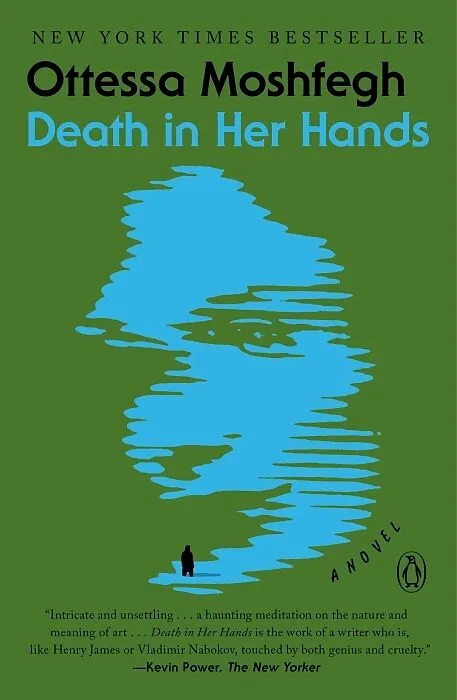
Death in Her Hands
Beschreibung
Named a Most Anticipated Book of 2020 by: Ottessa Moshfegh Klappentext Named a Most Anticipated Book of 2020 by: The Washington Post, Vogue, Marie Claire, Entertainment Weekly, The Millions, New York Magazine, Paste Magazine, LitHub, E! News Online, and many m...Format auswählen
- Kartonierter EinbandCHF 19.50
- Kartonierter EinbandCHF 31.90

Wird oft zusammen gekauft
Andere Kunden kauften auch
Beschreibung
**Named a Most Anticipated Book of 2020 by: Ottessa Moshfegh
Klappentext
Named a Most Anticipated Book of 2020 by: The Washington Post, Vogue, Marie Claire, Entertainment Weekly, The Millions, New York Magazine, Paste Magazine, LitHub, E! News Online, and many more
From one of our most ceaselessly provocative literary talents, a novel of haunting metaphysical suspense about an elderly widow whose life is upturned when she finds an ominous note on a walk in the woods.
While on her daily walk with her dog in a secluded woods, a woman comes across a note, handwritten and carefully pinned to the ground by stones. "Her name was Magda. Nobody will ever know who killed her. It wasn't me. Here is her dead body." But there is no dead body. Our narrator is deeply shaken; she has no idea what to make of this. She is new to this area, alone after the death of her husband, and she knows no one.
Becoming obsessed with solving this mystery, our narrator imagines who Magda was and how she met her fate. With very little to go on, she invents a list of murder suspects and possible motives for the crime. Oddly, her suppositions begin to find correspondences in the real world, and with mounting excitement and dread, the fog of mystery starts to fade into menacing certainty. As her investigation widens, strange dissonances accrue, perhaps associated with the darkness in her own past; we must face the prospect that there is either an innocent explanation for all this or a much more sinister one.
A triumphant blend of horror, suspense, and pitch-black comedy, Death in Her Hands asks us to consider how the stories we tell ourselves both reflect the truth and keep us blind to it. Once again, we are in the hands of a narrator whose unreliability is well earned, and the stakes have never been higher.
Zusammenfassung
Named a Best Book of the year by Elle, Bustle, and the New York Public Library
From one of our most ceaselessly provocative literary talents, a novel of haunting metaphysical suspense about an elderly widow whose life is upturned when she finds an ominous note on a walk in the woods.
While on her daily walk with her dog in a secluded woods, a woman comes across a note, handwritten and carefully pinned to the ground by stones. "Her name was Magda. Nobody will ever know who killed her. It wasn't me. Here is her dead body." But there is no dead body. Our narrator is deeply shaken; she has no idea what to make of this. She is new to this area, alone after the death of her husband, and she knows no one.
Becoming obsessed with solving this mystery, our narrator imagines who Magda was and how she met her fate. With very little to go on, she invents a list of murder suspects and possible motives for the crime. Oddly, her suppositions begin to find correspondences in the real world, and with mounting excitement and dread, the fog of mystery starts to fade into menacing certainty. As her investigation widens, strange dissonances accrue, perhaps associated with the darkness in her own past; we must face the prospect that there is either an innocent explanation for all this or a much more sinister one.
A triumphant blend of horror, suspense, and pitch-black comedy, Death in Her Hands asks us to consider how the stories we tell ourselves both reflect the truth and keep us blind to it. Once again, we are in the hands of a narrator whose unreliability is well earned, and the stakes have never been higher.
Leseprobe
One*
Her name was Magda. Nobody will ever know who killed her. It wasn't me. Here is her dead body.*
But there was no body. No bloodstain. No tangle of hair caught on the coarse fallen branches, no red wool scarf damp with morning dew festooned across the bushes. There was just the note on the ground, rustling at my feet in the soft May wind. I happened upon it on my dawn walk through the birch woods with my dog, Charlie.
I'd discovered the path the previous spring just after Charlie and I had moved to Levant. We'd worn it down all spring, summer, and fall, but abandoned it during winter. The slim white trees had been nearly invisible against the snow. On foggy mornings, the birches completely disappeared in the mist. Since the thaw, Charlie had been waking me up every morning at daybreak. We'd cross the dirt road and trudge up the slow rise and fall of a little hill, and weave our way back and forth through the birches. That morning, when I found the note laid flat on the path, we'd made it about a mile into the woods.
Charlie did not slow or tilt his head or even lower his nose to the ground to sniff. It seemed very odd to me that he'd just ignore it-my Charlie, who once broke off his leash and ran off across the freeway to fetch a dead bird, so strong was his instinct to ferret out the dead. No, he didn't give the note a second glance. Little black rocks pinned the note down to the ground, each placed carefully on the page in the top margin and along the bottom. I bent down to read it again. Under my hands, the earth was almost warm, shy pale grass poking up here and there in the crumbly black dirt, the sun just starting to brighten in hue from silver to yellow.
Her name was Magda.
It was a joke, I thought, a prank, a ruse. Somebody was playing games. That was my initial impression. Isn't it sweet to look back at how my mind jumped to the most innocuous conclusion? That after so many years, at seventy-two, my imagination was still so naive? Experience should have taught me that first impressions are often misleading. Kneeling down in the dirt, I considered the details: the paper was a page from a lined, spiral notebook, its perforated edge broken cleanly, no straggly bits from where it had been torn out; careful, small printed letters in blue ballpoint pen. It was hard to decipher much from the penmanship, and that seemed deliberate. It was the kind of neat, impersonal printing you'd use when making a sign for a yard sale, or filling out a form at the dentist. Wise, I thought. Smart. Whoever had written the note understood that by masking one's peculiarities, one invokes authority. There is nothing as imposing as anonymity. But the words themselves, when I spoke them aloud, seemed witty, a rare quality in Levant, where most people were blue collar and dull. I read the note again and almost chuckled over that penultimate line, It wasn't me. Of course it wasn't.
If not a prank, the note could have been the beginning of a story tossed out as a false start, a bad opening. I could understand the hesitation. It's a rather dark, damning way to begin a story: the pronouncement of a mystery whose investigation is futile. Nobody will ever know who killed her. The story is over just as it's begun. Was futility a subject worthy of exploration? The note certainly didn't promise any happy ending.
Here is her dead body. Surely there was more to say. Where was Magda? Was it so hard to come up with a description of her corpse, tangled in the brush under a fallen tree, her face half sunken into the soft black dirt, her hands hog-tied behind her back, the blood from her stab wounds leaching into the ground? How hard was it to imagine a small golden locket glinting between sodden birch leaves, the chain broken and dashed through the new, tender, hairy grass? The locket could contain photos of a young, gap-toothed child on one side-Magda at age five-and a m