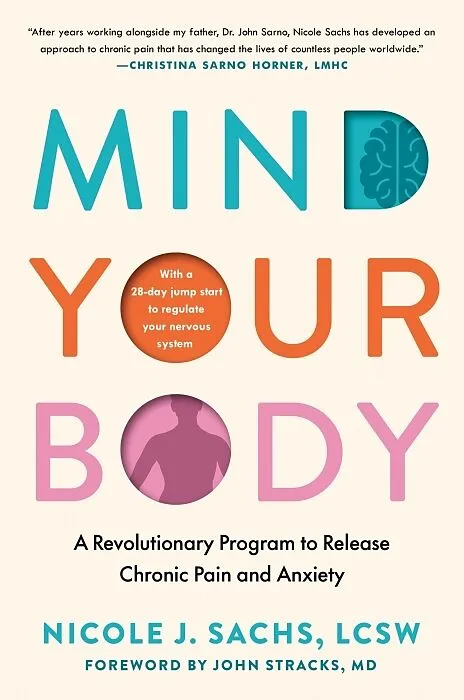
Mind Your Body
Beschreibung
Learn how to free yourself from chronic pain, anxiety, fatigue, and myriad debilitating conditions through the transformative process of nervous system regulation in this accessible guide from psychotherapist and leading Mindbody clinician Nicole Sachs. At a t...Format auswählen
- Fester EinbandCHF 31.60

Wird oft zusammen gekauft
Andere Kunden kauften auch
Beschreibung
Learn how to free yourself from chronic pain, anxiety, fatigue, and myriad debilitating conditions through the transformative process of nervous system regulation in this accessible guide from psychotherapist and leading Mindbody clinician Nicole Sachs. At a time when chronic pain and other conditions have reached epidemic proportions, and the medical model is coming up short for so many of us, Sachs knows that these kinds of syndromes often don’t originate from a physical source. Rather, they are fueled by trauma responses associated with deeply rooted psychological and emotional triggers that send the brain and the nervous system into fight or flight. In <Mind Your Body<, Sachs teaches readers about Mindbody medicine--which helped her overcome her own debilitating pain and dark prognosis. She explains the essential practice of turning inward, using her revolutionary JournalSpeak method, which has enabled countless people to achieve striking mental, emotional, and physical healing. <Mind Your Body< takes chronic pain recovery into its next stage, for a new generation of readers who have been so underserved by our medical system.
Autorentext
Nicole J. Sachs, LCSW, is a speaker, writer, psychotherapist, retreat leader, and podcaster who has dedicated her work and her practice to the treatment of chronic pain and conditions. She is the author of the book The Meaning of Truth and the online courses Freedom from Chronic Pain, Freedom From an Anxious Life, and The Sarno x Sachs Solution Practitioner training. Her brands, BreakAwake and The Cure for Chronic Pain, include a website, podcast, YouTube channel, membership community, and newsletter. Sachs is on faculty at the Omega Institute for Holistic Studies in New York.
Leseprobe
My trip into the fire began young. At nineteen years old, I lay on the orthopedic surgeon's table in mind-numbing pain and fear. The X-ray glowed on the screen while my mother wrung her hands beside me. We were awaiting a second opinion to explain my symptoms. My parents had taken me home from college a week before final exams when excruciating lower back pain prevented me from even walking to the bathroom, much less finishing my semester.
"I'm in agreement," the doctor said. "The diagnosis is spondylolisthesis, a degenerative condition of the lower spine. To avoid being in a wheelchair by forty, you will need to immediately stop several activities and accept certain realities. We will have to reevaluate what exercise looks like, and you certainly won't be rollerblading."
Rollerblading was a daily form of transportation that was integral to my joy and mental wellness. It was the nineties, after all. At that moment, his words directly called into question my entire sense of identity as strong, fit, and free to do as I pleased.
He went on. "It's ill-advised to lift anything over twenty pounds or ride in a car for more than an hour. You'll have to sleep in very specific positions to avoid pain and stabilize your back. Travel of any kind will need to be carefully considered from a risk/benefit analysis. Most importantly, you should come to terms with the fact that it's unlikely you will carry a biological child. The weight of the baby could strain your back to the point of irreparable harm." This last piece of news was too much to process. A life without the vibrant family I'd envisioned? Was that any life at all?
Based on what he saw on my films, the doctor explained that spinal fusion surgery was the standard protocol. But since I was young and otherwise healthy, it could wait. If I was willing to follow the strict guidelines for sleeping, travel, and exercise, I could put off the surgery as long as possible. Recovery would entail weeks of downtime and decreased mobility for life. Awash in the overwhelm of this dark prognosis, I felt that only the present seemed real. Yet what mattered most in that moment was not being addressed.
"Will the surgery eliminate my pain?" I asked in desperation. The tenor of the doctor's energy shifted as he explained that the surgery carried no guarantee of pain cessation.
For the first time in my life I realized that though they were well-versed in reading films and reporting results-and certainly wanted to help-the doctors didn't have solutions for what was most urgent: curing my pain. This was an inflection point for me. A quiet skepticism of their power to fix me, paired with the unimaginable vision of the future they were painting, became the seeds that would later grow into my desire to understand human pain more deeply. I needed to believe that there was a better way. I had no choice but to turn my attention to finding it.
Fast-forward thirty years: I am fifty-two years old, a mother of three almost-adults, and a barefoot beach runner. I travel the world, drive cross-country regularly to take my kids back and forth to college, and sleep any way I please. It turns out that this doctor, along with the many others who conferred over my diagnostic tests, was wrong. They saw an abnormality on a film and assumed, however understandably, that the finding was the cause of my pain. It was not.
First driven by desperation, then fueled by curiosity, I began a surprising and ultimately rewarding journey to discover all I could about the nature, cause, and treatment of pain and chronic suffering. It started with earning my undergraduate degree in psychology, followed by a master's in clinical social work, and culminated in the practice of Mindbody medicine in association with Dr. John Sarno's office at the Rusk Center for Rehabilitation/NYU Langone Medical Center. For over twenty years, I have been guiding people once mired in seemingly endless chronic pain, conditions, illness, and anxiety to total freedom through my private practice, podcast, retreats, and online offerings.
Pain Seen Through a New Lens
For those who might not be familiar with Dr. Sarno, he was a pioneer in Mindbody medicine, a paradigm that questions long-held assumptions of the medical establishment. Simply defined, Mindbody medicine recognizes the influence that our stored trauma and repressed emotions have on the brain science behind bodily health. When an individual is experiencing a physical illness-particularly a chronic one-the Mindbody approach looks at the issue through a wider lens, seeking to understand how our physical, mental, and emotional systems are working together to keep us safe and alive.
Dr. Sarno's model challenged the traditional Western view that pain or discomfort is directly correlated with the affected part of the body and should be treated as such. His remarkable scientific work uncovered that real physical symptoms, including chronic pain and anxiety, gastrointestinal issues, autoimmune flares, and even dermatological problems, were not always tied to pathology or structural abnormalities in the body. Rather, unprocessed trauma, psychosocial stressors, and repressed emotions, over time, could build up and trigger the brain to send signals of illness or the sensation of injury. He referred to this condition as tension myoneural syndrome (TMS)-and discussed its impact in his groundbreaking 1984 book, Mind over Back Pain: A Radically New Approach to the Diagnosis and Treatment of Back Pain.
Sarno defined TMS as the process that is activated when acute symptoms like tension headaches or strained muscles morph into a chronic condition or diagnosis. In the Mindbody community, you will often hear people refer to themselves as "TMSers" or exclaim, "My TMS is acting up today!" The acronym is an umbrella term under which myriad chronic conditions reside. It includes muscular pain/spasm/inflammation of all kinds, chronic anxiety, long COVID, panic disorders, IBS, sciatica, psoriasis, pelvic pain, fibromyalgia, migraines, skin disorders, the symptoms of autoimmune disease, and many, many more. This is far from an exhaustive list-which is why, as I men…