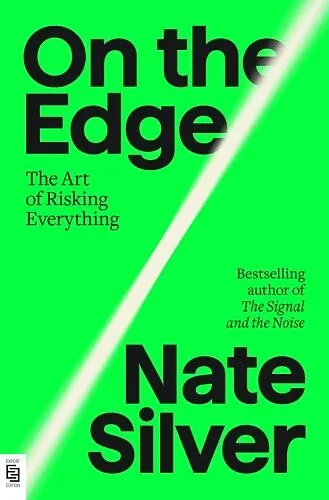
On the Edge
Beschreibung
NAMED A MOST-ANTICIPATED BOOK OF 2024 BY From the In the bestselling These professional risk takers--poker players and hedge fund managers, crypto true-believers and blue-chip art collectors--can teach us much about navigating the uncertainty of the 21st centu...Format auswählen
- Kartonierter EinbandCHF 23.50
- Fester EinbandCHF 40.70

Wird oft zusammen gekauft
Andere Kunden kauften auch
Beschreibung
NAMED A MOST-ANTICIPATED BOOK OF 2024 BY From the In the bestselling These professional risk takers--poker players and hedge fund managers, crypto true-believers and blue-chip art collectors--can teach us much about navigating the uncertainty of the 21st century. By embedding within the worlds of Doyle Brunson, Peter Thiel, Sam Bankman-Fried, and many others, Silver offers insight into a range of issues that affect us all, from the frontiers of finance to the future of AI. The River has increasing amounts of wealth and power in our society, and understanding their mindset--including the flaws in their thinking--is key to understanding what drives technology and the global economy today. There are certain commonalities in this otherwise diverse group: high tolerance for risk; appreciation of uncertainty; affinity for numbers; skill at de-coupling; self-reliance and a distrust of the conventional wisdom. For the River, complexity is baked in, and the work is how to navigate it, without going beyond the pale. Taking us behind-the-scenes from casinos to venture capital firms to the FTX inner sanctum to meetings of the effective altruism movement, <On the Edge< is a deeply-reported, all-access journey into a hidden world of powerbrokers and risk takers.
Autorentext
Nate Silver is the founder of FiveThirtyEight and the New York Times bestselling author of The Signal and the Noise. He writes the Substack "Silver Bulletin."
Klappentext
**The Instant New York Times Bestseller
“Engaging and entertaining… a glimpse of the economy of the future.” —Tim Wu, New York Times Book Review
From the New York Times bestselling author of The Signal and the Noise, the definitive guide to our era of risk—and the players raising the stakes
In a world wired for chaos, these players are rewriting the rules. High-stakes, high-IQ, and often high on their own mythologies, they are driving the next era of finance, tech, and politics. But what happens when their bets go too far?
Nate Silver’s On the Edge reveals the hidden world of the River. It is the domain of gamblers and like-minded folks who move markets and change the fabric of society: poker legends, hedge fund titans, crypto speculators, and even those willing to bet the world’s future on AI. They are obsessives with a deep hunger for volatility and an unrelenting desire to exploit every edge over the rest of us. Silver embeds with them, com-peting in the World Series of Poker, visiting Sam Bankman-Fried’s FTX compound, and attending wild Miami yacht parties at the height of the crypto bubble.
On the Edge is a front-row seat to a new world order built on risk, math, and ambition—a gripping ride through the minds shaping your future, whether you like it or not.
Leseprobe
Introduction
The Seminole Hard Rock Hotel & Casino in Hollywood, Florida, features one nightclub, seven pools, fourteen restaurants, a thirty‑foot‑high indoor waterfall, dozens of pieces of bedazzled rock‑ and‑roll memorabilia, two hundred gaming tables, 1,275 guest rooms, three thousand slot machines, and a glimmering guitar‑shaped hotel that shoots beams of neon blue light twenty thousand feet into the sky.
Like most casinos—and like most things in South Florida—the Hard Rock is designed to overwhelm your senses and undermine your inhibitions. Picture a casino in your head. If you haven’t been to a place like the Hard Rock or the Wynn in Las Vegas, you’re probably thinking of a dingy “slot barn” full of cigarette smoke and mazelike rows of chirping machines. Indeed, those can be some of the most depressing places on Earth. But at high‑end resorts like the Hard Rock, the mood at busy hours is exuberant. Few places in American life attract a broader cross section of society. There are adults of all ages, races, classes, ethnic groups, and political orientations. There are senior citizens hoping to hit a slot jackpot; groups of bros and gaggles of girls; and attendees of third‑rate trade association conferences compensating for the awkwardness of it all by overindulging in booze and blackjack.
I spent a lot of time in casinos over the course of writing this book. Needless to say, even the most glamorous ones eventually become tiresome. I sometimes had the feeling of being a professional wedding photographer: everyone was having the time of their life, their very special day. But I knew all the tropes, all the recurring characters—the dude trying to hide from his buddies at the craps table that he was playing beyond his means; the BFFs from the bachelorette party jockeying for pole position when a hot bachelor walked by; the friendly couple from Nebraska having the night of their life playing blackjack before giving all their winnings back twice over.
It was April 2021. I was in Florida for the Seminole Hard Rock Poker Showdown, the first really big poker tournament in the United States since the pandemic. For better or worse, I’d been pretty careful about avoiding crowded indoor spaces until I got vaccinated for COVID‑19. I hadn’t even been on a plane since March 11, 2020, when I learned midflight that Tom Hanks had gotten COVID, that the NBA had suspended its season, that President Trump had shut down travel from Europe—and that my fellow passengers and I had landed in a riskier universe.
But it was a year later, and it was time to gamble. Judging by the crowds at the Hard Rock, a lot of other people were in the same frame of mind. Despite their reputation for risk tolerance, casinos mostly did shut down in the early days of COVID. Even the Las Vegas Strip—which I’d always as‑ sumed would continue to operate even in the event of a nuclear apocalypse—was closed for two and a half months. During this period, casino gaming revenues across the United States were down by as much as 96 percent from a year earlier.
But they rebounded with a vengeance. Somehow, between the anxiety caused by the unprecedented mass death of COVID and the boredom caused by the unprecedented lack of social interaction, Americans’ appetite for YOLO (You Only Live Once) behavior exploded, manifesting itself in everything from illegal fireworks displays to traffic accidents to cryptocurrency bubbles. (Bitcoin prices increased roughly tenfold in the year after the WHO declared COVID‑19 to be a pandemic.) And so in April 2021—even as schools remained closed in parts of the country—American casinos won a staggering $4.6 billion in gaming revenues from their patrons, 26 percent higher than in the same month two years earlier, before the pandemic.
Poker players came out in a show of force at the Hard Rock. In April 2019, the last time this particular tournament had been held before COVID, it had a respectable 1,360 entrants. The 2021 version drew almost twice as many—2,482 entrants—despite still being in the middle of a pandemic and a travel ban affecting most of the poker‑playing world. It could easily have been more: demand was so overwhelming that there were hours‑long waits to pony up $3,500 and register for a seat. Still, this was the largest‑ ever number of entrants for a tournament on the World Poker Tour, which sponsored the event. Appropriately enough, the tournament was eventu‑ ally won by an ICU nurse from Grand Rapids, Michigan, named Brek Schutten, who had done his time in COVID wards.
We played through unusual conditions. There was a mask mandate, which I’d expected to be an enforcement disaster: poker players are both individualistic and irascible, not the types to quietly follow orders. But mo…