
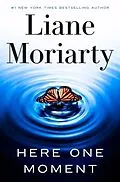
Here One Moment
Beschreibung
An upcoming book to be published by Penguin Random House. Autorentext Liane Moriarty is the author of the #1 New York Times bestsellers Big Little Lies, Apples Never Fall, The Husband’s Secret, and Truly Madly Guilty; the New York Times bestsellers ...Format auswählen
- Kartonierter EinbandCHF 21.10
- Fester EinbandCHF 33.20
- Kartonierter EinbandCHF 35.90

Wird oft zusammen gekauft
Andere Kunden kauften auch
Beschreibung
An upcoming book to be published by Penguin Random House.
Autorentext
Liane Moriarty is the author of the #1 New York Times bestsellers Big Little Lies, Apples Never Fall, The Husband’s Secret, and Truly Madly Guilty; the New York Times bestsellers Nine Perfect Strangers, What Alice Forgot, and The Last Anniversary; The Hypnotist’s Love Story; and Three Wishes. She lives in Sydney, Australia, with her husband and two children.
Klappentext
#1 NEW YORK TIMES BESTSELLER • From the beloved author of Big Little Lies, Apples Never Fall, and The Husband’s Secret comes a moving novel of love, marriage, family, and trying to find certainty in a fragile world.
“The premise is irresistible—a woman on a flight from Hobart to Sydney begins predicting the age and manner of death of her fellow passengers. Beautifully written, this propulsive novel has a serious theme. Could be a great . . . present for that special someone.”—Stephen King
“A riveting story so wild you don’t know how she’ll land it, and then she does, on a dime.”—Anne Lamott
AN NPR BEST BOOK OF THE YEAR
Life is full of twists and turns you never see coming. But what if you did?
Flight attendant Allegra Patel loves her job, but today is her twenty-eighth birthday and she’d rather not be placating a plane full of passengers unhappy about a long delay. There’s the well-dressed man in seat 4C desperate not to miss his daughter’s musical. A harried mother frantically tries to keep her toddler and baby quiet. Honeymooners still in their wedding finery dream of their new lives, while a chatty emergency room nurse dreams of retirement.
Suddenly a woman traveling alone stands. She walks down the aisle making predictions about how and when passengers will die. Some dismiss her, they don’t believe in psychics. Some are delighted with her prophecies! Their lives will supposedly be long. Others are appalled.
Then: a few months later, the first prediction comes true.
Intricately plotted, with the wonderful wit Liane Moriarty has become famous for, Here One Moment brilliantly looks at friends, lovers, and family and how we manage to hold onto them in our harried modern lives.
Leseprobe
Chapter 1
Later, not a single person will recall seeing the lady board the flight at Hobart Airport.
Nothing about her appearance or demeanor raises a red flag or even an eyebrow.
She is not drunk or belligerent or famous.
She is not injured, like the bespectacled hipster with his arm scaffolded in white gauze so that one hand is permanently pressed to his heart, as if he’s professing his love or honesty.
She is not frazzled, like the sweaty young mother trying to keep her grip on a slippery baby, a furious toddler, and far too much carry-on.
She is not frail, like the stooped elderly couple wearing multiple heavy layers as if they’re off to join Captain Scott’s Antarctic expedition.
She is not grumpy, like the various middle-aged people with various middle-aged things on their minds, or the flight’s only unaccompanied minor: a six-year-old forced to miss his friend’s laser-tag party because his parents’ shared custody agreement requires him to be on this flight to Sydney every Friday afternoon.
She is not chatty, like the couple so eager to share details of their holiday you can’t help but wonder if they’re working undercover for a Tasmanian state government tourism initiative.
She is not extremely pregnant like the extremely pregnant woman.
She is not extremely tall like the extremely tall guy.
She is not quivery from fear of flying or espresso or amphetamines (let’s hope not) like the jittery teen wearing an oversized hoodie over very short shorts that makes it look like she’s not wearing any pants, and someone says she’s that singer dating that actor, but someone else says no, that’s not her, I know who you mean, but that’s not her.
She is not shiny-eyed like the shiny-eyed honeymooners flying to Sydney still in their lavish bridal clothes, those crazy kids, leaving ripples of goodwill in their wake, and even eliciting a reckless offer from a couple to give up their business-class seats, which the bride and groom politely but firmly refuse, much to the couple’s relief.
The lady is not anything that anyone will later recall.
The flight is delayed. Only by half an hour. There are scowls and sighs, but for the most part passengers are willing to accept this inconvenience. That’s flying these days.
At least it’s not canceled. “Yet,” say the pessimists.
The PA crackles an announcement: Passengers requiring special assistance are invited to board.
“Told you so!” The optimists jump to their feet and sling bags over their shoulders.
While boarding, the lady does not stop to tap the side of the plane once, twice, three times for luck, or to flirt with a flight attendant, or to swipe frantically at her phone screen because her boarding pass has mysteriously vanished, it was there just a minute ago, why does it always do that?
The lady is not useful, like the passengers who help parents and spouses find vanished boarding passes, or the square-shouldered, square-jawed man with a gray buzz cut who effortlessly helps hoist bags into overhead bins as he walks down the aisle of the plane without breaking his stride.
Once all passengers are boarded, seated, and buckled, the pilot introduces himself and explains there is a “minor mechanical issue we need to resolve” and “passengers will appreciate that safety is paramount.” The cabin crew, he points out, with just the hint of a smile in his deep, trustworthy voice, are also only hearing about this now. (So leave them be.) He thanks “folks” for their patience and asks them to sit back and relax, they should be on their way in the next fifteen minutes.
They are not on their way in fifteen minutes.
The plane sits on the tarmac without moving for ninety-two horrendous minutes. This is just a little longer than the expected flight time.
Eventually the optimists stop saying, “I’m sure we’ll still make it!”
Everyone is displeased: optimists and pessimists alike.
During this time, the lady does not press her call button to tell a flight attendant about her connection or dinner reservation or migraine or dislike of confined spaces or her very busy adult daughter with three children who is already on her way to the airport in Sydney to pick her up, and what is she meant to do now?
She does not throw back her head and howl for twenty excruciating minutes, like the baby, who is really just manifesting everyone’s feelings.
She does not request the baby be made to stop crying, like the three passengers who all seem to have reached middle age with the belief that babies stop crying on request.
She does not politely ask if she may please get off the plane now, like the unaccompanied minor, who reaches his limit forty minutes into the delay and thinks that maybe the laser-tag party is a possibility after all.
She does not demand she be allowed to disembark, along with her checked bag-gage, like the woman in a leopard-print jumpsuit who has places she needs to be, who is never flying this airline again, but who finally allows herself to be placated and then self-medicates so effectively she falls deeply asleep.
She does not abruptly cry out in despair, “Oh, can’t someone do something?” like the red-faced, frizzy-haired woman sitting two rows behind the crying baby. It isn’t clear if she wants something done about the delay…