Alice's Adventures in Wonderland and Through the Looking Glass
Beschreibung
Die Einwohner des Wunderlands sind längst im allgemeinen Bewusstsein verankert: das Weiße Kaninchen, die Grinsekatze ... und natürlich Alice, die mal größer, mal kleiner wird, an einer verrückten Teeparty teilnimmt und auf lebendige Spielkarten trifft, mit den...Format auswählen
- Fester EinbandCHF 25.90

Wird oft zusammen gekauft
Andere Kunden kauften auch
Beschreibung
Die Einwohner des Wunderlands sind längst im allgemeinen Bewusstsein verankert: das Weiße Kaninchen, die Grinsekatze ... und natürlich Alice, die mal größer, mal kleiner wird, an einer verrückten Teeparty teilnimmt und auf lebendige Spielkarten trifft, mit denen sie Croquet spielt - und dabei alle Skurrilitäten mit Klarheit und rationalem Erstaunen beobachtet.
"Through the Looking-Glass" führt Alice in eine Welt voller Spiegelungen und Kinderreime. Hier trifft sie u.a. Humpty Dumpty und die Zwillinge Tweedledee und Tweedledum. Während Kinder von Alice fasziniert sind, weil die Heldin ihre Gedanken und Gefühle des Erwachsenwerdens repräsentiert, schätzen Erwachsene das Buch als schlaue Satire auf das Viktorianische Leben, seine Erziehung, Politik und Literatur. Lewis Carrolls Fantasiewelten, Bilder und Gleichnisse beeinflussen bis heute die verschiedensten Künstler, Schriftsteller, Musiker und Filmemacher.
Informationen zum Autor Lewis Carroll, born Charles Lutwidge Dodgson (1832-98), grew up in Cheshire in the village of Daresbury, the son of a parish priest. He was a brilliant mathematician, a skilled photographer and a meticulous letter and diary writer. Alice's Adventures in Wonderland, inspired by Alice Liddell, the daughter of the Dean of Christ Church in Oxford, was published in 1865, followed by Through the Looking-Glass in 1871. He wrote numerous stories and poems for children including the nonsense poem The Hunting of the Snark and fairy stories Sylvie and Bruno. Klappentext Nominated as one of America's best-loved novels by PBS's The Great American Read Part of Penguin's beautiful hardback Clothbound Classics series, designed by the award-winning Coralie Bickford-Smith, these delectable and collectible editions are bound in high-quality colourful, tactile cloth with foil stamped into the design. 'I had sent my heroine straight down a rabbit-hole without the least idea what was to happen afterwards,' wrote Dodgson, describing how Alice was conjured up one 'golden afternoon' in 1862 to entertain his child-friend Alice Liddell. In the magical world of Wonderland and the back-to-front Looking-Glass kingdom, order is turned upside-down: a baby turns into a pig; time is abandoned at a tea-party; and a chaotic game of chess makes a 7-year-old a Queen. Leseprobe From Chapter IV: The Rabbit Sends in a Little Bill It was the White Rabbit, trotting slowly back again, and looking anxiously about as it went, as if it had lost something; and she heard it muttering to itself, The Duchess! The Duchess! Oh my dear paws! Oh my fur and whiskers! She'll get me executed, as sure as ferrets are ferrets! Where can I have dropped them, I wonder? Alice guessed in a moment that it was looking for the fan and the pair of white kidgloves, and she very good-naturedly began hunting about for them, but they were nowhere to be seeneverything seemed to have changed since her swim in the pool; and the great hall, with the glass table and the little door, had vanished completely. Very soon the Rabbit noticed Alice, as she went hunting about, and called out to her, in an angry tone, Why, Mary Ann, what are you doing out here? Run home this moment, and fetch me a pair of gloves and a fan! Quick, now! And Alice was so much frightened that she ran o at once in the direction it pointed to, without trying to explain the mistake that it had made. He took me for his housemaid, she said to herself as she ran. How surprised he'll be when he finds out who I am! But I'd better take him his fan and glovesthat is, if I can find them. As she said this, she came upon a neat little house, on the door of which was a bright brass plate with the name W. RABBIT engraved upon it. She went in without knocking, and hurried upstairs, in great fear lest she should meet the real Mary Ann, and be turned out of the house before she had found the fan and gloves. How queer it seems, Alice said to herself, to be going messages for a rabbit! I suppose Dinah'll be sending me on messages next! And she began fancying the sort of thing that would happen: 'Miss Alice! Come here directly, and get ready for your walk!' 'Coming in a minute,' nurse! But I've got to watch this mouse-hole till Dinah comes back, and see that the mouse doesn't get out.' Only I don't think, Alice went on, that they'd let Dinah stop in the house if it began ordering people about like that! By this time she had found her way into a tidy little room with a table in the window, and on it (as she had hoped) a fan and two or three pairs of tiny white kid-gloves: she took up the fan and a pair of the gloves, and was just going to leave the room, when her eye fell upon a little bottle that stood near the looking-glass. There was no label this time with the words DRINK ME, but nevert...
Autorentext
Lewis Carroll, born Charles Lutwidge Dodgson (1832-98), grew up in Cheshire in the village of Daresbury, the son of a parish priest. He was a brilliant mathematician, a skilled photographer and a meticulous letter and diary writer. Alice's Adventures in Wonderland, inspired by Alice Liddell, the daughter of the Dean of Christ Church in Oxford, was published in 1865, followed by Through the Looking-Glass in 1871. He wrote numerous stories and poems for children including the nonsense poem The Hunting of the Snark and fairy stories Sylvie and Bruno.
Klappentext
Nominated as one of America's best-loved novels by PBS's The Great American Read
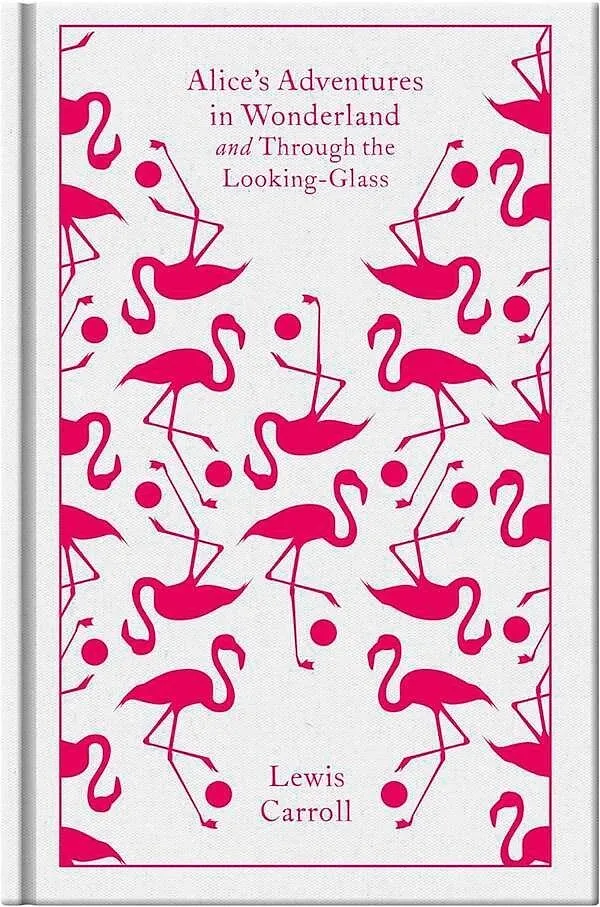
Part of Penguin's beautiful hardback Clothbound Classics series, designed by the award-winning Coralie Bickford-Smith, these delectable and collectible editions are bound in high-quality colourful, tactile cloth with foil stamped into the design. 'I had sent my heroine straight down a rabbit-hole without the least idea what was to happen afterwards,' wrote Dodgson, describing how Alice was conjured up one 'golden afternoon' in 1862 to entertain his child-friend Alice Liddell. In the magical world of Wonderland and the back-to-front Looking-Glass kingdom, order is turned upside-down: a baby turns into a pig; time is abandoned at a tea-party; and a chaotic game of chess makes a 7-year-old a Queen.
Zusammenfassung
In the magical world of Wonderland and the back-to-front Looking-Glass kingdom, order is turned upside-down: a baby turns into a pig; time is abandoned at a tea-party; and, a chaotic game of chess makes a 7-year-old a Queen.
Leseprobe
From Chapter IV: The Rabbit Sends in a Little Bill
It was the White Rabbit, trotting slowly back again, and looking anxiously about as it went, as if it had lost something; and she heard it muttering to itself, “The Duchess! The Duchess! Oh my dear paws! Oh my fur and whiskers! She’ll get me executed, as sure as ferrets are ferrets! Where can I have dropped them, I wonder?” Alice guessed in a
moment that it was looking for the fan and the pair of white kidgloves, and she very good-naturedly began hunting about for them, but they were nowhere to be seen—everything seemed to have changed since her swim in the pool; and the great hall, with the glass table and the little door, had vanished completely.
Very soon the Rabbit noticed Alice, as she went hunting about, and called out to her, in an angry tone, “Why, Mary Ann, what are you doing out here? Run home this moment, and fetch me a pair of gloves and a fan! Quick, now!” And Alice was so much frightened that she ran o at once in the direction it pointed to, without trying to explain the mistake that it had made.
“He took me for his housemaid,” she said to herself as she ran. “How surprised he’ll be when he finds out who I am! But I’d better take him his fan and gloves—that is, if I can find them.” As she said this, she came upon a neat little house, on the door of which was a bright brass plate with the name “W. RABBIT ” engraved upon it. She went in without…