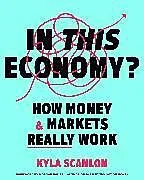
In This Economy?
Beschreibung
Informationen zum Autor Kyla Scanlon Klappentext NEW YORK TIMES BESTSELLER • The book Jon Stewart ( The Daily Show ) hailed as essential reading for anyone who wants to make informed decisions and have a basic understanding of the economy: an illustrated ...Format auswählen
- Fester EinbandCHF 22.70

Wird oft zusammen gekauft
Andere Kunden kauften auch
Beschreibung
Informationen zum Autor Kyla Scanlon Klappentext NEW YORK TIMES BESTSELLER • The book Jon Stewart ( The Daily Show ) hailed as essential reading for anyone who wants to make informed decisions and have a basic understanding of the economy: an illustrated guide to economics from one of the internet's favorite financial educators. Few people can communicate how the economy actually works better than Kyla Scanlon.Morgan Housel, author of The Psychology of Money Is our national debt really a threat? What is a mild recession, exactly? If you're worried about your bank account balance, job security, or mortgage rate, what data should you be keeping tabs on? For anyone trying to make sense of disorienting headlines, there's no better interpreter than Kyla Scanlon. Through her trademark blend of witty illustrations, creative analogies, and insights from behavioral economics, literature, and philosophy, Scanlon breaks down everything you need to know about how money and markets really work. This indispensable handbook reveals the hidden forces driving key economic outcomes, the most common myths to steer clear of, and the dusty, outdated assumptions that constrain our political imagination, offering a bold new path to building a prosperous society that works for everyone. Leseprobe Chapter 1 The Economic Kingdom The person that turns over the most rocks wins the game. And that's always been my philosophy. Peter Lynch When I was younger, I loved to play a game called The Princess and the Kingdom. My brother and I would build fantastical lands with our toys, complete with castles, moats, and tiny LEGO armies that really hurt if you accidentally stepped on them with your bare feet. For me, empire building was the best part. How fruitful the land was, how protected the entrances were, what tools the people had access tothat's what really determined how the game would play out. The same holds for the financial infrastructure that's woven through our lives, our very own Economic Kingdom. Let's start with the biggest castle: the monetary policy castle. The Kingdom The monetary policy castle is presided over by the Federal Reserve, which is supposed to be managing the entire kingdom. We'll get into the inner workings of the Fed soon, but for right now what you need to know is that the monetary policy castle is most directly in charge of two other castles: inflation (defined as a rise in prices that creates a decrease in purchasing power, something we are all familiar with) and the labor market (where we find critically important metrics such as the labor force participation rate, the quits rate, the unemployment rate, and more). As I dive deeper, I'll describe how the Federal Reserve's actions can have far-reaching effects on the economic well-being of the kingdom's citizens, influencing their ability to afford goods and services and to find meaningful employment. Each castle (such as the housing market, stock market, and bond market) has a moat around it that provides a little insulation. That's why the Fed may fire a cannon (say, raising interest rates), and the cannonball might land without much of a hitmeaning that it really didn't do much. In other cases, it might damage the drawbridge and make day-to-day functioning harder, or it might take out a squadron of an attacking army (such as unwanted inflation). The Federal Reserve is constantly firing cannons near all of those castles in an attempt to exert control over the empire. Near is an important part of that sentence because the Fed cannon can occasionally make direct hitsbut the castles are pretty strong, and it's hard to take them down easily. Sometimes, the Fed simply doesn't have enough (or the right kind of) ammo to directly hit them. Unlike my Princess and the Kingdom...
Autorentext
Kyla Scanlon
Klappentext
**NEW YORK TIMES BESTSELLER • The book Jon Stewart (The Daily Show) hailed as “essential reading” for anyone who wants to “make informed decisions” and “have a basic understanding of the economy”: an illustrated guide to economics from one of the internet’s favorite financial educators.
“Few people can communicate how the economy actually works better than Kyla Scanlon.”—Morgan Housel, author of The Psychology of Money**
Is our national debt really a threat? What is a “mild” recession, exactly? If you’re worried about your bank account balance, job security, or mortgage rate, what data should you be keeping tabs on?
For anyone trying to make sense of disorienting headlines, there’s no better interpreter than Kyla Scanlon. Through her trademark blend of witty illustrations, creative analogies, and insights from behavioral economics, literature, and philosophy, Scanlon breaks down everything you need to know about how money and markets really work. This indispensable handbook reveals the hidden forces driving key economic outcomes, the most common myths to steer clear of, and the dusty, outdated assumptions that constrain our political imagination, offering a bold new path to building a prosperous society that works for everyone.