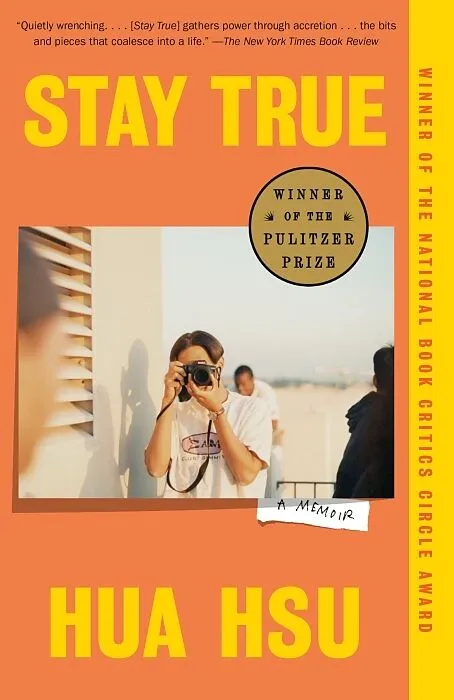
Stay True
Beschreibung
Informationen zum Autor Hua Hsu Klappentext One of the The New York Times 's 100 Best Books of the 21st Century Winner of the Pulitzer Prize Winner of the National Book Critics Circle Award New York Times Bestseller Quietly wrenchingTo say that this book is ab...Format auswählen
- Poche format BCHF 19.60
- Fester EinbandCHF 28.40
- Kartonierter EinbandCHF 31.10

Wird oft zusammen gekauft
Andere Kunden kauften auch
Beschreibung
Informationen zum Autor Hua Hsu Klappentext One of the The New York Times 's 100 Best Books of the 21st Century Winner of the Pulitzer Prize Winner of the National Book Critics Circle Award New York Times Bestseller Quietly wrenchingTo say that this book is about grief or coming-of-age doesn't quite do it justiceThis is a memoir that gathers power through accretionall those moments and gestures that constitute experience, the bits and pieces that coalesce into a life. The New York Times [A] luminous and tender-hearted story. . . Stay True is a nuanced and beautiful evocation of young adulthood in all its sloppy, exuberant glory. The Wall Street Journal An evolutionary step for Asian American literature. New York Magazine In the eyes of eighteen-year-old Hua Hsu, the problem with Kenwith his passion for Dave Matthews, Abercrombie & Fitch, and his fraternityis that he is exactly like everyone else. Ken, whose Japanese American family has been in the United States for generations, is mainstream; for Hua, the son of Taiwanese immigrants, who makes 'zines and haunts Bay Area record shops, Ken represents all that he defines himself in opposition to. The only thing Hua and Ken have in common is that, however they engage with it, American culture doesn't seem to have a place for either of them. But despite his first impressions, Hua and Ken become friends, a friendship built on late-night conversations over cigarettes, long drives along the California coast, and the successes and humiliations of everyday college life. And then violently, senselessly, Ken is gone, killed in a carjacking, not even three years after the day they first meet. Determined to hold on to all that was left of one of his closest friendshis memoriesHua turned to writing. Stay True is the book he's been working on ever since. A coming-of-age story that details both the ordinary and extraordinary, Stay True is a bracing memoir about growing up, and about moving through the world in search of meaning and belonging. Leseprobe Back then, there was no such thing as spending too much time in the car. We would have driven anywhere so long as we were together. I always offered my Volvo. First, it seemed like the cool, generous thing to do. Second, it ensured that everyone had to listen to my music. Nobody could cook, yet we were always piling into my station wagon for aspirational trips to the grocery store on College Avenue, the one that took about six songs to get to. We crossed the Bay Bridge simply to get ice cream, justifying a whole new mixtape. There was a twenty-four-hour Kmart down 880 that we discovered one night on the way back from giving someone a lift to the airportthe ultimate gesture of friendship. A half-hour drive just to buy notepads or underwear in the dead of night, and it was absolutely worth it. Occasionally, a stray, scratchy pop tune would catch someone's attention. What's this? I'd heard these songs hundreds of times before. But to listen to them with other people: it was what I'd been waiting for. Passengers had different personalities. Some called shotgun with a neurotic intensity, as though their entire sense of self relied on sitting up front. Sammi flicked her lighter all the time, until one afternoon when the glove compartment caught on fire. Paraag always ejected my tapes and insisted on listening to the radio. Anthony, forever staring out the window. You might come no closer to touching another person than in a cramped backseat, sharing a seat belt meant for one. I had taken my parents' fear of blind spots to heart, and my head constantly bounded from side to side, checking the various mirrors, noting cars in neighboring lanes, in between sneaking glances at my friends to see...
Autorentext
Hua Hsu
Klappentext
**One of the The New York Times’s 100 Best Books of the 21st Century
Winner of the Pulitzer Prize**
Winner of the National Book Critics Circle Award
New York Times Bestseller
“Quietly wrenching…To say that this book is about grief or coming-of-age doesn’t quite do it justice…This is a memoir that gathers power through accretion—all those moments and gestures that constitute experience, the bits and pieces that coalesce into a life.”
**— The New York Times**
“[A] luminous and tender-hearted story. . . Stay True is a nuanced and beautiful evocation of young adulthood in all its sloppy, exuberant glory.”
**— The Wall Street Journal**
“An evolutionary step for Asian American literature.”
**— New York Magazine**
In the eyes of eighteen-year-old Hua Hsu, the problem with Ken—with his passion for Dave Matthews, Abercrombie & Fitch, and his fraternity—is that he is exactly like everyone else. Ken, whose Japanese American family has been in the United States for generations, is mainstream; for Hua, the son of Taiwanese immigrants, who makes ’zines and haunts Bay Area record shops, Ken represents all that he defines himself in opposition to. The only thing Hua and Ken have in common is that, however they engage with it, American culture doesn’t seem to have a place for either of them.
But despite his first impressions, Hua and Ken become friends, a friendship built on late-night conversations over cigarettes, long drives along the California coast, and the successes and humiliations of everyday college life. And then violently, senselessly, Ken is gone, killed in a carjacking, not even three years after the day they first meet.
Determined to hold on to all that was left of one of his closest friends—his memories—Hua turned to writing. Stay True is the book he’s been working on ever since. A coming-of-age story that details both the ordinary and extraordinary, Stay True is a bracing memoir about growing up, and about moving through the world in search of meaning and belonging.
Leseprobe
Back then, there was no such thing as spending too much time in the car. We would have driven anywhere so long as we were together.
I always offered my Volvo. First, it seemed like the cool, generous thing to do. Second, it ensured that everyone had to listen to my music. Nobody could cook, yet we were always piling into my station wagon for aspirational trips to the grocery store on College Avenue, the one that took about six songs to get to. We crossed the Bay Bridge simply to get ice cream, justifying a whole new mixtape. There was a twenty-four-hour Kmart down 880 that we discovered one night on the way back from giving someone a lift to the airport—the ultimate gesture of friendship. A half-hour drive just to buy notepads or underwear in the dead of night, and it was absolutely worth it. Occasionally, a stray, scratchy pop tune would catch someone’s attention. What’s this? I’d heard these songs hundreds of times before. But to listen to them with other people: it was what I’d been waiting for.
Passengers had different personalities. Some called shotgun with a neurotic intensity, as though their entire sense of self relied on sitting up front. Sammi flicked her lighter all the time, until one afternoon when the glove compartment caught on fire. Paraag always ejected my tapes and insisted on listening to the radio. Anthony, forever staring out the window. You might come no closer to touching another person than in a cramped backseat, sharing a seat belt meant for one.
I had taken my parents’ fear of blind spots to heart, and my head constantly bounded from side to side, checking the various mirrors, noting cars in neighboring lanes, in between sneaking glances at my friends to see if anyone else noticed that Pavement was far superior to Pearl Jam. I was responsible for everyone’s safety, and for their enrichment, too.
I have a photo of Ken and Suzy sitting shoulder to sh…