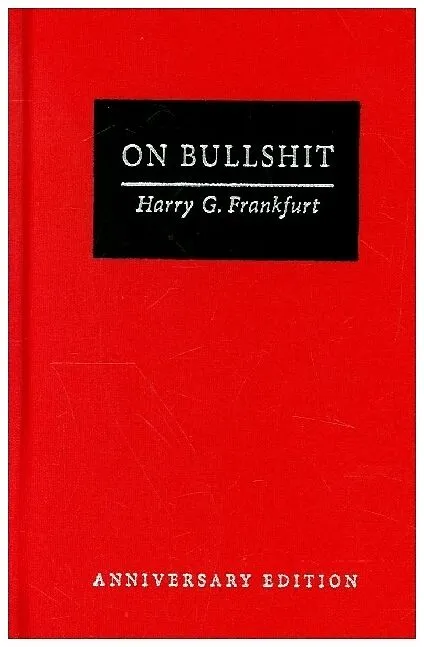
On Bullshit
Beschreibung
One of the most salient features of our culture is that there is so much bullshit. Everyone knows this. Each of us contributes his share. But we tend to take the situation for granted. Most people are rather confident of their ability to recognize bullshit and...Format auswählen
- Fester EinbandCHF 16.20

Wird oft zusammen gekauft
Andere Kunden kauften auch
Beschreibung
One of the most salient features of our culture is that there is so much bullshit. Everyone knows this. Each of us contributes his share. But we tend to take the situation for granted. Most people are rather confident of their ability to recognize bullshit and to avoid being taken in by it. So the phenomenon has not aroused much deliberate concern. We have no clear understanding of what bullshit is, why there is so much of it, or what functions it serves. And we lack a conscientiously developed appreciation of what it means to us. In other words, as Harry Frankfurt writes, "we have no theory." Frankfurt, one of the world's most influential moral philosophers, attempts to build such a theory here. With his characteristic combination of philosophical acuity, psychological insight, and wry humor, Frankfurt proceeds by exploring how bullshit and the related concept of humbug are distinct from lying. He argues that bullshitters misrepresent themselves to their audience not as liars do, that is, by deliberately making false claims about what is true. In fact, bullshit need not be untrue at all. Rather, bullshitters seek to convey a certain impression of themselves without being concerned about whether anything at all is true. They quietly change the rules governing their end of the conversation so that claims about truth and falsity are irrelevant. Frankfurt concludes that although bullshit can take many innocent forms, excessive indulgence in it can eventually undermine the practitioner's capacity to tell the truth in a way that lying does not. Liars at least acknowledge that it matters what is true. By virtue of this, Frankfurt writes, bullshit is a greater enemy of the truth than lies are.
Autorentext
Harry G. Frankfurt (1929–2023) was one of the world’s most influential moral philosophers and a professor of philosophy emeritus at Princeton University. His books included On Inequality, The Reasons of Love, and Demons, Dreamers, and Madmen (all Princeton).
Klappentext
Over one million copies sold worldwide
The international and #1 New York Times bestseller
The anniversary edition of the acclaimed book that reveals why bullshit is more dangerous than lying
One of the most prominent features of our world is that there is so much bullshit. Yet we have no clear understanding of what bullshit is, how it’s different from lying, what purposes it serves, and what it means. In his acclaimed bestseller On Bullshit, which was featured on The Daily Show and 60 Minutes, Harry Frankfurt, who was one of the world’s most influential moral philosophers, explores one of the most serious problems of our politics and our world. This twentieth anniversary edition features a postscript in which Frankfurt emphasizes that “indifference to the truth is extremely dangerous.”
With his characteristic combination of philosophical acuity, psychological insight, and wry humor, Frankfurt argues that bullshitters misrepresent themselves to their audience not as liars do—that is, by deliberately making false claims about what’s true. Rather, bullshitters seek to convey a certain impression of themselves without being concerned about whether anything at all is true. They quietly change the rules governing the conversation so that claims about truth and falsity are irrelevant. Although bullshit can take innocent forms, excessive indulgence in it can eventually undermine the bullshitter’s capacity to tell the truth in a way that lying doesn’t. Liars at least acknowledge that the truth matters. Because of this, Frankfurt says, “bullshit is a greater enemy of the truth than lies are.”
Remarkably prescient and insightful, On Bullshit is a small book that explains a great deal about our time.