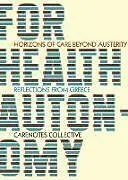
For Health Autonomy
Beschreibung
Autorentext Intensifying inequality and violence have heightened the need to deepen our capacity to resist, offer concrete alternatives, and reproduce ourselves in the process. CareNotes Collective organizes directly on this terrain and seeks to record and amp...Format auswählen
- Kartonierter EinbandCHF 18.70

Wird oft zusammen gekauft
Andere Kunden kauften auch
Beschreibung
Autorentext
Intensifying inequality and violence have heightened the need to deepen our capacity to resist, offer concrete alternatives, and reproduce ourselves in the process. CareNotes Collective organizes directly on this terrain and seeks to record and amplify the experiences of those struggling for health autonomy in their own communities. The challenge is to imagine how to expand these practices while defending our communities from the risks of cooption, state violence, and emotional trauma as well as financial domination. CareNotes is a collective of care workers who are organizing for health autonomy. They are committed to sharing experiences and analysis from autonomous care practices resisting the violence of the state and capitalist life. The editorial collective functions anonymously, without any grant funding, or any affiliation with academic/NGOs/foundations.
Klappentext
The present way of life is a war against our bodies. Nearly everywhere, we are caught in a crumbling health system that furthers our misery and subordination to the structural violence of capital and a state that only intensifies our general precarity. Can we build the capacity and necessary infrastructure to heal ourselves and transform the societal conditions that continue to mentally and physically harm us?
Amidst the perpetual crises of capitalism is a careful resistance—organized by medical professionals and community members, students and workers, citizens and migrants. For Health Autonomy: Horizons of Care Beyond Austerity—Reflections from Greece explores the landscape of care spaces coordinated by autonomous collectives in Greece. These projects operate in fierce resistance to austerity, state violence and abandonment, and the neoliberal structure of the healthcare industry that are failing people.
For Health Autonomy is a powerful collection of first-hand accounts of those who join together to build new possibilities of care and develop concrete alternatives based on the collective ability of communities and care workers to replace our dependency on police and prisons.
Zusammenfassung
“Here, the treatment of pathologies—such as cancers or viruses—is considered as important as dismantling the causes of pathologies, including the social problems of debt, homelessness, police violence, and isolation. We must grasp how the de-individualization of care, what we might refer to as the communization of care, is central to fighting state and capital’s racialized and gendered forms of abandonment.” *
For Health Autonomy: Horizons of Care Beyond Austerity—Reflections from Greece explores the landscape of care spaces coordinated by autonomous collectives in Greece, including clinics, social spaces for health, social kitchens, and safe spaces liberated from the state and capital. The significance of autonomous spaces is intensified in the very moment the state, capital, and their complicit institutions attempt to penetrate their power via austerity and state violence. In tandem with the broader anticapitalist movement, these spaces have ruptured the legitimacy of the state and capital, and reclaimed care beyond the limits of the biomedical, nonprofit, and capitalist frameworks.
The experience of Greek autonomous care spaces encapsulates care within, as well as beyond, the biomedical; where addressing pathologies, such as cancers or colds, are as important as dismantling the causes of the pathology, including debt, homelessness, police violence, and social isolation. The collected essays grasp how emotional and physical distress is preventable—where ensuring access to antibiotics, vaccines, or herbal remedies is as relevant as liberating unused space for housing or de-policing a neighborhood. The subjects of this collection include a network of users of psychosocial services, defending their right to autonomy within mental healthcare systems; a healthcare center organized and maintained by an anarchist collective; a worker’s clinic founded by a coalition of factory workers and healthcare solidarity activists; among others.
The Greek contribution to autonomous care work emancipates labor, space, and resources towards a form of life that sustains the bodies and well-being of the collectives directly involved in this process, and the broader network of autonomous communities that rely on such care spaces to reproduce other modes of noncapitalist life. Efforts to defend and expand the very elements necessary for the survival of our bodies and ecology are in tandem with efforts to rupture from hierarchies, profits, and institutionalized singularities. For Health Autonomy is a powerful collection of first-hand accounts of concrete alternatives that are replacing our need for police and prisons based on the collective power of communities and care workers. These reflections have merged from within and beyond healthcare institutions.
Leseprobe
There are over thirty social clinics in Greece. These spaces provide primary and specialized care for roughly ten percent of the popu- lation and a rising number of migrants. They operate beyond the financial flows and authority of the state, religious charities, and other external funders. Despite worsening austerity measures and police and fascist violence, these spaces maintain horizontal assem- blies that coordinate all aspects of fundraising, medical supplies, care delivery, and emotional support.
Most accounts from academics, journalists, and even some ac- tivists only consider Greek autonomous care work in its proximity to modern medicine and reflect upon healthcare reform based on these experiences. Some perceive these spaces as temporary materializations that address only a limited range of health issues by and for activists that disappear once the state and its neoliberal apparatus formulate new healthcare policies or more “efficient” forms of healthcare ser- vices. However, such notions rely on a nostalgic misperception of the permanence of a stable and benevolent social welfare state that ensures access to quality healthcare despite decades of neoliberal pol- icies devaluing care workers, closing healthcare facilities, and piling debt upon allied health students. For instance, when tracing the course of the UK’s National Health Service or the Affordable Care Act in the US, we can see how care workers are constantly struggling against hospital closures despite increased need by patients, longer work hours, more dangerous labor conditions due to higher patient turnover, and the hidden epidemic of depression, substance use, and suicide gripping care workers and allied health students. The deval- uation of care work more broadly is situated within a neoliberal logic that has led to more people becoming dependent on healthcare, not less. The biomedical model is falling short of sustaining our well- being while destroying our capacity to collectivize and confront against the violence committed against our bodies and ecologies.
Some doctors, rooted within the biomedical model, may dismiss these social clinics due to their inability to address the more acute di- mensions of clinical medicine, such as gunshot wounds, traumatic in- juries, or cancer. These require the kind of expert and resource-intensive services that western medicine rests its superiority upon. However, the overwhelming majority of healthcare needs can be addressed using preventative and primary care approaches that market-driven health systems do not deliver evenly or effectively to society.
To fully understand how Greek autonomous care work functions, one must imagine how it operates beyond the biomedical experience. Here, the treatment of pathologies—such as cancers or viruses—is considered as important as dismantling the causes of pathologies, in- cluding the social problem…