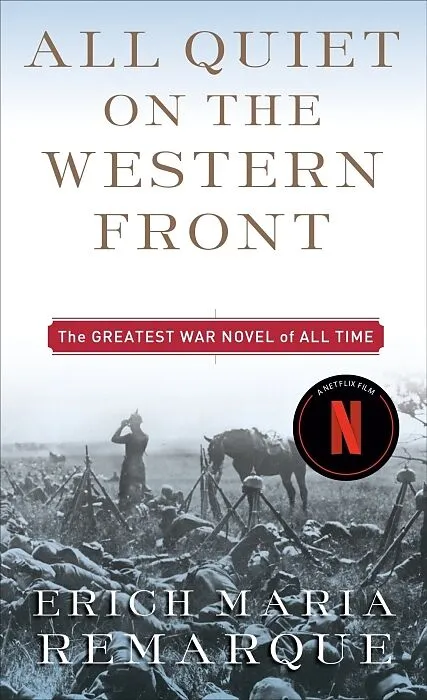
All Quiet on the Western Front
Beschreibung
Zusatztext The world has a great writer in Erich Maria Remarque. He is a craftsman of unquestionably first rank! a man who can bend language to his will. Whether he writes of men or of inanimate nature! his touch is sensitive! firm! and sure. The New York Time...Format auswählen
- Kartonierter EinbandCHF 11.40
- Kartonierter EinbandCHF 16.00
- Kartonierter EinbandCHF 24.00

Wird oft zusammen gekauft
Andere Kunden kauften auch
Beschreibung
Zusatztext The world has a great writer in Erich Maria Remarque. He is a craftsman of unquestionably first rank! a man who can bend language to his will. Whether he writes of men or of inanimate nature! his touch is sensitive! firm! and sure. The New York Times Book Review Informationen zum Autor Erich Maria Remarque Klappentext Considered by many the greatest war novel of all time, All Quiet on the Western Front is Erich Maria Remarque's masterpiece of the German experience during World War I. I am young, I am twenty years old; yet I know nothing of life but despair, death, fear, and fatuous superficiality cast over an abyss of sorrow. . . . This is the testament of Paul Bäumer, who enlists with his classmates in the German army during World War I. They become soldiers with youthful enthusiasm. But the world of duty, culture, and progress they had been taught breaks in pieces under the first bombardment in the trenches. Through years of vivid horror, Paul holds fast to a single vow: to fight against the principle of hate that meaninglessly pits young men of the same generation but different uniforms against one another . . . if only he can come out of the war alive. "The world has a great writer in Erich Maria Remarque. He is a craftsman of unquestionably first rank, a man who can bend language to his will. Whether he writes of men or of inanimate nature, his touch is sensitive, firm, and sure."-The New York Times Book Review Zusammenfassung The masterpiece of the German experience during World War I, considered by many the greatest war novel of all timewith an Oscarwinning film adaptation now streaming on Netflix. [Erich Maria Remarque] is a craftsman of unquestionably first rank. The New York Times Book Review I am young, I am twenty years old; yet I know nothing of life but despair, death, fear, and fatuous superficiality cast over an abyss of sorrow. . . . This is the testament of Paul Bäumer, who enlists with his classmates in the German army during World War I. They become soldiers with youthful enthusiasm. But the world of duty, culture, and progress they had been taught breaks in pieces under the first bombardment in the trenches. Through years of vivid horror, Paul holds fast to a single vow: to fight against the principle of hate that meaninglessly pits young men of the same generation but different uniforms against one another . . . if only he can come out of the war alive....
Autorentext
Erich Maria Remarque
Klappentext
Considered by many the greatest war novel of all time, All Quiet on the Western Front is Erich Maria Remarque's masterpiece of the German experience during World War I.
I am young, I am twenty years old; yet I know nothing of life but despair, death, fear, and fatuous superficiality cast over an abyss of sorrow. . . .
This is the testament of Paul Bäumer, who enlists with his classmates in the German army during World War I. They become soldiers with youthful enthusiasm. But the world of duty, culture, and progress they had been taught breaks in pieces under the first bombardment in the trenches.
Through years of vivid horror, Paul holds fast to a single vow: to fight against the principle of hate that meaninglessly pits young men of the same generation but different uniforms against one another . . . if only he can come out of the war alive.
"The world has a great writer in Erich Maria Remarque. He is a craftsman of unquestionably first rank, a man who can bend language to his will. Whether he writes of men or of inanimate nature, his touch is sensitive, firm, and sure."-The New York Times Book Review
Zusammenfassung
The masterpiece of the German experience during World War I, considered by many the greatest war novel of all time—with an Oscar–winning film adaptation now streaming on Netflix.
“[Erich Maria Remarque] is a craftsman of unquestionably first rank.”—The New York Times Book Review
*I am young, I am twenty years old; yet I know nothing of life but despair, death, fear, and fatuous superficiality cast over an abyss of sorrow. . . .
*This is the testament of Paul Bäumer, who enlists with his classmates in the German army during World War I. They become soldiers with youthful enthusiasm. But the world of duty, culture, and progress they had been taught breaks in pieces under the first bombardment in the trenches.
Through years of vivid horror, Paul holds fast to a single vow: to fight against the principle of hate that meaninglessly pits young men of the same generation but different uniforms against one another . . . if only he can come out of the war alive.
Leseprobe
Introduction by Norman Stone
For some years after the end of the First World War the memoirs of generals and statesmen dominated publication about it – none more prominently than Churchill’s great classic, The World Crisis (1923). Then, quite suddenly, ten years down the line, came the other side, the horror, the view from below. The British had lost almost a million men dead, the French over a million, and the Germans nearly two, mainly on the Western Front, where thousands of guns churned up the mud. War cripples hobbled the streets of Berlin, and are recorded in the bitter Twenties paintings of Georg Grosz and Otto Dix. Writers followed – in Great Britain, amongst the earliest books were Richard Aldington’s novel Death of a Hero (1929) and Robert Graves’s memoir Goodbye to All That (1929), the most famous of them all. I was given it as a Christmas present when I was fifteen and read it at a session. At the time, the mid- Fifties, there were men around, not even sixty, who had gone through the Western Front but you could never get them to talk about it. British critics did not attack ‘the system’, they tended to dwell on the incompetence of the generals. The French had a rather similar experience, in that the from-below story of 1914-18 surfaced with Louis-Ferdinand Celine’s Voyage au bout de la nuit (1932), which is brilliant black farce. Celine, who had volunteered in 1912, entered the War with the usual young man’s patriotism, and was badly maimed at an early stage; and he made a mockery of the whole business. But there is not really any French, let alone British or American, equivalent of the bitterness and edge that went into the paintings of Dix and Grosz. Two films come the closest – Oh! What a Lovely War (1969) which started off as a musical (1963) by Joan Littlewood based on the songs of the poor bloody infantry, and Stanley Kubrick’s Paths of Glory (1957). On the literary side, the German Erich Maria Remarque’s All Quiet on the Western Front (1929) is in a class of its own. It appeared not long before the Wall Street Crash started a process that was soon to give Germany eight million unemployed, and the Chancellorship of Adolf Hitler. Not just the Nazis banned it; so did the Lord Mayor of Cologne, Konrad Adenauer, a Centre Party Catholic and later first Chancellor of West Germany. Official Germany would not accept any responsibility for the War. In 1923 the legal scholar Hermann Kantorowicz put in a memorandum to the Reichstag ‘War Guilt’ committee, showing that three quarters of the published documents from 1914 were false, and even the ‘good German’ Gustav Stresemann tried to stop him from getting a Chair, and suppressed the report.
This is all understandable, because Germany did face a war indemnity, ‘reparations’, designed to cripple her for two generations, and to suggest that she had caused the War counted as treachery. But so did criticism of the army (and the fourteen-volume official history, besides being incomplete, was almost free of it). Exposing the reality was left to a writer such as Remarqu…