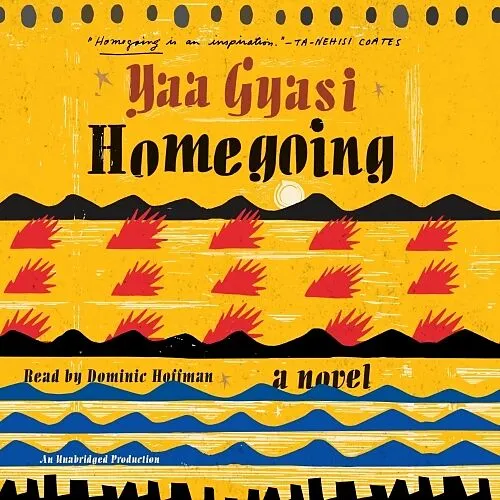
Homegoing
Beschreibung
Zusatztext 93543485 Informationen zum Autor YAA GYASI was born in Ghana and raised in Huntsville! Alabama. She holds a BA in English from Stanford University and an MFA from the Iowa Writers' Workshop! where she held a Dean's Graduate Research Fellowship. She ...Format auswählen
- Audio CD (CD/SACD)CHF 53.50

Wird oft zusammen gekauft
Andere Kunden kauften auch
Beschreibung
Zusatztext 93543485 Informationen zum Autor YAA GYASI was born in Ghana and raised in Huntsville! Alabama. She holds a BA in English from Stanford University and an MFA from the Iowa Writers' Workshop! where she held a Dean's Graduate Research Fellowship. She lives in Brooklyn. Klappentext Winner of the NBCC's John Leonard First Book Prize A New York Times 2016 Notable Book One of Oprah's 10 Favorite Books of 2016 NPR's Debut Novel of the Year One of Buzzfeed's Best Fiction Books Of 2016 One of Time's Top 10 Novels of 2016 "Homegoing is an inspiration." -Ta-Nehisi Coates The unforgettable New York Times best seller begins with the story of two half-sisters! separated by forces beyond their control: one sold into slavery! the other married to a British slaver. Written with tremendous sweep and power! Homegoing traces the generations of family who follow! as their destinies lead them through two continents and three hundred years of history! each life indeliably drawn! as the legacy of slavery is fully revealed in light of the present day. Effia and Esi are born into different villages in eighteenth-century Ghana. Effia is married off to an Englishman and lives in comfort in the palatial rooms of Cape Coast Castle. Unbeknownst to Effia! her sister! Esi! is imprisoned beneath her in the castle's dungeons! sold with thousands of others into the Gold Coast's booming slave trade! and shipped off to America! where her children and grandchildren will be raised in slavery. One thread of Homegoing follows Effia's descendants through centuries of warfare in Ghana! as the Fante and Asante nations wrestle with the slave trade and British colonization. The other thread follows Esi and her children into America. From the plantations of the South to the Civil War and the Great Migration! from the coal mines of Pratt City! Alabama! to the jazz clubs and dope houses of twentieth-century Harlem! right up through the present day! Homegoing makes history visceral! and captures! with singular and stunning immediacy! how the memory of captivity came to be inscribed in the soul of a nation. Includes a PDF of the Family Tree Effia The night effia otcher was born into the musky heat of Fanteland, a fire raged through the woods just outside her father's compound. It moved quickly, tearing a path for days. It lived off the air; it slept in caves and hid in trees; it burned, up and through, unconcerned with what wreckage it left behind, until it reached an Asante village. There, it disappeared, becoming one with the night. Effia's father, Cobbe Otcher, left his first wife, Baaba, with the new baby so that he might survey the damage to his yams, that most precious crop known far and wide to sustain families. Cobbe had lost seven yams, and he felt each loss as a blow to his own family. He knew then that the memory of the fire that burned, then fled, would haunt him, his children, and his children's children for as long as the line continued. When he came back into Baaba's hut to find Effia, the child of the night's fire, shrieking into the air, he looked at his wife and said, We will never again speak of what happened today. The villagers began to say that the baby was born of the fire, that this was the reason Baaba had no milk. Effia was nursed by Cobbe's second wife, who had just given birth to a son three months before. Effia would not latch on, and when she did, her sharp gums would tear at the flesh around the woman's nipples until she became afraid to feed the baby. Because of this, Effia grew thinner, skin on small birdlike bones, with a large black hole of a mouth that expelled a hungry cry which could be heard throughout the village, even on the days Baaba did her best to smother it, covering the baby's lips with the rough palm of her left hand. Love her, Cobbe commanded, as though l...
“Gyasi’s characters are so fully realized, so elegantly carved—very often I found myself longing to hear more. Craft is essential given the task Gyasi sets for herself—drawing not just a lineage of two sisters, but two related peoples. Gyasi is deeply concerned with the sin of selling humans on Africans, not Europeans. But she does not scold. She does not excuse. And she does not romanticize. The black Americans she follows are not overly virtuous victims. Sin comes in all forms, from selling people to abandoning children. I think I needed to read a book like this to remember what is possible. I think I needed to remember what happens when you pair a gifted literary mind to an epic task. Homegoing is an inspiration.”
—Ta-Nehisi Coates, National Book Award-winning author of Between the World and Me
"Homegoing is a remarkable feat—a novel at once epic and intimate, capturing the moral weight of history as it bears down on individual struggles, hopes, and fears. A tremendous debut.”
—Phil Klay, National Book Award-winning author of *Redeployment
*“I could not put this book down”
—Roxane Gay
“It is hard to overstate how much I LOVE this book”
—Michele Norris *
"One of the most fantastic books I've read in a long time...you cry and you laugh as you're reading it...a beautiful story"
—Trevor Noah, The Daily Show
*“The hypnotic debut novel by Yaa Gyasi, a stirringly gifted writer . . . magical . . . the great, aching gift of the novel is that it offers, in its own way, the very thing that enslavement denied its descendants: the possibility of imagining the connection between the broken threads of their origins.”
—Isabel Wilkerson, *The New York Times Book Review
*"It’s impossible not to admire the ambition and scope of “Homegoing,” and thanks to Ms. Gyasi’s instinctive storytelling gifts, the book leaves the reader with a visceral understanding of both the savage realities of slavery and the emotional damage that is handed down, over the centuries, from mothers to daughters, fathers to sons. At its best, the novel makes us experience the horrors of slavery on an intimate, personal level; by its conclusion, the characters’ tales of loss and resilience have acquired an inexorable and cumulative emotional weight."
—Michiko Kakutani, *The New York Times
*"The brilliance of this structure, in which we know more than the characters do about the fate of their parents and children, pays homage to the vast scope of slavery without losing sight of its private devastation . . . . [Toni Morrison’s] influence is palpable in Gyasi’s historicity and lyricism; she shares Morrison’s uncanny ability to crystalize, in a single event, slavery’s moral and emotional fallout. What is uniquely Gyasi’s is her ability to connect it so explicitly to the present day: **No novel has better illustrated the way in which racism became institutionalized in this country.”
—Megan O’Grady, Vogue
*“Toni Morrison’s masterpiece, “Beloved,” seared into our imagination the grotesque distortions of antebellum life. And now, Yaa Gyasi’s rich debut novel, “Homegoing,” confronts us of the involvement of Africans in the enslavement of their own people . . . the speed with which Gyasi sweeps across the decades isn’t confusing so much as dazzling, creating a kind of time-elapsed photo of black lives in America and in the motherland . . . haunting . . . Gyasi has developed a style agile enough to reflect the remarkable range of her first novel. As she moves across the centuries, from old and new Ghana and to pre-Civil War Alabama and modern-day Palo Alto, her prose modulates subtly according to time and setting: The 18th-century chapters resonate with the tones of legend, while the cont…