
IHR WARENKORB IST AKTUELL LEER.
Haben Sie noch nichts passendes gefunden? Stöbern Sie durch unser komplettes Sortiment.
Oder melden Sie sich an bzw. registrieren Sie sich.
- Kostenlose Lieferung
- Kauf auf Rechnung
- Ex Libris Tiefpreis
- Filiallieferung und 650+ Abholorte
- Rabatt-Bons als Club-Mitglied
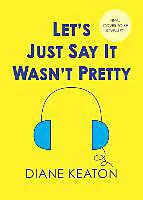
Let's Just Say It Wasn't Pretty
Beschreibung
ldquo;Behind the sterling movie credits and tomboyish wardrobe, we see a soulful and deep woman contemplating the narrative arc of her own life.”—Newsweek “Delicious writing . . . This book is like a dishy lunch with the movie star you...Format auswählen
- Audio CD (CD/SACD)CHF 42.50
Wird oft zusammen gekauft
Andere Kunden kauften auch
Beschreibung
ldquo;Behind the sterling movie credits and tomboyish wardrobe, we see a soulful and deep woman contemplating the narrative arc of her own life.”—Newsweek
“Delicious writing . . . This book is like a dishy lunch with the movie star you thought you’d never be lucky enough to meet. . . . Diane Keaton is in a class by herself and this book is good for the soul.”—Liz Smith, Chicago Tribune
“She’s talented, iconic, quirky . . . and wonderfully blunt. This is just a small sampling of the reasons we love Diane Keaton, and they all permeate the pages of her new memoir.”—Elle
“As disarming and personable as the actress herself.”—The Huffington Post
“Wise, witty, thoughtful, uplifting, the truth, unvarnished—and very funny.”—Toronto Star
From the Hardcover edition.
Autorentext
Diane Keaton is the New York Times bestselling author of Then Again, which was named one of the ten best books of the year by Janet Maslin of The New York Times, People, and Vogue. She has starred in some of the most memorable movies of the past forty years, including the Godfather trilogy, Annie Hall, Manhattan, Reds, Baby Boom, The First Wives Club, and Something’s Gotta Give. Her many awards include the Golden Globe and the Academy Award. Keaton lives with her daughter and son in Los Angeles.
From the Audiobook Download edition.
Zusammenfassung
**NEW YORK TIMES BESTSELLER
From Academy Award winner and bestselling author Diane Keaton comes a candid, hilarious, and deeply affecting look at beauty, aging, and the importance of staying true to yourself—no matter what anyone else thinks.**
Diane Keaton has spent a lifetime coloring outside the lines of the conventional notion of beauty. In Let’s Just Say It Wasn’t Pretty, she shares the wisdom she’s accumulated through the years as a mother, daughter, actress, artist, and international style icon. This is a book only Diane Keaton could write—a smart and funny chronicle of the ups and downs of living and working in a world obsessed with beauty.
In her one-of-a-kind voice, Keaton offers up a message of empowerment for anyone who’s ever dreamed of kicking back against the “should”s and “supposed to”s that undermine our pursuit of beauty in all its forms. From a mortifying encounter with a makeup artist who tells her she needs to get her eyes fixed to an awkward excursion to Victoria’s Secret with her teenage daughter, Keaton shares funny and not-so-funny moments from her life in and out of the public eye.
For Diane Keaton, being beautiful starts with being true to who you are, and in this book she also offers self-knowing commentary on the bold personal choices she’s made through the years: the wide-brimmed hats, outrageous shoes, and all-weather turtlenecks that have made her an inspiration to anyone who cherishes truly individual style—and catnip to paparazzi worldwide. She recounts her experiences with the many men in her life—including Warren Beatty, Jack Nicholson, Al Pacino, and Sam Shepard—shows how our ideals of beauty change as we age, and explains why a life well lived may be the most beautiful thing of all.
Wryly observant and as fiercely original as Diane Keaton herself, Let’s Just Say It Wasn’t Pretty is a head-turner of a book that holds up a mirror to our beauty obsessions—and encourages us to like what we see.
Praise for Let's Just Say It Wasn't Pretty*
*
“Behind the sterling movie credits and tomboyish wardrobe, we see a soulful and deep woman contemplating the narrative arc of her own life.”—Newsweek
“Delicious writing . . . This book is like a dishy lunch with the movie star you thought you’d never be lucky enough to meet. . . . Diane Keaton is in a class by herself and this book is good for the soul.”—Liz Smith, Chicago Tribune
“She’s talented, iconic, quirky . . . and wonderfully blunt. This is just a small sampling of the reasons we love Diane Keaton, and they all permeate the pages of her new memoir.”—Elle
“As disarming and personable as the actress herself.”—The Huffington Post
“Wise, witty, thoughtful, uplifting, the truth, unvarnished—and very funny.”—Toronto Star
From the Hardcover edition.
Leseprobe
Prisoners
on My
Wall
As I throw my coat on the chair, I see Alexander Gardner’s 1865 portrait of Abraham Lincoln hanging on my living room wall. My first impression of President Lincoln came from a book I checked out of the Bushnell Way Elementary School library, Abe Lincoln: Log Cabin to White House, by Sterling North. In it President Lincoln fought to free the slaves. He was a great man who paid the ultimate price. Mr. North described Pres-ident Lincoln as unsightly, even homely. To a ten-year-old girl, that meant President Lincoln was ugly. I didn’t understand how an ugly man could become the president of the United States. Gardner’s photograph, taken just days before Lincoln was shot in Ford’s Theatre, contradicts North’s description of a man who got shortchanged in the looks department.
Dominated by a pair of eyes set in darkness, Lincoln’s face is magnificent. His left eye, engaged by what it sees, looks out with endless empathy, while his right eye tells a story that is harder to comprehend. The bottom half of his face, framed by two deep lines, singles out his prominent nose, but it’s those eyes, particularly the left eye, the caring eye, the engaged eye, that is so compelling. Or is it? As my own eyes drift across Lincoln’s wide forehead, I look back into the right eye, the one drawn toward reflection, and you know what I see? I see the darkness of a great calling.
Did President Lincoln’s face become magnificent because he accepted a grave responsibility that would lead to a tragic end? Or was it the angle of Mr. Gardner’s pose, the light, the patina? Was it good luck or a fortunate mistake? After living with Mr. Lincoln’s portrait for several years, I’ve come to this conclusion: his beauty, like the hidden cast of his right eye, became identifiable only after I included “unsightly” as a possible way of describing a beautiful face.
Sharing wall space with Abraham Lincoln are forty-seven other portraits of men I’ve collected over twenty-five years. I call them my prisoners. There’s Robert Mapplethorpe’s portrait of the artist Francesco Clemente, who presents his hands from under a black coat. There’s Marion Robert Morrison’s face before he became John Wayne. On the bottom left, Tony Ward is painted with mud. His hands frame his eyes. Maybe he’s sick of looking out from under the dirt. Maybe he doesn’t want to be painted into a shadow; maybe he’s tired of being Herb Ritts’s favorite model. The face of the Russian revolutionary and poet Vladimir Mayakovsky stares out in shaved-head resistance. He brings up longings. I’d carry his coattails. I’d be his lackey. Next to the kitchen door, Elvis Presley is sticking his tongue into a young woman’s mouth. I never understood why he made millions of girls cry until I saw Albert Wertheimer’s Kiss in an ad for Sam Shepard’s play Fool for Love.
Which brings up Sam Shepard, who is framed dead center among the other prisoners on my wall. I was thirty-one when…