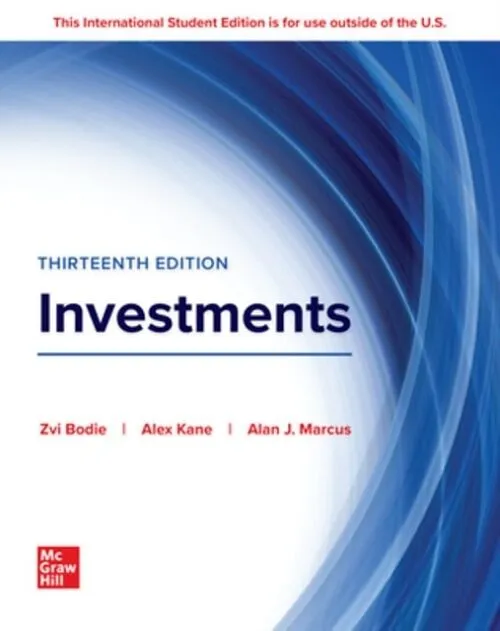
Investments
Beschreibung
Informationen zum Autor Zvi Bodie is Professor Emeritus at Boston University. He holds a PhD from the Massachusetts Institute of Technology and has served on the finance faculty at the Harvard Business School and MIT's Sloan School of Management. He has publis...Format auswählen
- Kartonierter EinbandCHF 98.00

Wird oft zusammen gekauft
Andere Kunden kauften auch
Beschreibung
Informationen zum Autor Zvi Bodie is Professor Emeritus at Boston University. He holds a PhD from the Massachusetts Institute of Technology and has served on the finance faculty at the Harvard Business School and MIT's Sloan School of Management. He has published widely in scholarly and professional journals on pension investment strategy and life-cycle asset-liability matching. In 2007 the Retirement Income Industry Association gave him its Lifetime Achievement Award for applied research. Alex Kune holds a PhD from the Stern School of Business of New York University and has been Visiting Professor at the Faculty of Economics, University of Tokyo; Graduate School of Business, Harvard; Kennedy School of Government, Harvard; and Research Associate, National Bureau of Economic Research. An author of many articles in finance and management journals. Professor Kane's research is mainly in corporate finance, portfolio management. and capital markets. Alan Marcus is the Mario J. Gabelli Professor of Finance in the Carroll School of Management at Boston College. He received his PhD in economics from MIT. Professor Marcus has been a visiting professor at the Athens Laboratory of Business Administration and at MIT's Sloan School of Management and has served as a research associate at the National Bureau of Economic Research. Professor Marcus has published widely in the fields of capital markets and portfolio management. He also spent two years at the Federal Home Loan Mortgage Corporation (Freddie Mac), where he developed models of mortgage pricing and credit risk. He currently serves on the Research Foundation Advisory Board of the CFA Institute. Klappentext Investments set the standardas a graduate (MBA) text intended primarily for courses in investment analysis.The guiding principle has been to present the material in a framework that isorganized by a central core of consistent fundamental principles and will introducestudents to major issues currently of concern to all investors. In an effort to link theory to practice, the authorsmake their approach consistent with that of the CFA Institute. Many features ofthis text make it consistent with and relevant to the CFA curriculum. The common unifying theme is that securitymarkets are nearly efficient, meaning that most securities are priced appropriately given their risk and return attributes. Investments is alsoorganized around several important themes: The central theme is the near informational-efficiency of well-developed security markets and the general awareness that competitive markets do not offer "free lunches" to participants. A second theme is the risk-return trade-off. Also, this text places great emphasis on asset allocation. Finally, this text offers a broad and deep treatment of futures, options, and other derivative security markets. Inhaltsverzeichnis PART I: IntroductionChapter 1: The Investment EnvironmentChapter 2: Asset Classes and Financial InstrumentsChapter 3: How Securities Are TradedChapter 4: Mutual Funds and Other InvestmentCompanies PART II: Portfolio Theory and PracticeChapter 5: Risk, Return, and the HistoricalRecordChapter 6: Capital Allocation to Risky AssetsChapter 7: Efficient DiversificationChapter 8: Index Models PART III: Equilibrium in Capital MarketsChapter 9: The Capital Asset Pricing ModelChapter 10: Arbitrage Pricing Theory andMultifactor Models of Risk and ReturnChapter 11: The Efficient Market HypothesisChapter 12: Behavioral Finance and TechnicalAnalysisChapter 13: Empirical Evidence on SecurityReturns PART IV: Fixed-Income SecuritiesChapter 14: Bond Prices and YieldsChapter 15: The Term Structure of Interest RatesChapter 16: Managing Bond Portfolios PART V: Security AnalysisChapter 17: Macroeconomic and Industry AnalysisChapter 18: Equity Valuation ModelsChapter 19: Financial Statement AnalysisPA...
Autorentext
Zvi Bodie is Professor Emeritus at Boston University. He holds a PhD from the Massachusetts Institute of Technology and has served on the finance faculty at the Harvard Business School and MIT's Sloan School of Management. He has published widely in scholarly and professional journals on pension investment strategy and life-cycle asset-liability matching. In 2007 the Retirement Income Industry Association gave him its Lifetime Achievement Award for applied research.
Alex Kune holds a PhD from the Stern School of Business of New York University and has been Visiting Professor at the Faculty of Economics, University of Tokyo; Graduate School of Business, Harvard; Kennedy School of Government, Harvard; and Research Associate, National Bureau of Economic Research. An author of many articles in finance and management journals. Professor Kane's research is mainly in corporate finance, portfolio management. and capital markets.
Alan Marcus is the Mario J. Gabelli Professor of Finance in the Carroll School of Management at Boston College. He received his PhD in economics from MIT. Professor Marcus has been a visiting professor at the Athens Laboratory of Business Administration and at MIT's Sloan School of Management and has served as a research associate at the National Bureau of Economic Research. Professor Marcus has published widely in the fields of capital markets and portfolio management. He also spent two years at the Federal Home Loan Mortgage Corporation (Freddie Mac), where he developed models of mortgage pricing and credit risk.
He currently serves on the Research Foundation Advisory Board of the CFA Institute.
Klappentext
Investments set the standardas a graduate (MBA) text intended primarily for courses in investment analysis.The guiding principle has been to present the material in a framework that isorganized by a central core of consistent fundamental principles and will introducestudents to major issues currently of concern to all investors. In an effort to link theory to practice, the authorsmake their approach consistent with that of the CFA Institute. Many features ofthis text make it consistent with and relevant to the CFA curriculum.
The common unifying theme is that securitymarkets are nearly efficient, meaning that most securities are priced appropriately given their risk and return attributes. Investments is alsoorganized around several important themes: The central theme is the near informational-efficiency of well-developed security markets and the general awareness that competitive markets do not offer "free lunches" to participants. A second theme is the risk-return trade-off. Also, this text places great emphasis on asset allocation. Finally, this text offers a broad and deep treatment of futures, options, and other derivative security markets.
Inhalt
PART I: Introduction
Chapter 1: The Investment Environment
Chapter 2: Asset Classes and Financial Instruments
Chapter 3: How Securities Are Traded
Chapter 4: Mutual Funds and Other InvestmentCompanies
PART II: Portfolio Theory and Practice
Chapter 5: Risk, Return, and the HistoricalRecord
Chapter 6: Capital Allocation to Risky Assets
Chapter 7: Efficient Diversification
Chapter 8: Index Models
PART III: Equilibrium in Capital Markets
Chapter 9: The Capital Asset Pricing Model
Chapter 10: Arbitrage Pricing Theory andMultifactor Models of Risk and Return
Chapter 11: The Efficient Market Hypothesis
Chapter 12: Behavioral Finance and TechnicalAnalysis
Chapter 13: Empirical Evidence on SecurityReturns
PART IV: Fixed-Income Securities
Chapter 14: Bond Prices and Yields
Chapter 15: The Term Structure of Interest Rates
Chapter 16: Managing Bond Portfolios
PART V: Security Analysis
Chapter 17: Macroeconomic and Industry Analysis
Chapter 18: Equity Valuation Models
Chapter 19: Financial Statement Analysis
PART VI: Options, Futures, and Other Derivatives
Chapter 20: Options Markets: Introduction
Chapter 21: Option Valuation
Chapter 22: Futures Markets
Chapter 23: Futur…