Beschreibung
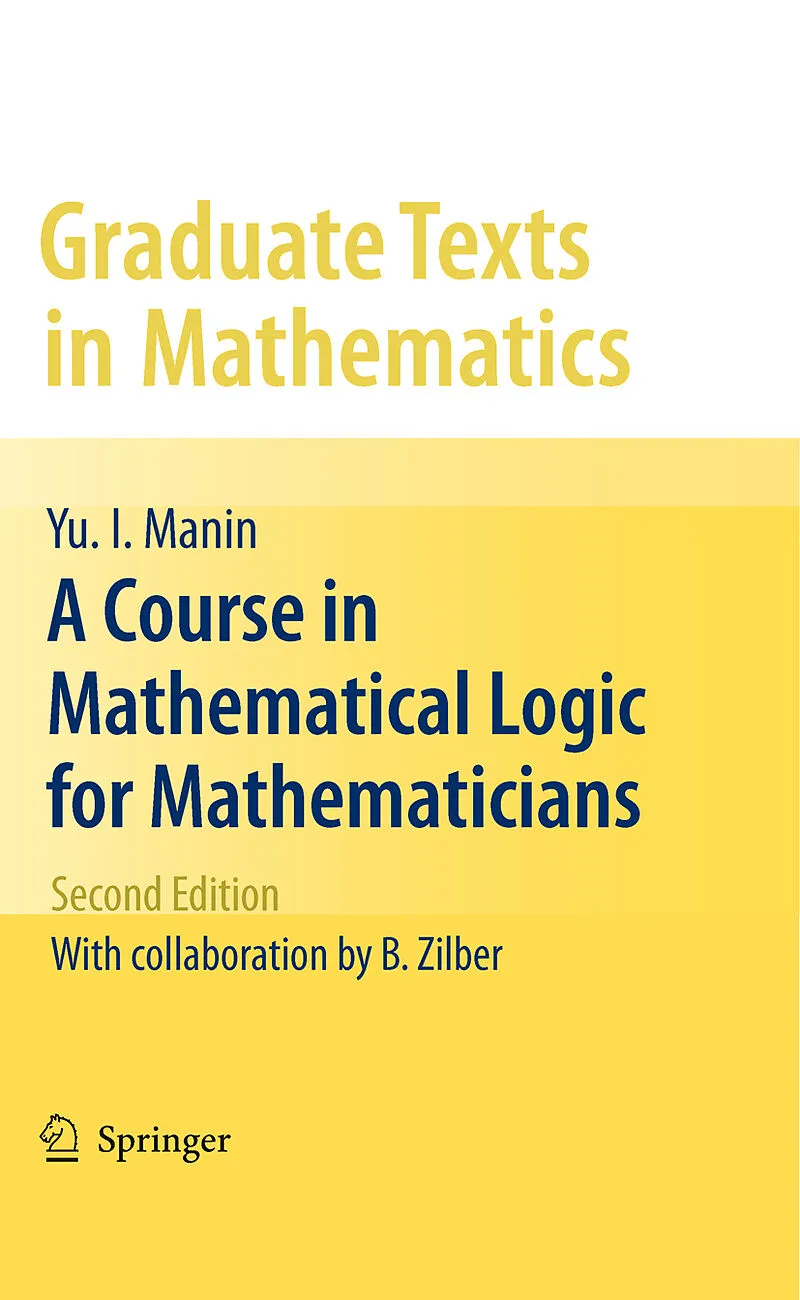
This fresh edition of the straightforward introduction to modern mathematical logic retains its appeal to the intuition of working mathematicians, yet along with the material from the first edition, it has fresh chapters, one of which deals with Model Theory. ...This fresh edition of the straightforward introduction to modern mathematical logic retains its appeal to the intuition of working mathematicians, yet along with the material from the first edition, it has fresh chapters, one of which deals with Model Theory.
The ?rst edition of this book was published in 1977. The text has been well received and is still used, although it has been out of print for some time. In the intervening three decades, a lot of interesting things have happened to mathematical logic: (i) Model theory has shown that insights acquired in the study of formal languages could be used fruitfully in solving old problems of conventional mathematics. (ii) Mathematics has been and is moving with growing acceleration from the set-theoretic language of structures to the language and intuition of (higher) categories, leaving behind old concerns about in?nities: a new view of foundations is now emerging. (iii) Computer science, a no-nonsense child of the abstract computability theory, has been creatively dealing with old challenges and providing new ones, such as the P/NP problem. Planning additional chapters for this second edition, I have decided to focus onmodeltheory,the conspicuousabsenceofwhichinthe ?rsteditionwasnoted in several reviews, and the theory of computation, including its categorical and quantum aspects. The whole Part IV: Model Theory, is new. I am very grateful to Boris I. Zilber, who kindly agreed to write it. It may be read directly after Chapter II. The contents of the ?rst edition are basically reproduced here as Chapters IVIII. Section IV.7, on the cardinality of the continuum, is completed by Section IV.7.3, discussing H. Woodin's discovery.
Contains a new chapter on categorical approach to theory of computations, quantum computations, and P/NP problem New chapter containing basic results of Model Theory and its applications to mainstream mathematics Presents several highlights of mathematical logic of the 20th century including Gödel's and Tarski's Theorems, Cohen's Theorem on the independence of Continuum Hypothesis Complete proof of Davis-Putnam-Robinson-Matiyasevich theorem Discusses Kolmogorov complexity Includes supplementary material: sn.pub/extras
Klappentext
A Course in Mathematical Logic for Mathematicians, Second Edition offers a straightforward introduction to modern mathematical logic that will appeal to the intuition of working mathematicians. The book begins with an elementary introduction to formal languages and proceeds to a discussion of proof theory. It then presents several highlights of 20th century mathematical logic, including theorems of Gödel and Tarski, and Cohen's theorem on the independence of the continuum hypothesis. A unique feature of the text is a discussion of quantum logic.
The exposition then moves to a discussion of computability theory that is based on the notion of recursive functions and stresses number-theoretic connections. The text present a complete proof of the theorem of DavisPutnamRobinsonMatiyasevich as well as a proof of Higman's theorem on recursive groups. Kolmogorov complexity is also treated.
Part III establishes the essential equivalence of proof theory and computation theory and gives applications such as Gödel's theorem on the length of proofs. A new Chapter IX, written by Yuri Manin, treats, among other things, a categorical approach to the theory of computation, quantum computation, and the P/NP problem. A new Chapter X, written by Boris Zilber, contains basic results of model theory and its applications to mainstream mathematics. This theory has found deep applications in algebraic and diophantine geometry.
Yuri Ivanovich Manin is Professor Emeritus at Max-Planck-Institute for Mathematics in Bonn, Germany, Board of Trustees Professor at the Northwestern University, Evanston, IL, USA, and Principal Researcher at the Steklov Institute of Mathematics, Moscow, Russia. Boris Zilber, Professor of Mathematical Logic at the University of Oxford, has contributed the Model Theory Chapter for the second edition.
Inhalt
PROVABILITY.- to Formal Languages.- Truth and Deducibility.- The Continuum Problem and Forcing.- The Continuum Problem and Constructible Sets.- COMPUTABILITY.- Recursive Functions and Church#x2019;s Thesis.- Diophantine Sets and Algorithmic Undecidability.- PROVABILITY AND COMPUTABILITY.- G#x00F6;del#x2019;s Incompleteness Theorem.- Recursive Groups.- Constructive Universe and Computation.- MODEL THEORY.- Model Theory.
10%