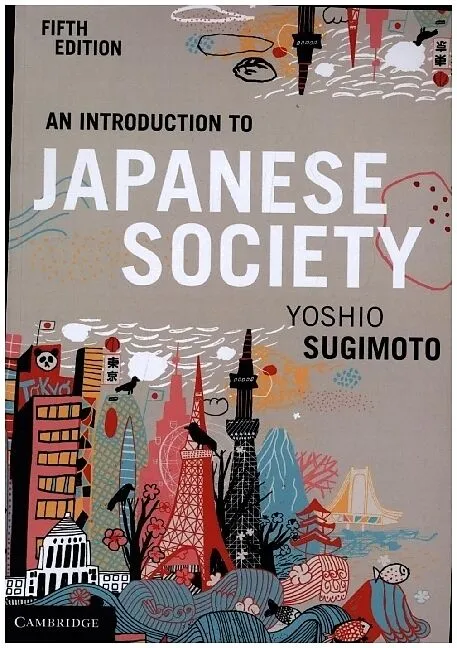
An Introduction to Japanese Society
Beschreibung
Taking a sociological approach, this text provides a sophisticated, highly readable introduction to Japanese society. An Introduction to Japanese Society provides a highly readable introduction to Japanese society by internationally renowned scholar Yoshio Sug...Format auswählen
- Kartonierter EinbandCHF 47.60

Wird oft zusammen gekauft
Andere Kunden kauften auch
Beschreibung
Taking a sociological approach, this text provides a sophisticated, highly readable introduction to Japanese society.
An Introduction to Japanese Society provides a highly readable introduction to Japanese society by internationally renowned scholar Yoshio Sugimoto. Taking a sociological approach, the text examines the multifaceted nature of contemporary Japanese society with chapters covering class, geographical and generational variation, work, education, gender, ethnicity, religion, popular culture, and the establishment. This edition begins with a new historical introduction placing the sociological analysis of contemporary Japan in context, and includes a new chapter on religion and belief systems. Comprehensively revised to include current research and statistics, the text covers changes to the labor market, evolving conceptions of family and gender, demographic shifts in an aging society, and the emergence of new social movements. Each chapter now contains illustrative case examples, research questions, recommended further readings and useful online resources. Written in a lively and engaging style, An Introduction to Japanese Society remains essential reading for all students of Japanese society.
Autorentext
Yoshio Sugimoto is Professor Emeritus in the Department of Social Inquiry at La Trobe University in Melbourne, Australia.
Klappentext
An Introduction to Japanese Society is a provocative, insightful and accessible book that comprehensively examines contemporary Japanese society. It not only provides a thorough and critical analysis of the dominant view that groupism and homogeneity characterise Japanese society, but highlights Japan's internal variation and social stratification. The book covers a wide range of aspects of Japanese society, with chapters on class, geographical variation, generation, work, education, gender, minorities, popular culture, and the establishment. Yoshio Sugimoto contests the notion that Japanese society comprises an extremely uniform culture, drawing attention to its subcultural diversity and class competition. In offering a comparison with other countries, the book also explores the idea that subcultural groups may have similar characteristics in different societies. Sugimoto also examines what he calls "friendly authoritarianism" - the force behind the Japanese tendency to remain ostensibly faithful to their particular groups and organizations.
Zusammenfassung
An Introduction to Japanese Society provides a sophisticated, highly readable introduction to Japanese society by internationally renowned scholar Yoshio Sugimoto. This edition begins with a new historical introduction placing the sociological analysis of contemporary Japan in context, and includes a new chapter on religion and belief systems.
Inhalt
- Historical backdrop: disintegration and restoration; 2. The Japan phenomenon: analysis and understanding; 3. Class: stratification and disparity; 4. Generations and geography: variations in an aging society; 5. Work: 'Japanese-style' management and cultural capitalism; 6. Education: diversity and unity; 7. Gender and family: challenges to ideology; 8. Ethnicity and Japaneseness: defining the nation; 9. The establishment: competition and collusion; 10. Religion: belief and secularization; 11. Culture: the popular and the cool; 12. Civil society: activism and friendly authoritarianism.