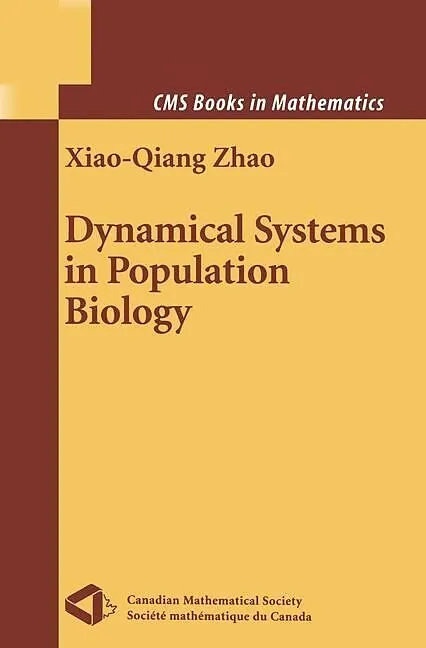
Dynamical Systems in Population Biology
Beschreibung
Population dynamics is an important subject in mathematical biology. A cen tral problem is to study the long-term behavior of modeling systems. Most of these systems are governed by various evolutionary equations such as difference, ordinary, functional, and p...Format auswählen
- Kartonierter Einband (Kt)CHF 136.55
- Fester EinbandCHF 127.80
- Fester EinbandCHF 144.00
- E-Book (pdf)CHF 142.00
- Kartonierter EinbandCHF 144.00

Wird oft zusammen gekauft
Andere Kunden kauften auch
Beschreibung
Population dynamics is an important subject in mathematical biology. A cen tral problem is to study the long-term behavior of modeling systems. Most of these systems are governed by various evolutionary equations such as difference, ordinary, functional, and partial differential equations (see, e. g. , [165, 142, 218, 119, 55]). As we know, interactive populations often live in a fluctuating environment. For example, physical environmental conditions such as temperature and humidity and the availability of food, water, and other resources usually vary in time with seasonal or daily variations. Therefore, more realistic models should be nonautonomous systems. In particular, if the data in a model are periodic functions of time with commensurate period, a periodic system arises; if these periodic functions have different (minimal) periods, we get an almost periodic system. The existing reference books, from the dynamical systems point of view, mainly focus on autonomous biological systems. The book of Hess [106J is an excellent reference for periodic parabolic boundary value problems with applications to population dynamics. Since the publication of this book there have been extensive investigations on periodic, asymptotically periodic, almost periodic, and even general nonautonomous biological systems, which in turn have motivated further development of the theory of dynamical systems. In order to explain the dynamical systems approach to periodic population problems, let us consider, as an illustration, two species periodic competitive systems dUI dt = !I(t,Ul,U2), (0.
Autorentext
Dr. Xiao-Qiang Zhao is a professor in applied mathematics at Memorial University of Newfoundland, Canada. His main research interests involve applied dynamical systems, nonlinear differential equations, and mathematical biology. He is the author of more than 40 papers and his research has played an important role in the development of the theory of periodic and almost periodic semiflows and their applications.
Klappentext
PThe conjoining of nonlinear dynamics and biology has brought about significant advances in both areas, with nonlinear dynamics providing a tool for understanding biological phenomena and biology stimulating developments in the theory of dynamical systems. This research monograph provides an introduction to the theory of nonautonomous semiflows with applications to population dynamics. It develops dynamical system approaches to various evolutionary equations such as difference, ordinary, functional, and partial differential equations, and pays more attention to periodic and almost periodic phenomena. The presentation includes persistence theory, monotone dynamics, periodic and almost periodic semiflows, traveling waves, and global analysis of typical models in population biology. Research mathematicians working with nonlinear dynamics, particularly those interested in applications to biology, will find this book useful. It may also be used as a textbook or as supplementary reading for a graduate special topics course on the theory and applications of dynamical systems. /PPDr. Xiao-Qiang Zhao is a professor in applied mathematics at Memorial University of Newfoundland, Canada. His main research interests involve applied dynamical systems, nonlinear differential equations, and mathematical biology. He is the author of more than 40 papers and his research has played an important role in the development of the theory of periodic and almost periodic semiflows and their applications./P
Zusammenfassung
From the reviews:
"This is a highly technical research monograph which will be mainly of interest to those working in the field of mathematical population dynamics. ... The book provides a comprehensive coverage of the latest theoretical developments, particularly in the purely mathematical sophistications of the field ... ." (Tony Crilly, The Mathematical Gazette, March, 2005)
"This book provides an introduction to the theory of periodic semiflows on metric spaces and their applications to population dynamics. ... This book will be most useful to mathematicians working on nonlinear dynamical models and their applications to biology." (R.Bürger, Monatshefte für Mathematik, Vol. 143 (4), 2004)
"The main purpose of the book, in the author's words, 'is to provide an introduction to the theory of periodic semiflows on metric spaces' and to apply this theory to a collection of mathematical equations from population dynamics. ... The book presents its mathematical theory in a coherent and readable fashion. It should prove to be a valuable resource for mathematicians who are interested in non-autonomous dynamical systems and in their applications to biologically inspired models." (J. M. Cushing, Mathematical Reviews, 2004 f)
Inhalt
- Introduction * Discrete Dynamical Systems * Monotone Dynamics * Nonautonomous Semiflows * A Discrete-time Chemostat Model * N-species Competition in a Periodic Chemostat * Almost Periodic Competitive Systems * Competitor-Competitor-Mutualist Systems * A Periodically Pulsed Bioreactor Model * A Nonlocal and Delayed Predator-Prey Model * Traveling Waves in Bistable Nonlinearities * Bibliography * Index