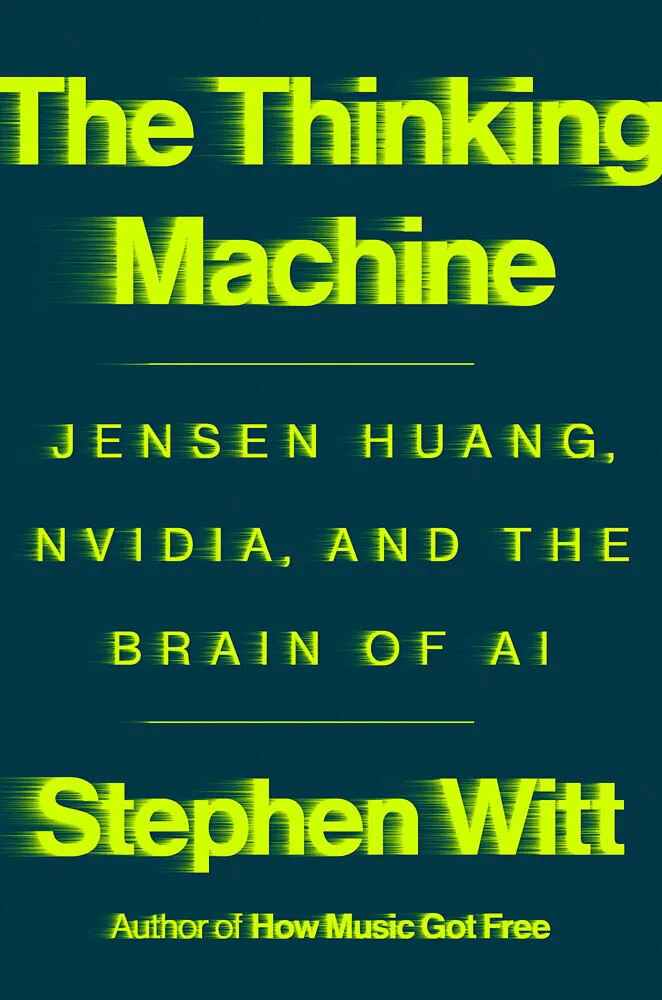
The Thinking Machine
Beschreibung
The riveting investigative account of Nvidia, the tech company that has exploded in value for its artificial intelligence computing hardware, and Jensen Huang, Nvidia’s charismatic, uncompromising CEO In March 2024, following the revelation that ChatGPT ...Format auswählen
- Fester EinbandCHF 31.60

Wird oft zusammen gekauft
Andere Kunden kauften auch
Beschreibung
The riveting investigative account of Nvidia, the tech company that has exploded in value for its artificial intelligence computing hardware, and Jensen Huang, Nvidia’s charismatic, uncompromising CEO In March 2024, following the revelation that ChatGPT had trained on Nvidia’s microchips, and twenty-one years after its founding in a Denny’s restaurant, Nvidia became the third most-valuable corporation on Earth. In Essential to Nvidia’s meteoric success is its visionary CEO Jensen Huang, who more than a decade ago, on the basis of a few promising scientific results, bet his entire company on AI. Through unprecedented access to Huang, his friends, his investors, and his employees, Witt documents for the first time the company’s epic rise and its iconoclastic CEO, who emerges as a compelling, single-minded, and ferocious leader, and now one of Silicon Valley’s most influential figures. <The Thinking Machine< is the story of how Nvidia evolved from selling cheap, aftermarket circuit boards to hundred-million-dollar room-sized supercomputers. It is the story of a determined entrepreneur who defied Wall Street to push his radical vision for computing, in the process becoming one of the wealthiest men alive. It is about a revolution in computer architecture, and the small group of renegade engineers who made it happen. And it’s the story of our awesome and terrifying AI future, which Huang has billed as the “next industrial revolution,” as a new kind of microchip unlocks hyper-realistic avatars, autonomous robots, self-driving cars, and new movies, art, and books, generated on command.
Autorentext
Stephen Witt
Klappentext
**Winner of the FT and Schroders Business Book of the Year Award
Named a Best Book of 2025 by The Economist
“Framed as a biography of Jensen Huang, the only CEO Nvidia has ever had, the book is also something more interesting and revealing: a window onto the intellectual, cultural, and economic ecosystem that has led to the emergence of superpowerful AI.” —James Surowiecki, The Atlantic
“A lively biography. . . . The story of how Nvidia became the hottest investment on Wall Street and a household name is fascinating.” —Katie Notopoulos, The New York Times Book Review
Nvidia is as valuable as Apple and Microsoft. It has shaped the world as we know it. But its story is little known. This is the definitive story of the greatest technology company of our times.**
In June of 2024, thirty-one years after its founding in a Denny’s restaurant, Nvidia became the most valuable corporation on Earth. The Thinking Machine is the astonishing story of how a designer of video game equipment conquered the market for AI hardware, and in the process re-invented the computer.
Essential to Nvidia’s meteoric success is its visionary CEO Jensen Huang, who more than a decade ago, on the basis of a few promising scientific results, bet his entire company on AI. Through unprecedented access to Huang, his friends, his investors, and his employees, Witt documents for the first time the company’s epic rise and its single-minded and ferocious leader, now one of Silicon Valley’s most influential figures.
The Thinking Machine is the story of how Nvidia evolved to supplying hundred-million-dollar supercomputers. It is the story of a determined entrepreneur who defied Wall Street to push his radical vision for computing, becoming one of the wealthiest men alive. It is the story of a revolution in computer architecture, and the small group of renegade engineers who made it happen. And it’s the story of our awesome and terrifying AI future, which Huang has billed as the ‘next industrial revolution,’ as a new kind of microchip unlocks hyper-realistic avatars, autonomous robots, self-driving cars, and new movies, art, and books, generated on command.
This is the story of the company that is inventing the future.
Leseprobe
Introduction
This is the story of how a niche vendor of video game hardware became the most valuable company in the world. It is the story of a stubborn entrepreneur who pushed his radical vision for computing for thirty years, in the process becoming one of the wealthiest men alive. It is the story of a revolution in silicon and the small group of renegade engineers who defied Wall Street to make it happen. And it is the story of the birth of an awesome and terrifying new category of artificial intelligence, whose long-term implications for the human species cannot be known.
At the center of this story is a propulsive, mercurial, brilliant, and extraordinarily dedicated man. His name is Jensen Huang, and his thirty-two-year tenure is the longest of any technology CEO in the S& P 500. Huang is a visionary inventor whose familiarity with the inner workings of electronic circuitry approaches a kind of intimacy. He reasons from first principles about what microchips can do today, then gambles with great conviction on what they will do tomorrow. He does not always win, but when he does, he wins big: his early, all‑in bet on AI was one of the best investments in Silicon Valley history. Huang’s company, Nvidia, is today worth more than $3 trillion, rivaling both Apple and Microsoft in value.
In person, Huang is charming, funny, self-deprecating, and frequently self-contradictory. He keeps up a semicomic deadpan patter at all times. We met in 2023 for breakfast at a Denny’s diner, his favorite restaurant chain. Huang had developed the business plan for Nvidia at this same restaurant thirty years earlier; chatting with our waitress, he ordered seven items, including a Super Bird sandwich and a chicken-fried steak. “You know, I used to be a dishwasher here,” he told her. “But I worked hard! Like, really hard. So I got to be a busboy.”
Huang, born in Taiwan, immigrated to the United States when he was ten. Denny’s was the crucible of his assimilation—working there as a teenager, he ate through the entire menu. Still, he told me, he maintains an outsider’s perspective. “You’re always an immigrant,” he said. “I’m always Chinese.” He cofounded Nvidia (pronounced IN‑vidia, not NUH-vidia) in 1993 when he was thirty, first targeting the nascent market for high-end video game graphics. His products were popular; his customers liked to build their own PCs, sometimes buying transparent housing to showcase their Nvidia hardware.
In the late 1990s, seeking to better render the Quake series of games, Nvidia made a subtle change to the circuit architecture of its processors, allowing them to solve more than one problem at a time. This approach, known as “parallel computing,” was a radical gamble. “The success rate of parallel computing was zero percent before we came along,” Huang said, rattling off a list of forgotten start-ups. “Literally zero. Everyone who tried to make it into a business had failed.” Huang ignored this dismal record, pursuing his unconventional vision in open defiance of Wall Street for more than a decade. He looked for customers besides gamers, ones who needed a lot of computing power—weather forecasters, radiologists, deep-water oil prospectors, that sort of thing. During this time, Nvidia’s stock price floundered, and he had to fend off corporate raiders to retain his job.
Huang stuck with this bet, losing money on it for years, until in 2012 a group of dissident academics in Toronto purchased two consumer video game cards to train an exotic kind of artificial intelligence called a neural network. At the time, neural networks, which mimic the structure of biological brains, were deeply out of favo…