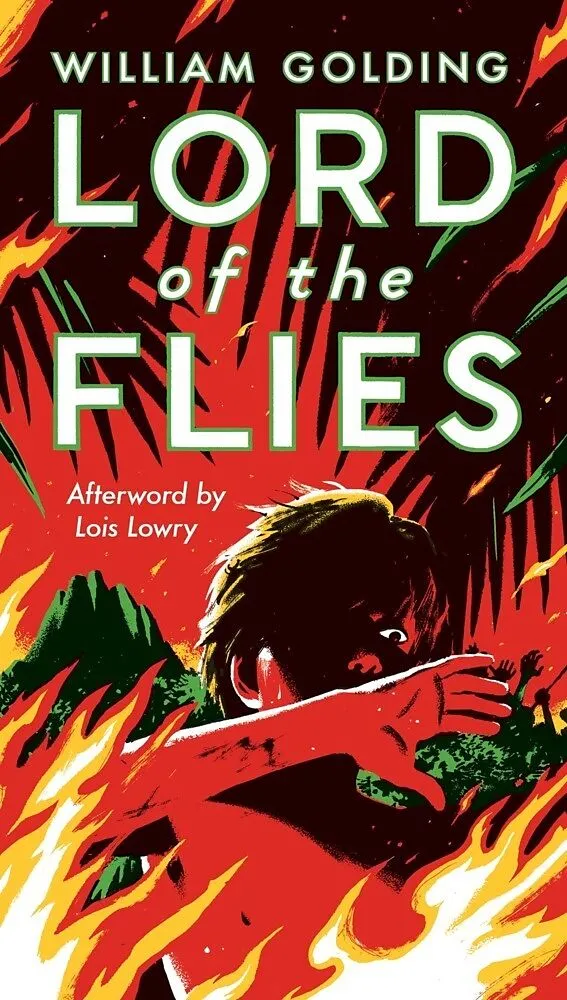
Lord of the Flies
Beschreibung
" Lord of the Flies is one of my favorite books. I still read it every couple of years." Suzanne Collins, author of The Hunger Games trilogy "I finished the last half of Lord of the Flies in a single afternoon, my eyes wide, my heart pounding, not thinking, ju...Format auswählen
- Kartonierter EinbandCHF 13.00

Wird oft zusammen gekauft
Andere Kunden kauften auch
Beschreibung
" Lord of the Flies is one of my favorite books. I still read it every couple of years." Suzanne Collins, author of The Hunger Games trilogy "I finished the last half of Lord of the Flies in a single afternoon, my eyes wide, my heart pounding, not thinking, just inhaling....My rule of thumb as a writer and readerlargely formed by Lord of the Flies is feel it first, think about it later ." Stephen King "This brilliant work is a frightening parody on man's return [in a few weeks] to that state of darkness from which it took him thousands of years to emerge. Fully to succeed, a fantasy must approach very close to reality. Lord of the Flies does. It must also be superbly written. It is." The New York Times Book Review Informationen zum Autor William Golding was born in Cornwall, England, in 1911 and educated at Oxford University. His first book, Poems , was published in 1935. Following a stint in the Royal Navy during World War II, Golding wrote Lord of the Flies while teaching school. It was the first of several works, including the novels Pincher Martin , Free Fall , and The Inheritors and a play, The Brass Butterfly , which led to his being awarded the Nobel Prize for Literature in 1983. Lois Lowry is the two-time Newbery Awardwinning author of Number the Stars , The Giver Quartet , and numerous other books for young adults. Jennifer Buehler is an associate professor of educational studies at Saint Louis University and President of The Assembly on Literature for Adolescents of the National Council of Teachers of English. Klappentext William Golding's profound tale of stranded youth, survival, and the shadowy depths of human nature, with an afterword by Lois Lowry Lord of the Flies is one of my favorite books. I still read it every couple of years.Suzanne Collins, author of The Hunger Games trilogy At the dawn of the next World War, a plane crash strands a group of schoolboys on a remote island. There are no grownups. No rules. Freedom is celebrated. But when strange, distant noises and visions of a beast begin to haunt the boys, their fragile order unravels, and all hopes of rescue fade. Since 1954, William Golding's Lord of the Flies has shaped our understanding of human naturethe latent darkness within, and the destructive or creative capacity of collective will. This edition also includes Suggestions for Further Exploration by Jennifer Buehler to contextualize Golding's classic as one of the most timeless and socially relevant texts in the last century of literature. THE SOUND OF THE SHELL THE BOY WITH FAIR HAIR LOWERED HIMSELF down the last few feet of rock and began to pick his way toward the lagoon. Though he had taken off his school sweater and trailed it now from one hand, his grey shirt stuck to him and his hair was plastered to his forehead. All round him the long scar smashed into the jungle was a bath of heat. He was clambering heavily among the creepers and broken trunks when a bird, a vision of red and yellow, flashed upwards with a witchlike cry; and this cry was echoed by another. "Hi!" it said. "Wait a minute!" The undergrowth at the side of the scar was shaken and a multitude of raindrops fell pattering. "Wait a minute," the voice said. "I got caught up." The fair boy stopped and jerked his stockings with an automatic gesture that made the jungle seem for a moment like the Home Counties. The voice spoke again. "I can't hardly move with all these creeper things." The owner of the voice came backing out of the undergrowth so that twigs scratched on a greasy wind-breaker. The naked crooks of his knees were plump, caught and scratched by thorns. ...
"Lord of the Flies is one of my favorite books. I still read it every couple of years."
**—Suzanne Collins, author of The Hunger Games trilogy**
"I finished the last half of Lord of the Flies in a single afternoon, my eyes wide, my heart pounding, not thinking, just inhaling....My rule of thumb as a writer and reader—largely formed by Lord of the Flies—is feel it first, think about it later."
**—Stephen King**
"This brilliant work is a frightening parody on man's return [in a few weeks] to that state of darkness from which it took him thousands of years to emerge. Fully to succeed, a fantasy must approach very close to reality. Lord of the Flies does. It must also be superbly written. It is."
****—The New York Times Book Review
Autorentext
William Golding was born in Cornwall, England, in 1911 and educated at Oxford University. His first book, Poems, was published in 1935. Following a stint in the Royal Navy during World War II, Golding wrote Lord of the Flies while teaching school. It was the first of several works, including the novels Pincher Martin, Free Fall, and The Inheritors and a play, The Brass Butterfly, which led to his being awarded the Nobel Prize for Literature in 1983.
Lois Lowry is the two-time Newbery Award–winning author of Number the Stars,The Giver Quartet, and numerous other books for young adults.
Jennifer Buehler is an associate professor of educational studies at Saint Louis University and President of The Assembly on Literature for Adolescents of the National Council of Teachers of English.
Klappentext
**William Golding’s profound tale of stranded youth, survival, and the shadowy depths of human nature, with an afterword by Lois Lowry
“Lord of the Flies is one of my favorite books. I still read it every couple of years.”—Suzanne Collins, author of The Hunger Games trilogy
** At the dawn of the next World War, a plane crash strands a group of schoolboys on a remote island. There are no grownups. No rules. Freedom is celebrated. But when strange, distant noises and visions of a beast begin to haunt the boys, their fragile order unravels, and all hopes of rescue fade.
Since 1954, William Golding’s Lord of the Flies has shaped our understanding of human nature—the latent darkness within, and the destructive or creative capacity of collective will. This edition also includes Suggestions for Further Exploration by Jennifer Buehler to contextualize Golding’s classic as one of the most timeless and socially relevant texts in the last century of literature.
Leseprobe
THE SOUND OF
THE SHELL
THE BOY WITH FAIR HAIR LOWERED HIMSELF down the last few feet of rock and began to pick his way toward the lagoon. Though he had taken off his school sweater and trailed it now from one hand, his grey shirt stuck to him and his hair was plastered to his forehead. All round him the long scar smashed into the jungle was a bath of heat. He was clambering heavily among the creepers and broken trunks when a bird, a vision of red and yellow, flashed upwards with a witchlike cry; and this cry was echoed by another.
"Hi!" it said. "Wait a minute!"
The undergrowth at the side of the scar was shaken and a multitude of raindrops fell pattering.
"Wait a minute," the voice said. "I got caught up."
The fair boy stopped and jerked his stockings with an automatic gesture that made the jungle seem for a moment like the Home Counties.
The voice spoke again.
"I can't hardly move with all these creeper things."
The owner of the voice came backing out of the undergrowth so that twigs scratched on a greasy wind-breaker. The naked crooks of his knees were plump, caught and scratched by thorns. He bent down, removed the thorns carefully, and turned around. He was shorter than the fair boy and very fat. He came forward, searching out safe lodgments for his feet, and then looked up through thick spectacles.
"Where's the man with the megaphone?"
The fair boy shook his h…