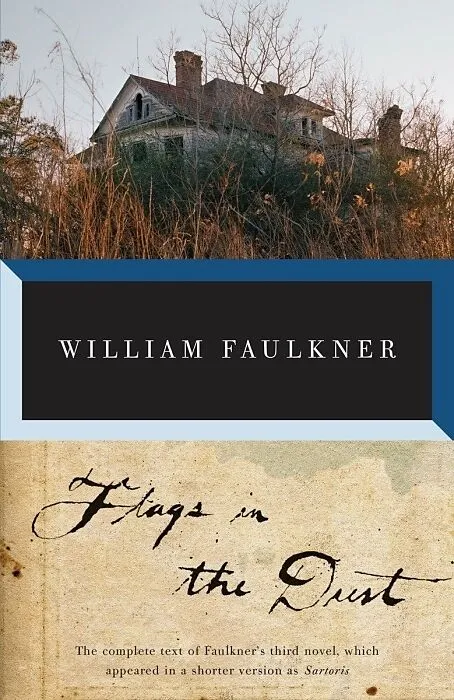
Flags in the Dust
Beschreibung
Informationen zum Autor While Faulkner's first novels garnered him very little attention, he went on to write works such as Absalom, Absalom!, Light in August, and The Sound and the Fury. He later went on to win the Nobel Prize for Literature in 1949 and the P...Format auswählen
- Kartonierter EinbandCHF 19.20
Wird oft zusammen gekauft
Andere Kunden kauften auch
Beschreibung
Informationen zum Autor While Faulkner's first novels garnered him very little attention, he went on to write works such as Absalom, Absalom!, Light in August, and The Sound and the Fury. He later went on to win the Nobel Prize for Literature in 1949 and the Pulitzer Prize for Fiction in 1955 and 1963, among many other accolades. While Faulkner's rise to fame isn't well-known by most, his influence and lasting impression on Southern Literature will not soon be forgotten. Faulkner wasn't afraid to examine the racial disparity of the South or question the lives of Southern aristocrats. Through his use of the Gothic style, his analytical and aberrant texts, and his examination of the Southern tragedy through elaborate and grotesque prose, Faulkner opens the door for his readers to inhabit a crumbling Southern landscape through a literary lens. Klappentext The complete text of Faulkner's third novel, published for the first time in 1973, appeared with his reluctant consent in a much cut version in 1929 as Sartoris. Zusammenfassung The complete text of Faulkner's third novel! published for the first time in 1973! appeared with his reluctant consent in a much cut version in 1929 as Sartoris .
Klappentext
The complete text of Faulkner's third novel, published for the first time in 1973, appeared with his reluctant consent in a much cut version in 1929 as Sartoris.
Zusammenfassung
The complete text of Faulkner’s third novel, published for the first time in 1973, appeared with his reluctant consent in a much cut version in 1929 as Sartoris.
Leseprobe
One
1
As usual old man Falls had brought John Sartoris into the room with him, had walked the three miles in from the county Poor Farm, fetching, like an odor, like the clean dusty smell of his faded overalls, the spirit of the dead man into that room where the dead man's son sat and where the two of them, pauper and banker, would sit for a half an hour in the company of him who had passed beyond death and then returned.
Freed as he was of time and flesh, he was a far more palpable presence than either of the two old men who sat shouting periodically into one another's deafness while the business of the bank went forward in the next room and people in the adjoining stores on either side listened to the indistinguishable uproar of their voices coming through the walls. He was far more palpable than the two old men cemented by a common deafness to a dead period and so drawn thin by the slow attenuation of days; even now, although old man Falls had departed to tramp the three miles back to that which he now called home, John Sartoris seemed to loom still in the room, above and about his son, with his bearded, hawklike face, so that as old Bayard sat with his crossed feet propped against the corner of the cold hearth, holding the pipe in his hand, it seemed to him that he could hear his father's breathing even, as though that other were so much more palpable than mere transiently articulated clay as to even penetrate into the uttermost citadel of silence in which his son lived.
The bowl of the pipe was ornately carved and it was charred with much usage, and on the bit were the prints of his father's teeth, where he had left the very print of his ineradicable bones as though in enduring stone, like the creatures of that prehistoric day that were too grandly conceived and executed either to exist very long or to vanish utterly when dead from an earth shaped and furnished for punier things. Old Bayard sat holding the pipe in his hand.
"What are you giving it to me for, after all this time?" he had asked, fingering the pipe, and old man Falls answered.
"Well, I reckon I've kept it long as Cunnel aimed for me to," old man Falls answered. "A po' house aint no fitten place for anything of his'n, Bayard. And I'm goin' on ninety-fo' year old."
Later he gathered up his small parcels and left, but still old Bayard sat for some time, the pipe in his hand, rubbing the bowl slowly with his thumb. After a while John Sartoris departed also, withdrawn rather to that place where the peaceful dead contemplate their glamorous frustrations, and old Bayard rose and thrust the pipe into his pocket and took a cigar from the humidor on the mantel. As he struck the match the door across the room opened and a man wearing a green eyeshade entered and approached.
"Simon's here, Colonel," he said in a voice utterly without inflection.
"What?" Old Bayard said across the match.
"Simon's come."
"Oh. All right."
The other turned and went out. Old Bayard flung the match into the grate and put the cigar in his pocket and closed his desk and took his black felt hat from the top of it and followed the other from the room. The man in the eyeshade and the cashier were busy beyond the grille. Old Bayard stalked on through the lobby and passed through the door with its drawn green shade and emerged upon the street, where Simon in a linen duster and an ancient top-hat held the matched geldings glittering in the spring afternoon, at the curb.
There was a hitching-post there, which old Bayard retained with a testy disregard of industrial progress, but Simon never used it. Until the door opened and Bayard emerged from behind the drawn shades bearing the words "Bank Closed" in cracked gold leaf, Simon retained his seat, the reins in his left hand and the thong of the whip caught smartly back in his right and usually the unvarying and seemingly incombustible fragment of a cigar at a swaggering angle in his black face, talking to the shining team in a steady, lover-like flow. He spoiled horses. He admired Sartorises and he had for them a warmly protective tenderness, but he loved horses, and beneath his hands the sorriest beast bloomed and acquired comeliness like a caressed woman, temperament like an opera star.
Old Bayard closed the door behind him and crossed to the carriage with that stiff erectness which, as a countryman once remarked, if he ever stumbled, would meet itself falling down. One or two passers and a merchant or so in the adjacent doorways saluted him with a sort of florid servility, and behind him the shade on one window drew aside upon the disembodied face of the man in the green eye-shade. The book- keeper was a hillman of indeterminate age, a silent man who performed his duties with tedious slow care and who watched Bayard constantly and covertly all the while he was in view.
Nor did Simon dismount even then. With his race's fine feeling for potential theatrics he drew himself up and arranged the limp folds of the duster, communicating by some means the histrionic moment to the horses so that they too flicked their glittering coats and tossed their leashed heads, and into Simon's wizened black face there came an expression indescribably majestical as he touched his whiphand to his hatbrim. Bayard got into the carriage and Simon clucked to the horses, and the onlookers, halted to admire the momentary drama of the departure, fell behind.
There was something different in Simon's air today, in the very shape of his back and the angle of his hat: he appeared to be bursting with something momentous and ill-contained. But he withheld it for the time being, and at a dashing, restrained pace he drove among the tethered wagons about the square and swung into a broad street where what Bayard called paupers sped back and forth in automobiles, and withheld it until the town was behind them and they trotted on across burgeoning countryside cluttered still with gasoline-propelled paupers but at greater intervals, and his employer had settled back for the changing and peaceful monotony of the four-mile drive. Then Simon checked the team to a more sedate pace and turned his head.
His voice was not particularly robust nor resonant, yet somehow he could talk to old Bayard without difficulty. Others must shout in order to penetrate tha…