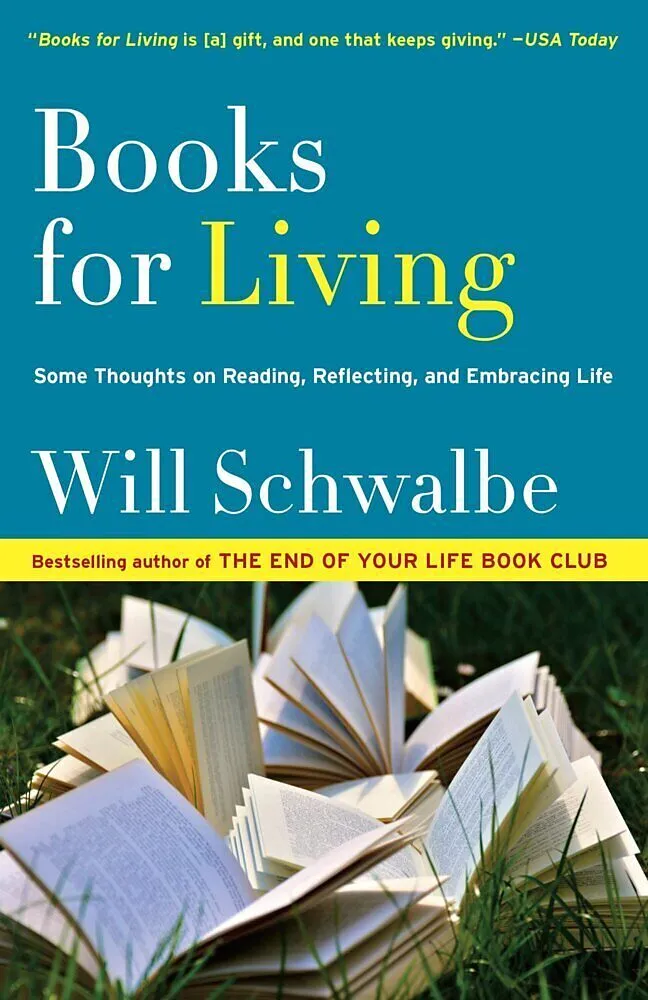
Books for Living
Beschreibung
From the author of the beloved New York Times best-selling The End of Your Life Book Club, an inspiring and magical exploration of the power of books to shape our lives in an era of constant connectivity. For Will Schwalbe, reading is a way to entertain himsel...Format auswählen
- Kartonierter EinbandCHF 19.20
Wird oft zusammen gekauft
Andere Kunden kauften auch
Beschreibung
From the author of the beloved New York Times best-selling The End of Your Life Book Club, an inspiring and magical exploration of the power of books to shape our lives in an era of constant connectivity. For Will Schwalbe, reading is a way to entertain himself but also to make sense of the world, and to find the answers to life’s questions big and small. In each chapter, he discusses a particular book and how it relates to concerns we all share. These books span centuries and genres--from Stuart Little to The Girl on the Train , from David Copperfield to Wonder , from Giovanni's Room to Rebecca , and from 1984 to Gifts from the Sea . Throughout, Schwalbe tells stories from his life and focuses on the way certain books can help us honor those we've loved and lost, and also figure out how to live each day more fully.
ldquo;Books for Living is [a] gift, and one that keeps giving.”
—USA Today
 “A sweet and utterly restorative series of vignettes about how books—the right books, at the right times—can not only deepen a life but save it.” 
****—The Christian Science Monitor
"Any season of the year, this book is a gift"
*—*Mary Oliver 
- * 
“Inspiring and charming. . . . Books, to Schwalbe, are our last great hope to keep us from spiraling into the abyss.”
***—The New York Times * *“Moving. . . . Schwalbe truly shines. . . . It should convince even reluctant readers to pick up a book.”
***—Boston Globe*“First-rate. . . . Schwalbe’s enthusiasm for what he covers is contagious.”
**—San Francisco Chronicle*
 - “A love letter to reading, bibliophiles will close the last page with a few more entries on their to-read list.”
**—Real Simple * - “Witty, warm, [and] insightful. . . . A field guide to a handful of titles that might entertain, stir up trouble, or—yes—even save the life a reader already has.”
**—Shelf Awareness * - “The casual but polished way in which Schwalbe writes about some of his favorite books—and smartly peppers in his own life’s stories—makes for an engaging and easy read. Books for Living quietly reminds readers that books are works of art that carry great import in our lives, and might even leave you wondering what your own list of books for living might look like.”
**—5280*  
“Very much a work for our age. . . . Vital.” **—The Anniston Star**Autorentext
Will Schwalbe
Zusammenfassung
*From the author of the beloved New York Times best-selling The End of Your Life Book Club,* an inspiring and magical exploration of the power of books to shape our lives in an era of constant connectivity."[A] gift, and one that keeps giving.” —USA Today 
For Will Schwalbe, reading is a way to entertain himself but also to make sense of the world, and to find the answers to life’s questions big and small. In each chapter, he discusses a particular book and how it relates to concerns we all share. These books span centuries and genres—from Stuart Little to The Girl on the Train, from David Copperfield to Wonder, from Giovanni's Room to Rebecca, and from 1984 to Gifts from the Sea. Throughout, Schwalbe tells stories from his life and focuses on the way certain books can help us honor those we've loved and lost, and also figure out how to live each day more fully.
Leseprobe
Introduction From time to time I have a terrifying dream. I call it the Reader’s Nightmare. 
I’m in a busy airport, and they’ve announced my flight. There is an epic walk to the gate, and I know I have only a few minutes before they will close the door to the jetway and my plane will leave without me. Suddenly, I realize that I don’t have a book to read on the flight. Not one single book. I spin around, my eyes searching frantically for a bookstore. I see none. I run through the airport, past the duty-free counters selling liquor and perfume, past the luggage stores and fashion boutiques, past the place that offers neck massage. Still, I can’t find an airport bookstore. Now, over the loudspeakers, comes the final call for my flight. “Flight ninety-seven to Perth is ready for departure. All passengers must be on board at this time.” They even call me by name. Panic sets in as I realize that I am almost certainly going to miss my flight. But the idea of hours on a plane without a book? Intolerable. So I run and run, searching for that bookstore—or at least a newsstand with a rack of paperbacks. I can’t find a single book anywhere in the airport. I start to scream. 
Then I wake up. 
I don’t have this dream about food or television or movies or music. My unconscious is largely untroubled by the idea of spending hours in a metal tube hurtling through the sky without something to eat or a program to watch or tunes in my ears. It’s the thought of being bookless for hours that jolts me awake in a cold sweat. 
Throughout my life I’ve looked to books for all sorts of reasons: to comfort me, to amuse me, to distract me, and to educate me. But just because you know that you can find anything you need in a book doesn’t mean you can easily find your way to the right book at the right time, the one that tells you what you need to know or feel when you need to know or feel it. 
A few years ago, I wrote a book about the books I read with my mother when she was dying of pancreatic cancer. During this time we read casually, promiscuously, and whimsically, allowing one book to lead us to the next. We read books we were given and books that had sat on our shelves for decades, waiting to be noticed; books we had stumbled across, and books we had chosen to reread simply because we felt like it. Were we looking for anything in particular? Usually not. At times, the books gave us something to talk about when we wanted to talk about anything rather than her illness. But they also gave us a way to talk about subjects that were too painful to address directly. They helped guide and prompt our conversations, so that I could learn as much as I could from my mother while she was still here to teach me. 
At other times throughout my life, though, I’ve felt a very specific need and have searched for a book to answer it. It hasn’t always been easy to find the right book. Sure, when that burning need was to learn how to make a pineapple upside-down cake, I turned to The Cake Bible. Or when it was a need to find a place to eat in Chicago, the Zagat guide. Or when I wanted to self-diagnose that angry rash, to the Mayo Clinic Family Health Book. More and more, when I need this kind of information, my first line of attack isn’t a book at all—it’s the Internet, or social media, where I quiz the ubiquitous “hive mind” to find, say, good Malaysian food near Union Square. 
There are, however, questions that the Internet and the hive mind are spectacularly unable to answer to my satisfaction. These are the big ones, the ones that writers have been tackling for thousands of years: the problem of pain, meaning, purpose, happiness. Questions about how to live your life. Yes, the Internet tries to help—inasmuch as any inanimate thing can be said to try to do anything. There are digital video channels devoted to streaming inspirational speeches from conferences in which people package insight into brief uplifting lectures—many with a compelling hook and some memorable stories. But th…